


Aslan Shand
Council’s willingness to defend residents’ amenity and properties has been raised by concerned locals and residents following the outcome of the land and environment court (L&EC) case in Bian Court, Ocean Shores.
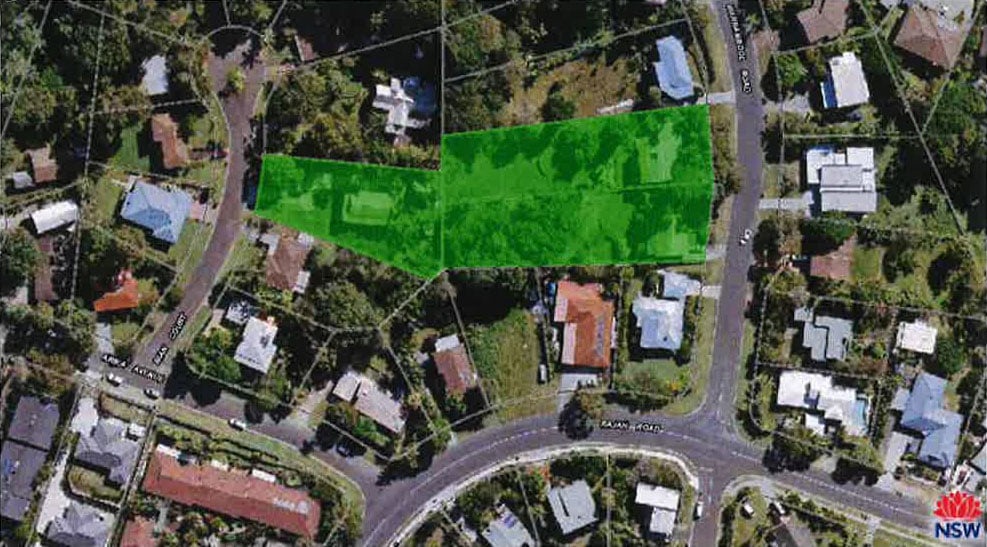
The proposal by developer Callum Sked to consolidate and develop three large lots, by adding eight townhouses between the three existing dwellings, went to the L&EC for a second time (after an earlier deemed refusal) with a decision made on 15 January 2021 to approve the development.
Issues raised as major concerns for local residents included the history of landslips, and that existing flooding of dwellings downhill of the site would be exacerbated, as well as issues around stormwater management as well as changing the low density character of the area.
‘A house was previously lost in a landslip in the same valley and there are two houses that are currently having issues in relation to landslips. The amount of mud and dirt washing down into the street when it rains is concerning,’ said local resident, Paul Wilsher.
As previously reported in The Echo when the developer had originally put in the DA he failed to examine a wide range of issues including getting a geotechnical report.
Mr Wilsher explained that while the development application (DA) was always ostensibly compliant in relation to measurements for planning regulations, the developer was furnishing new documents up till, and on the day, of the hearing.
‘I suppose it is the court process that I am more disappointed with,’ Mr Wilsher told The Echo.
‘I know the private planning consultant they (Council) hired was good but he didn’t get a chance to speak very much. I thought Council should have called an expert witness on stormwater, drainage and landslips and more experienced arborist/ecologists. At one stage the expert the council was using said “I am not actually experienced at that, I will have to defer to the expert from the other side”.
‘All the issues that were raised in the court to do with drainage, stormwater, and landslips that was discussed on the first day seemed to disappear overnight in discussions between engineers, and we still have no indication if these issues have been adequately resolved.’
While Greens mayoral candidate and former councillor, Duncan Dey, praised council for defending the case in the L&EC, he said that ‘Council staff and consultants defending the case seem to think their job is to find a way through, rather than to say “No”. To them, saying “No” will just mean another court case. Cashed up developers use this tiring process to win.’
Last minute documents
‘One of the dodgiest aspects of L&E Court processes is that the Court accepts revisions of the proposal right up to and during the hearing. This compounds the exhaustion of the defence team as they often have to drop everything and start fresh assessments. They can finish up either guessing or acquiescing.
‘L&E Court arrangements are set up by state legislation & regulation, and interpreted by commissioners with middle-class “status quo” values. Status quo in development is the philosophy, since settlement, that the landscape is empty and therefore available to be filled in.
‘I was engaged by the neighbours in my professional capacity as a hydrologist to analyse the impacts of the various proposals on stormwater and flooding, which is already a problem in this micro-valley now to be converted from grass-scape to steel and concrete. Properties downstream of the site already flood. I cannot see how the stormwater issue could have been resolved other than by exhaustion of the parties.’
Over the past five years Council has spent only $2 million on legal costs with the allegation that Council is actively seeking to avoid court cases and are willing to accept less than ideal outcomes for residents as a result. This is certainly reflected in Council meetings where a decision often hinges on the advice about whether it will open the Council up to a court challenge.
Responding to questions on the case Mayor Simon Richardson told The Echo that, ‘Staff working with proponents to seek an outcome occurs in a L&EC regardless of which avenue the DA took to get to the L&EC. It is a matter of course that the L&ECwould require parties to try and find a mediated way forward to avoid costs and court time… as it goes to court, Council prepares and if compromises can’t be reached, we continue, until a conclusion, and incur the costs that result.’
 For four decades The Echo has printed the stories some people loved, some people hated, and some pretended not to read. If you want us to keep telling the truth, the real truth, not the sugar-coated version. We’ll need your support to keep the presses rolling.