


While public meetings have concluded around the CSIRO’s flood report, the dust is is anything but settled around the proposal to establish up to 10 mega-dams upstream of Lismore to mitigate future floods.
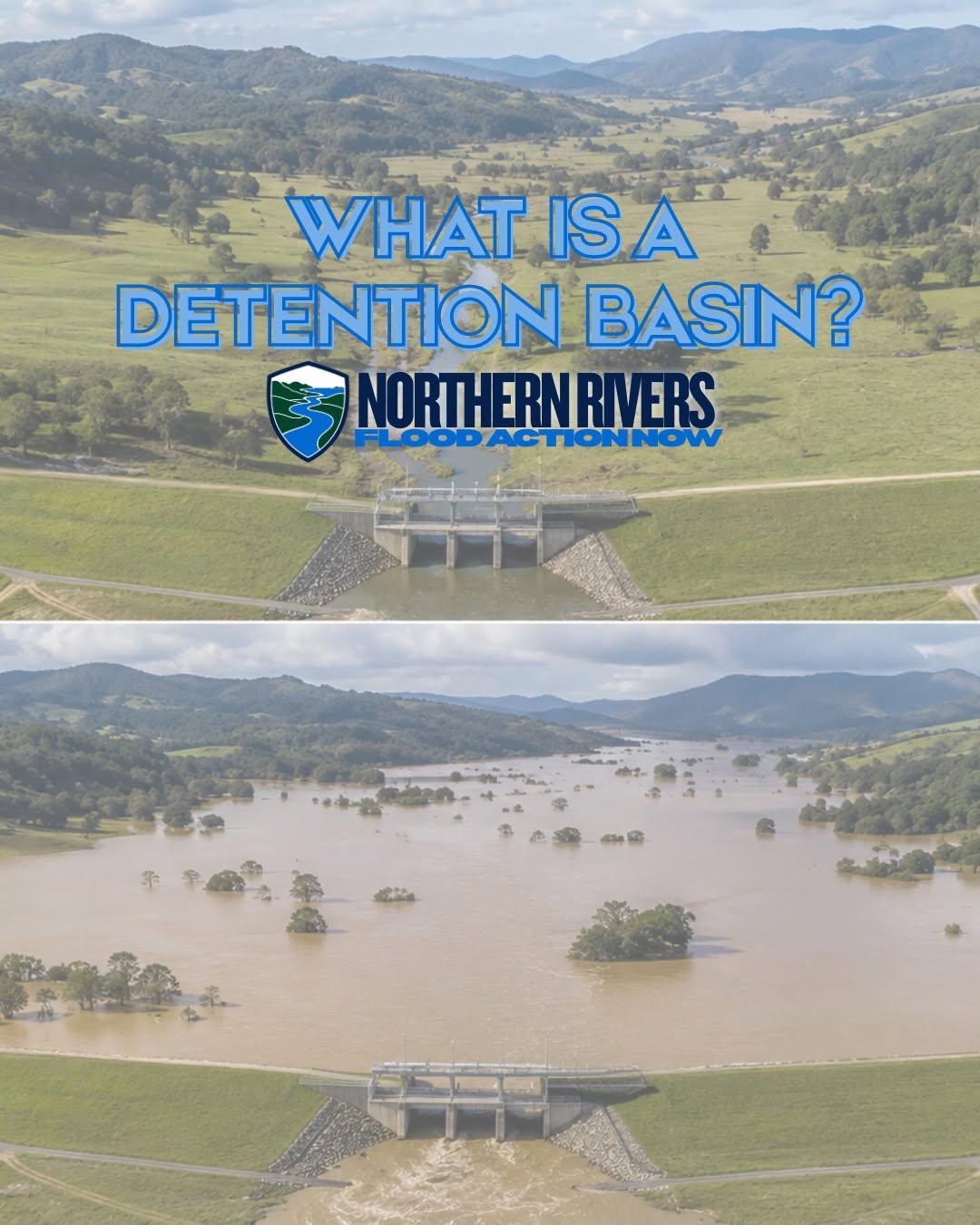
A new Facebook group, Northern Rivers Flood Action Now, has entered the conversation in favour of the temporary detention dams, and claims that the dams proposed by CSRIO are instead ‘temporary flood gates’.
They say, ‘There is a lot of fear being spread right now about what detention basins will mean for farmers and landowners in the upper catchment. Here are the facts:
‘A detention basin is not a dam. It is not a wetland. It is not a permanent water storage facility’.
‘It is a temporary flood gate. Here is how it works.
‘During a significant flood event, gates close and water is temporarily held upstream – slowing the peak that hits towns downstream. Once the flood peak passes, the gates open, the water drains completely and the land returns to exactly what it was before.
‘Between flood events, the river flows normally. The gates are open. The land is dry. Farmers graze their cattle. Life continues exactly as it always has.
In minor and moderate events the gates may not activate at all. CSIRO is still determining the precise trigger points.
‘Full capacity only occurs during an extreme event – a 2022 scale flood. The worst in Australian recorded history. And critically, every single site selected for a detention basin was already under metres of water during 2022. These are not areas that have never flooded.
‘The detailed property impacts will be assessed properly through the feasibility study. Anyone producing maps or making claims about specific property impacts before that study is complete is not giving you science. They are giving you speculation designed to frighten people into opposing flood mitigation before the facts are known.
‘The bottom line is simple: Dry land most of the time. Active farming between events. Temporary water storage only when the catchment needs it most. Gone completely when the job is done’, they say.

Claims dismissed by Kyogle mayor
Kyogle mayor Danielle Mulholland said, ‘I’m neither a Green nor a member of an activist group but that page is just propaganda. They can call the detention basins anything they want but at the end of the day, a body of water 650 metres wide is going to erode riparian zones, impact on prime agricultural land, impact the roads and bridges we have fought so hard to get funding for, destroy critical habitat – I could go on but at the end of the day, you can dress anything up as “science” but that’s right up there with putting lipstick on a pig and calling it a lady’.
So far, there is no name attributed to the group. As of Friday (today), Northern Rivers Flood Action Now had attracted 436 followers.

Science vs policy
Meanwhile, Member for Ballina, Ms Tamara Smith MP has applauded the ‘extraordinary level of community engagement at this week’s Northern Rivers Resilience Initiative drop-in sessions’, saying the turnout demonstrates just how important future flood mitigation remains to local communities.
She said, ‘Hundreds of residents across the Northern Rivers attended sessions in Kyogle, Casino, Lismore, Ballina, and Woodburn to talk about the findings of the Northern Rivers Resilience Initiative’s recent report, published in June’.
‘Four years on from the catastrophic 2022 floods, people remain deeply invested in finding solutions that actually protect our community and livelihoods,’ Ms Smith said.
Ms Smith said the sessions also highlighted the importance of distinguishing between the scientific work undertaken by CSIRO and the important policy decisions that now confront governments.
‘The CSIRO’s role was to develop a sophisticated hydraulic model of the Richmond River catchment and use it to test a range of flood mitigation scenarios.’
‘The modelling tells us what is technically possible, but it is the government’s role alongside communities to decide which options deliver the best overall outcome for our community and future generations.’
Ms Smith said the value of the work extends well beyond the specific projects examined in the report.
‘For the first time, we have a catchment-wide modelling tool that allows decision makers to test ideas and see their impact before making major investments.”
‘That capability will be priceless as we continue adapting our communities to future flood risk, whether we’re assessing these proposals or completely different ones in the years ahead.’
Ms Smith acknowledged that the sessions brought together people from all walks of life with different perspectives about how the Northern Rivers should respond to future flooding.
‘Flood policy is deeply personal in our region, it affects people’s homes, businesses and the environment. During these sessions, there were clearly strongly held and often competing views, and that’s understandable. These important conversations have a vital role to play in ensuring that future flood adaptation plans are community centred and informed by the best available scientific data.’
Ms Smith said the report and our community should help inform what is ultimately a broader public policy discussion.
‘Science can help us understand what may reduce flood impacts, but it can’t tell us what governments should prioritise.’
‘Those difficult decisions require policy makers to weigh up costs, environmental impacts, agricultural impacts, community expectations, and the number of homes that could be better protected.”
‘It’s important that these conversations continue to happen outside of these sessions, where people and governments ask themselves, what will bring the best possible outcome to a scenario that will continue to impact communities here in the Northern Rivers and across Australia.”
‘Do we invest primarily in large-scale flood mitigation infrastructure, or should more funding go towards house raising, adaptations and stronger planning controls? Is the right answer a combination of all of these or something else entirely.
‘These are difficult questions and conversations but can now be based on a combination of personal experiences and far stronger scientific data than we’ve ever had before’, she added.
 For four decades The Echo has printed the stories some people loved, some people hated, and some pretended not to read. If you want us to keep telling the truth, the real truth, not the sugar-coated version. We’ll need your support to keep the presses rolling.



