


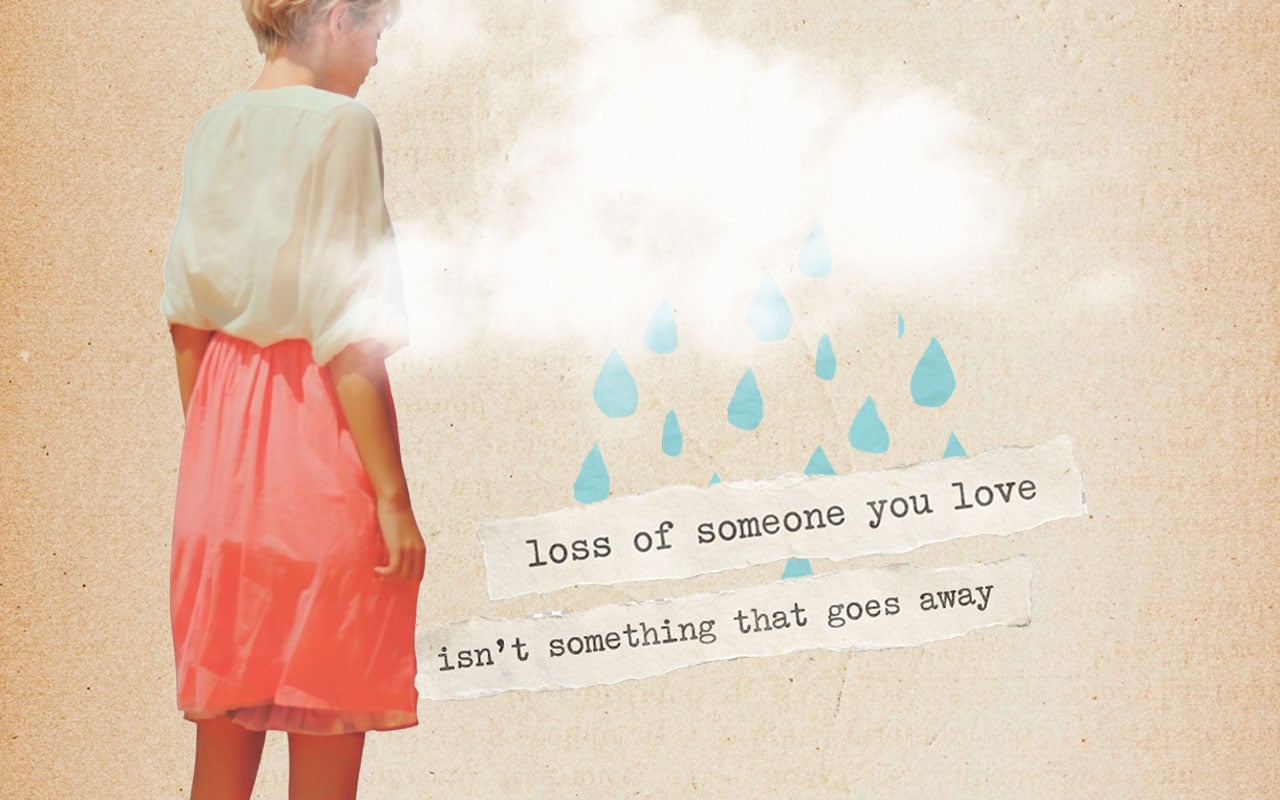
Having a dead father made me different to other kids. I was six when he died, and in a small town even I knew that for the week of his death, our family was all anyone was talking about. The 30-year-old, wild and misunderstood Robert, who drove his powder blue Valiant, drunk, head on into an oncoming vehicle, killing the grandfather of someone who I was to later meet in high school. It was a collision that changed my life forever.
I could feel the spectre of death on my skin. It didn’t feel good. I hated the pity. I heard old women in doctors’ surgeries say: ‘Oh that poor little girl.’ But they didn’t say it to me. Just about me. I remember attending a birthday party of a girl I didn’t know. I was invited because everyone felt sorry for me. I heard the mother instruct her unknowing daughter – a stranger to me, to ‘be nice to Mandy – her dad died.’ I felt so alone.
A town observant of my grief and circumstance filled me with shame. The edges of the birthday party are still so sharp in my memory. I’m wearing my bright yellow halterneck sun dress. It has hot pink and green geometric designs. My hair is cut short in a replica of Mia Farrow’s famous Vidal Sassoon pixie chop. My mother was a hairdresser and so in the absence of a willing country-town wife, who preferred the set and comb up, had used her tiny daughter as an unwitting hair model. Unaware she would soon be starring in her own horror.
Ironically it was the perfect haircut for the horror and violence of my tiny life. And like Farrow, not only did I not win an Oscar for my performance, I didn’t even get nominated. Grief to me felt like a performance with no rehearsal.
Then after a week or so when my father was dead and buried, when I sat quietly with my mum, who wept softly as she fed my baby brother, I realised that was it. In my small town, I became the girl with the dead father. No one talked to me about it. Life just went on and death got put in a bottom drawer and closed.
We don’t know how to do death well. Which when you think about it is nuts. Death isn’t a surprise. In fact it’s the most ordinary biological occurrence. We all die. It’s the same end for us all. Yet we have this strange denial. This discomfort in our own death, and a discomfort with knowing how to witness the grief of another. My initiation into grief as a small child has made me strangely familiar with death. The wordless sound of loss – the primal moan that comes from somewhere deep in the bones, is a sound I recognise immediately. I know there is nothing to say. I know how to sit in discomfort because that’s the place where I had my childhood. It’s familiar.
Zenith Virago has stood in this space for decades. She has patiently midwifed our community into a kind of unique comfort with death. She has been the quiet witness to grief and loss. She has held the space of compassion and kindness. She has a kind of knowing that has allowed so many the space to feel their grief unencumbered. I think it’s why I love her. Her comfort with the uncomfortable. As a child born into grief, I recognise those not scared by it. To be honest, there’s not many. And Zenith, has definitely been the rock in a wild sea for so many.
For the last 20 years Zenith has hosted The Day of the Dead – a community ceremony that honours all our dead. Not just those who have just departed. Because loss of someone you love isn’t something that goes away, it grows into you. And these gatherings provide a shared space to acknowledge this beautiful complexity. To remember our dead.
This will be Zenith’s last time hosting Day of the Dead, as she hands it to the next person who will carry it forward. Because endings are as important as beginnings
20th Day of the Dead Ceremony.
Sunday, 25 October from 3pm to 5pm.
Shrine making at 3pm. Ceremony at 4pm.
The fig trees, Heritage Park, Mullum.
Mandy Nolan’s column has appeared in The Echo for almost 25 years. She is a writer, comedian and artist, is the preselected Greens candidate for Ballina and was the Greens candidate at the past two federal elections.
 For four decades The Echo has printed the stories some people loved, some people hated, and some pretended not to read. If you want us to keep telling the truth, the real truth, not the sugar-coated version. We’ll need your support to keep the presses rolling.



