


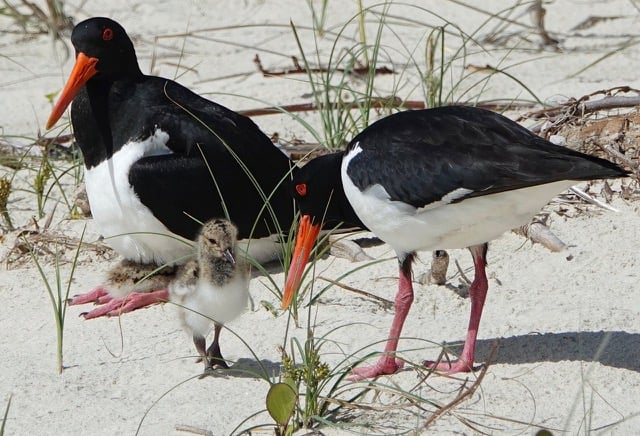
Perched on the edge of the Brunswick River estuary, binoculars poised, Jan and I are searching for beach-nesting birds. It’s a magnificent morning in early spring and these birds are starting to build their nest scrapes in the sand. The estuary’s waters are mostly shallow, its nutrients supplied by the sea’s tidal movements, shifting sands and run-off from the land. Together with four surrounding nature reserves and three tributaries of the river, these waters attract a host of wildlife, including the Pied Oystercatcher pair who’ve just come into view.
‘They are one of this shire’s 18 species of resident shorebirds,’ says Jan, who is part of the Byron Bird Buddies’ monitoring team.
‘Along with 22 migratory shorebird species that visit each year, they need quiet places for foraging and somewhere to roost above the high tide line. Our resident population includes three beach-nesters: Pied Oystercatchers, Beach Stone-curlews, and Red-Capped Plovers. They’re here year-round, so also require somewhere safe to nest and raise their chicks.’
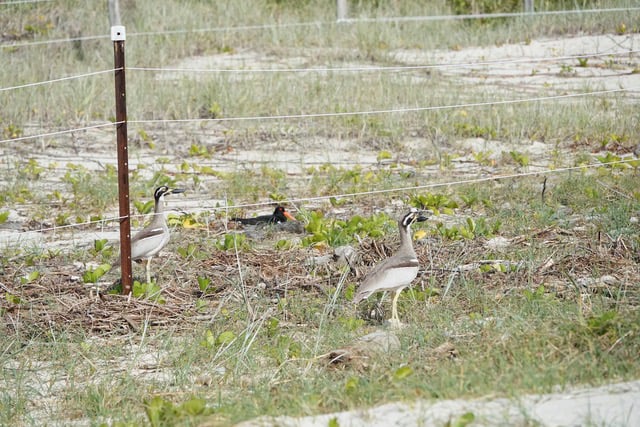
While the residents nest in late winter and early spring, migratory birds start arriving at the end of August. Little Terns come from their breeding grounds in Japan; Whimbrels and Bar-Tailed Godwits fly all the way from Siberia and the Arctic respectively.
‘They’re exhausted when they get here and need to recover. Some stay right through summer. As March approaches, the migratory birds begin to depart, and by May most of them have gone. It’s …’
Jan’s words are drowned by the sudden roar of two motorboats. Their wakes rush in successive laps across a sandy patch on a mid-stream island, startling the Pied Oystercatchers.
Jan grimaces. ‘Each disturbance can imperil shorebirds. It’s not just powerboats. We’ve seen paddle-boarders and kayakers approaching beach-nesting birds. We’ve even seen the odd dog leap from a paddle-board, swim ashore and wreak havoc.’
Byron Shire is blessed with numerous estuaries, wetlands, creeks, and beaches, which should offer a wide choice of isolated habitat where these birds can go about their daily business in peace. While marine parks, national parks, and reserves supposedly protect all of our shorebirds – and international agreements protect migratory ones – boating, fishing, and yabbying are widely permitted across the shire.
Impacts of population and tourism increase
Sadly, even endangered resident shorebirds, such as Pied Oystercatchers and Beach Stone-curlews, have nowhere safe to go.
This reality is reflected in Byron Bird Buddies’ annual monitoring reports, which, in the case of the Belongil estuary and beach, date back to 2004. Declining numbers of successfully raised and fledged chicks coincide with increases in population and tourist numbers. Added to that is the toll taken by introduced predators, along with natural predation by Silver Gulls, Osprey, Brushturkeys, and Crows. There are also cyclones, east coast lows, flooding rain, gale-force winds, even abnormally high tides to contend with. Little wonder that only two Beach Stone-curlew nest sites remain in the entire shire.
‘From our observations, a pair of Pied Oystercatchers requires 200 square metres for nesting,’ Jan says. ‘The parents have to compete for food, not just with other nesting birds but with their own offspring, because their chicks are precocial. That means the chicks hatch with eyes open, bodies covered in down and immediate mobility. They have to escape from predators and defend themselves from the start. Pied Oystercatchers generally lay 2-3 eggs, and each nest site needs enough room for parents and young to forage.
‘Beach Stone-curlews usually only lay one egg per year when nesting, although they might lay a second one if the first egg is destroyed or a newly-hatched chick dies. Either way, survival odds are grim now that we’re down to two pairs.’

With that, Jan and I visit one of the Brunswick River breakwaters, a popular spot for tourists and locals alike. It’s mid-morning in the school holidays and the rock wall is bristling with people. Amongst the busyness, a Pied Oystercatcher nests in a modest nook between the rocks. Towering above it, a Pelican, ostensibly engaged in preening, waits for a disturbance. It’s hoping someone will walk close to the nesting bird. Once startled, the Pelican will pounce on the egg.
‘This is a new nest site,’ Jan says. ‘Precarious, to say the least.’ It seems the Oystercatcher is pleading with us – showing us what it’s been reduced to in its desperate attempt to reproduce.
Next is one of Byron Bay’s popular beaches where a stormwater outlet empties into the sand dunes. Shorebirds forage here and the surrounding area has become a roost site. As we watch Welcome Swallows chase insects mid-air, a bright flash draws our attention. It’s a pair of spectacular Rainbow Bee-eaters, whose vibrant colours and deft, aerial skills instantaneously lift our somewhat sombre mood.
‘They make long tunnels in the sandy banks here,’ Jan says, pointing at the Bee-eaters, ‘with a special nesting chamber at the end. Striated Pardalotes nest here too. Trouble is, people – especially kids – walk and run all over the top of the sand dunes and that causes catastrophic cave-in events.’
Nearby is a small, temporarily fenced-off area, aimed at protecting beach-nesting birds. In 2024, one of the two pairs of Beach Stone-curlews moved here from a site that had become unstable. Other birds that nested here in the latest monitoring period include Pied Oystercatchers, a pair of Red-capped Plovers and a pair of Masked Lapwings. Reid Waters, an original founder of Byron Bird Buddies and dedicated member of the monitoring team, checks these and other shorebirds’ nests regularly – sometimes daily – during nesting season, recording his observations at every stage.
At the Belongil estuary, another fenced-off area is in place to protect roosting and nesting birds. This site is truly dynamic, with shifting sand and tidal flows causing constant fluctuations in water levels. Some of the birds that formerly nested here have turned up at different sites, others have simply disappeared, fate unknown. That climate change will exacerbate weather events is a given.
In this year’s monitoring period, our beach-nesting birds laid 32 eggs between them. Of these, the number of chicks known to have fledged is sobering: three Pied Oystercatchers, one Beach Stone-Curlew and one Red-capped Plover.
‘The promotion of tourism and our ever-growing population are putting pressure on our shorebirds,’ Jan says.
‘Different birds have different needs. Shorebirds are complex edge-feeders with special requirements. They don’t nest in trees but in a shallow scrape on the ground. Their evolutionary traits compel them to nest where there’s a food source for chicks that’s free of predation and has a 360° view to watch for predators. Increasingly, there’s a lack of such places. Instead, there’s constant disturbance by people, dogs, and foxes. Beach-nesting birds are an important story, especially for a tourist town. We have to change our thinking.’
You can help preserve these precious, vulnerable birds by:
• Reading signage and following instructions about nesting shorebirds.
• Avoiding fenced-off areas and ‘no-go’ zones established to protect birds.
• Keeping your dog on a leash, particularly from August to March.
• Using bait pumps away from shorebird nesting areas.
• Staying out of sand dunes and confining walking to wet sand.
To learn more or to join Byron Bird Buddies, email [email protected].
 For four decades The Echo has printed the stories some people loved, some people hated, and some pretended not to read. If you want us to keep telling the truth, the real truth, not the sugar-coated version. We’ll need your support to keep the presses rolling.



