


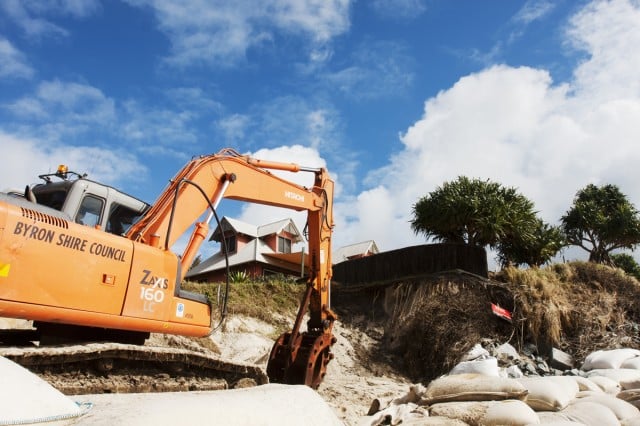
Hans Lovejoy
Are the public happy to lose Belongil beach to around 34 private landowners?
That reality continues to unfold after consultants preparing a management strategy for the beach say a seawall and groynes are still the best ‘economic’ option.
The long-awaited draft Coastal Zone Management Plan Byron Bay Embayment, or CZMP BBE, will be tabled at this Thursday’s Council meeting. And while it’s incomplete and bases some of its research on assumptions, it’s likely to be accepted by the ruling council faction and put out on public exhibition as quickly as possible.
The minority councillors have been highly critical of the process, claiming that the report is authored by a company whose core business is designing coastal engineering solutions. And thus, they could be biased against other options such as planned retreat.
Desired outcomes
Remarkably the plan admits that ‘some assumptions’ are required for ‘desired outcomes’ and does not take into account ‘ecological impacts, value of surfing and visual amenity impacts’. Nor is there any details regarding the suggestion for sand nourishment, which will be required to replenish Belongil beach.
While the focus is on Belongil, the draft CZMP BBE also covers other areas: Wategos, the Pass, Clarkes Beach, Main Beach and Cavvanbah.
The Echo understands that for 12 years Council have operated without a CZMP. Most recently, the issue was shrouded in legal confidentiality when the last draft CZMP was inexplicably withdrawn amid legal threats by Belongil landowners in April 2011.
Given rock-type structures erode beaches over time, consultants Water Research Laboratory (WRL) have hosed down the loss of public amenity by stating there are a ‘range of usable public beaches’ that will still be available within the 37km of the shire’s coastline.
Land value up 40pc
Regardless, the likelihood of protection is good news for landowners; WRL told councillors in a recent workshop that land values since July 2015 have increased 40 per cent, which is ‘up to 140 per cent increase since commencement of study.’
Protection cost $15m
The cost of protecting Belongil landowners, according to WRL, would be $15m in the first year, and then be $34m over a ten-year construction phase.
For the first year, WRL suggest landowners pay $12m, council $1m and the state government $2m.
For the ten-year plan, WRL suggest $21m (62 per cent) should be paid by landowners and the public would stump up the other $13m. council would use $6m of ratepayer’s money and the state government would contribute $7m of public funds.
The contentious plan led by Cr Sol Ibrahim aims to overturn a long-held previous policy of planned retreat.
And despite legal threats by Belongil landowners, Council staff told The Echo planned retreat is considered as ‘one of six shortlisted management options.’
The Echo previously reported that Belongil landowner and Brisbane-based developer John James – along with un-named fellow neighbours – intend to take Council to court if planned retreat was included within the draft CZMP BBE.
Council staff have also previously stated that there is legal uncertainty with overturning a planned-retreat policy in favour of rock-type structures, owing to erosion issues.
Planned retreat cost $43m: WRL
WRL claim the funding cost of planned retreat would be $43m, split 69 per cent for landowners and 31 per cent for the public sector. There are 34 Belongil properties that are at immediate risk, says WRL.
And while consultants WRL admit that planned retreat ‘most closely aligns with the NSW Coastal Policy 1997 and the Coastal Protection Act 1979’, they argue the Belongil landowners’ property is now the ‘status quo’.
They say, ‘Planned retreat has received backing in court rulings regarding setbacks for new development and removable buildings… Seawalls now protect all private Belongil beachfront properties and are the status quo.’
‘Planned retreat could only be implemented with the orderly removal of all seawalls on Belongil.’
The main disadvantages with planned retreat, WRL say, are ‘low economic viability, funding inequity, likely protracted resistance from affected landowners… and a high probability of a breakthrough of Belongil Spit at Manfred Street during a major storm.’
Council’s last Belongil project – a 105-metre rock wall – was highly criticised owing to it being outside an operational CZMP, and for a lack of broad community involvement.
But a workshop presentation by WRL claims that if the new seawall works were removed and there were a breakthrough of Belongil spit, it could threaten approximately 15 properties to the north of Manfred Street.
Legitimate errors
It’s been a difficult document in the making; most recently the state government’s office of environment and heritage (OEH) rejected the consultant’s cost benefit analysis (CBA) within the draft CZMP.
OEH pointed to ‘legitimate errors’ and suggested that if calculated differently, planned retreat would be a better option rather than rock-type structures.
But now the latest cost benefit analysis (CBA) report, which cost ratepayers $13,500, suggests that an engineering solution for Belongil should roll out over stages and include a seawall, walkway, groynes and ‘small-scale sand nourishment.’ The Echo asked OEH if they have full confidence in the document, but OEH is yet to reply.
WRL have coined the strategy as ‘adaptive management’.
But Cr Duncan Dey (Greens) says, ‘“Adaptive management” is the key phrase, as this management plan is based on ideas and intentions. It commits to the one-kilometre seawall, but leaves it for others later to overcome their impact, which includes loss of beach at and north of Belongil.
‘For example, there is no consideration of how the Little Tern nesting area at the Belongil Creek mouth will survive’.
Dailan Pugh, who is one of the members of the project reference group (PRG) that is overseeing the plan’s development, is also highly critical.
He told The Echo, ‘If this proceeds it will result in the loss of 1.6km of Belongil Beach in front of, and to the west of, the walls, dramatically increased erosion of the mouth of the Belongil estuary within the Cape Byron Marine Park, cause loss of shorebird habitat, SEPP 14 wetlands, and endangered littoral rainforest, and increased erosion of North Beach, none of which has been considered.
‘It will leave council vulnerable to claims for millions of dollars in compensation for increased erosion from the Elements resort.
‘It will also make council liable for the tens of millions of dollars for works (groynes, sand-pumping) required to try to vainly retain a public beach in front of the new walls.
The council’s latest conservative estimates are that Byron Bay’s beaches generate a minimum local income of $115 million annually for Byron Bay due to beach-related tourism expenditure.
‘By their calculation, the loss of 1.6km of Belongil’s beaches will equate to a loss of $20 million in tourism revenue each year.
‘Byron’s beaches are also worth millions more annually for Byron Shire’s residents, so the losses will be far more than this.
‘This proposed option is directly contrary to legal and planning requirements, as it is effectively getting rid of the beach and public access to it.
‘The fact that council staff are recommending it speaks volumes about their competence and independence.’
 For four decades The Echo has printed the stories some people loved, some people hated, and some pretended not to read. If you want us to keep telling the truth, the real truth, not the sugar-coated version. We’ll need your support to keep the presses rolling.


