


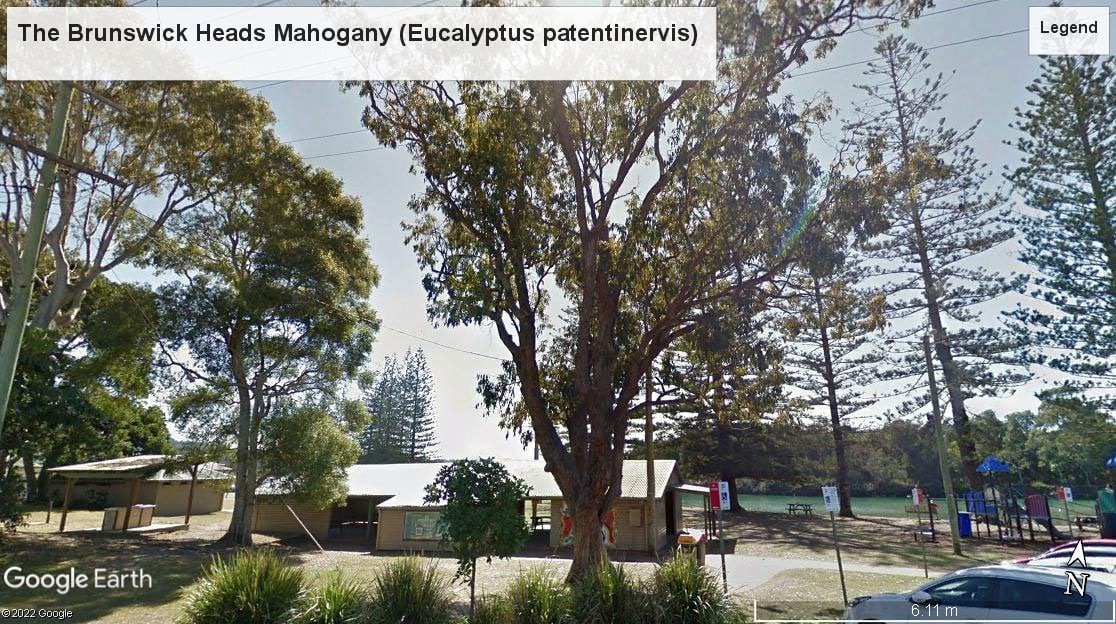
The foulest crime against the planet was committed secretly in the heart of Brunswick Heads during the pandemic lockdown. The rarest and most iconic tree in Byron Shire, under which the Arakwal, Minyangbal, and other Bundjalung people celebrated life, survived in perfect health – for hundreds of years – until it was secretly exterminated.
The beautiful Brunswick Heads mahogany (Eucalyptus patentinervis), with its metre-wide trunk of fibrous reddish bark, beautiful canopy of green pendulous leaves covered in sweetly scented white flower was a stunning component of the surviving remnant of Brunswick Heads forests growing in Banner Park, adjacent Mullumbimbi Street.
The Brunswick Heads mahogany, two forest red gums, and several hard quandongs were the last surviving trees where the original people played, the last living links of our sacred heritage. Only a single tree of the Brunswick Heads mahogany survived, one of the last known living individuals of its species, all others were cut down by British settlers. It was long thought to be a natural hybrid between swamp mahogany and forest red gum until genetic studies proved how unique it was.
For 35 years I admired this spectacular tree that grew in Banner Park between the Housie Shed and the pedestrian crossing opposite the pharmacy – until its secret destruction. The huge stump was ground down then covered with soil and planted with grass so that no one would notice its disappearance when the lockdown ceased.
As far as I know, it was in perfect health and its canopy contained no dangerous branches. Remember how the tourist cabin development was halted because it necessitated the destruction of the World War I Coastal Cypress Pine Memorial Grove; a critically endangered ecological community?
Anyone who pushes to destroy a living planted memorial to our First World War Diggers against the wishes of the Brunswick Heads community is certainly, in my opinion, capable of acting against the community by exterminating a most sacred tree.
In 1983 after the No Dams on the Franklin/ Gordon Rivers Wilderness Society campaign successfully protected the Wild Rivers National Park in South-west Tasmania, someone deep within the national park cut down and burnt the oldest living Australian; a four-thousand-year-old Huon Pine that was four metres in diameter, the last large individual of its species, all others long ago logged.
Now, an important and unique tree in the heart of Byron Shire has been felled, and I have little doubt that the perpetrators are laughing to themselves.
Community members should keep an eye on the surviving trees lest they too suddenly disappear. No longer will the Brunswick Heads community be able to enjoy their last large, beautiful, majestic mahogany.
 For four decades The Echo has printed the stories some people loved, some people hated, and some pretended not to read. If you want us to keep telling the truth, the real truth, not the sugar-coated version. We’ll need your support to keep the presses rolling.


