


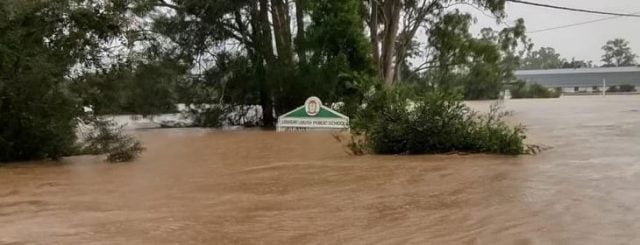
Many children in Queensland and northern New South Wales have had their lives disrupted by ex-Tropical Cyclone Alfred.
Schools were closed (about 14 were still shut as of Thursday afternoon, 13 March, 2025), families hunkered down and then the clean-up and repair efforts began.
For students in Lismore, the past week will have likely brought back memories of the catastrophic floods in the area in 2022.
Our research on the Lismore floods (which is awaiting publication in two peer-reviewed journals) contains key lessons for how communities and schools can support young people after Cyclone Alfred and other disasters.
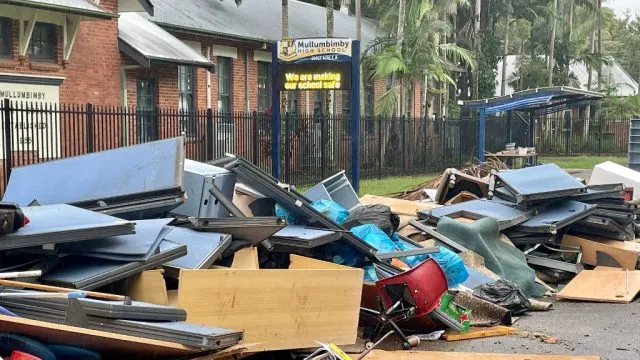
Our research
Between late February and March 2022, the northern NSW town of Lismore and surrounding region faced two catastrophic flooding events. Almost 1,000 schools in the broader area were temporarily closed and in some cases, schools were relocated or permanently shut.
In the Floods + Me project, we worked with young people in Lismore to understand the impact of the floods on their lives and education.
Twenty-nine young people aged five to 17 documented their experiences through art, poetry and stories. The project also surveyed 107 students (aged 11–17) at a Lismore school in December 2024.
Profound experiences
Young people told us how their worlds were upended by the floods. As Aisha said:
‘My mum told me to pack a bag, and we went to my aunty’s house for a couple of hours as we had nowhere to go. We then stayed at my grandma’s house in Alstonville for around three–four months.’
Lovely told us how the flood made its way up to the second level of the home, and her Dad and dog had to escape through the roof.
‘Until evening, we kept going back to the last reachable place near our house on the hill to observe the flood level. I went to bed with a lot of stress and couldn’t sleep properly.’
Wanting more emotional support
The young people in our study said there were many kinds of support after the flooding. This ranged from rebuilding and cleaning houses to donations of food and clothes. But almost a quarter of those in the survey said they didn’t observe any support.
Young people also said they wanted more emotional and mental support. Or, as one young person put it: comfort, counselling, trauma management, therapy, hugs, kindness, love.
Others said they wanted specific training: I don’t know how to be resilient – I need to be taught how to be. Don’t just tell me to be it.
There were differing experiences of ‘bouncing back’. While many reported being able to recover with little difficulty (36 per cent), almost the same number reported the opposite (32 per cent). About one fifth (21 per cent) of respondents were unsure and 11 per cent did not respond.

Wanting more school support
In the Lismore floods, some students reported 2022 as a ‘lost year’ at school. As Erika told us:
There were a lot of things going on, lots of things not working, even as we tried to still get education.
Our participants said more financial and educational support such as tutoring and online schooling would have helped to fill the gaps in their learning.
Taking time to recover
Young people told us they didn’t necessarily want to rush back to ‘normal’.
They said they didn’t want to ignore what had happened. This suggests the return to learning should be well planned and structured. And include consultation with students about what they need.
Floods and their aftermath can be unsettling, frightening and sometimes traumatic. These experiences need to be processed in healthy and constructive ways.
Our participants wanted more information about disasters to be included in their formal education. About 80 per cent of the survey respondents said teaching about flooding and disasters in schools was necessary.
The majority of students reported being worried about climate change, but this was more pronounced among girls. Half (50 per cent) of female respondents said they were concerned, compared to 24 per cent of boys and 3 per cent of non-binary/gender-diverse students and those who do not disclose a gender.
Listen to young people
A key theme in our research is young people want to be listened to and want to be included in recovery and future planning efforts.
As one young person told us: ‘Give us hands-on jobs in the moment so we don’t feel helpless. A lot of my friends felt this, and I felt lucky that I got to help; it helped me recover.’
They also raised caring for pets during floods as a key issue for communities to plan for.
As another participant explained: ‘there was an evacuation the night before, but we said ‘we’re not leaving unless we know our pets are going to be safe’.
What’s next?
Unfortunately, climate change means young people are increasingly likely to face disruptions to their education and their communities in the form of floods, heatwaves, bushfires and storms.
According to a 2025 UNICEF analysis, at least 242 million children and young people in 85 countries had their schooling disrupted by extreme climate events in 2024.
This means schools, teachers and communities need plans to empower children to face these crises and recover in healthy ways.
In the meantime, for those now rebuilding from Ex-Cyclone Alfred, our participants advise it is important not to rush the recovery phase. As one told us: ‘We took a long time to come back to feeling normal.’
Authors: Amy Cutter-Mackenzie-Knowles, Alexandra Lasczik, Jeanti St Clair, Liberty Pascua de Rivera, and Simone M Blom at Southern Cross University.
Reprinted from The Conversation.
 For four decades The Echo has printed the stories some people loved, some people hated, and some pretended not to read. If you want us to keep telling the truth, the real truth, not the sugar-coated version. We’ll need your support to keep the presses rolling.


