


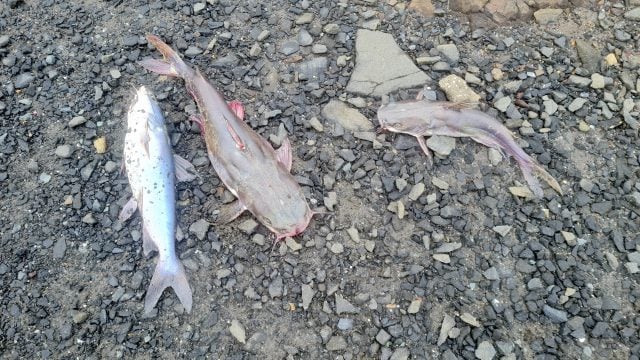
There have been multiple fish kills across the Northern Rivers following Tropical Cyclone Alfred. They were first reported in the Richmond River and are now occurring in the Clarence and Macleay Rivers. Calls to rehabilitate wetlands, use sustainable farming practices and facilitate cultural leadership continue to grow.
‘Recent fish kills have again emphasised the poor management of drained wetlands which creates deoxygenation of water after rainfall events and then long periods of acid drainage,’ explained Duncan Leadbitter from consulting company Fish Matter who has been working in this area since the 1980s.
‘The flow of water with the acid level of vinegar has been a known issue for almost 40 years but government action has largely focused on studies and monitoring, with precious little investment in rehabilitation,’ he says.
Acid water is created by the over-drainage of coastal wetlands to create agricultural land and mitigate floods. When sulphur in the soil is exposed to air the addition of rainfall creates sulphuric acid.
‘The situation on the NSW North Coast has been labeled one of the worst in the world and the Richmond River labeled a national disgrace by some of those involved in the past,’ Mr Leadbitter said.
Incoming Richmond Riverkeeper, Zoe White, pointed out that ‘the mass fish kill we’re witnessing is a stark reminder of the ill health of our river ecosystems as a result of historical management issues across the floodplain. This particular event in the Richmond River can be directly linked to blackwater run-off from the Tuckean Swamp. By restoring this important wetland, which once thrived, we can reduce the likelihood of events like this in the future, and community support behind this is crucial.
‘The Richmond Riverkeeper is issuing a call to action for local communities, landowners, environmental groups, and government agencies to collaborate on immediate and long-term solutions.’

Fish kills a warning to take action
The Jagun Alliance Aboriginal Corporation says that the mass fish kill in the Richmond River is a warning we must not ignore.
‘Our Elders teach us that the river has a voice – it’s asking us to pay attention. Through listening, respect, and shared action, we can bring life back to these waters and create a healthier future for everyone,’ said Bundjalung Elder, Uncle Ricky Cooke.
Jagun Alliance in consultation with community, Country and government, operates a framework of collaborative care, in which floodplain health, water quality, and cultural knowledge are central to ecological resilience.
‘We have a clear path forward to heal our rivers through Indigenous-led restoration. These recent challenges and catastrophic events offer an opportunity for governments, communities and custodians to work hand-in-hand to regenerate our precious river systems,’ said Oliver Costello, Executive Director, Jagun Alliance.
‘This is more than a fish kill – it’s a message from the river that Country needs care.’
Historically the Northern Rivers wetlands were nursery grounds for juvenile fish and prawns but poor water quality means they can no longer provide this function, explained Mr Leadbitter.
The NSW state government has commissioned a myriad of studies over the past 30 years and a few small rehabilitation projects, including the Yarahappini Broadwater on the Macleay River. There are seven priority rivers for action – the Tweed, Richmond, Clarence, Macleay, Hastings, Manning and Shoalhaven rivers.
OzFish are calling for the NSW government to collaborate with local governments and community organisations to restore NSW’s historically drained floodplain swamps.
Now is the time for ‘a major expansion of efforts to rehabilitate damaged coastal floodplains in NSW to reduce the flow of toxic water from deoxygenation and acid sulphate soils,’ said Mr Leadbitter.
OzFish CEO Cassie Price agrees saying, ‘We must work together to restore these crucial areas, so they can function for the health of the river, native fish and other wildlife – and our communities. Government must lead the solution, but OzFish staff and volunteers are ready to assist in on-ground efforts to restore and monitor the recovery of these area.’
Locals with on-ground information, or who wish to get involved in restoration work to prevent further fish kills, are encouraged to email [email protected] or register as a member to join OzFish’s local volunteer groups.
 For four decades The Echo has printed the stories some people loved, some people hated, and some pretended not to read. If you want us to keep telling the truth, the real truth, not the sugar-coated version. We’ll need your support to keep the presses rolling.


