


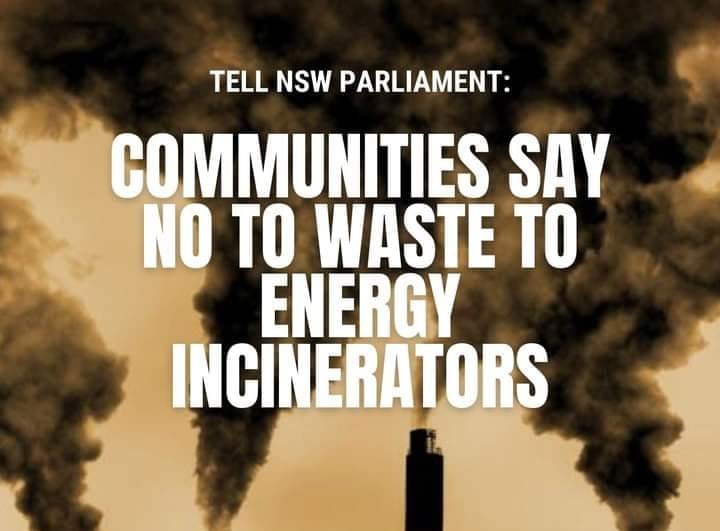
Today is the last day to oppose incineration, burning garbage to create energy, in NSW.
Western Sydney Direct Action and Residents Against the Richmond Valley Incinerator Inc. (RARVI) are calling on anyone with concerns about burning garbage and its impacts on health and the environment to get a submission into the Environmental Protection Agency’s review by 5pm today at: [email protected].
The Energy from Waste (EfW) policy amendments are a ‘dangerous plan to expand incineration across the state,’ say Western Sydney Direct Action group.
‘We do not want manufacturers and industry powering operations with dirty incineration – it will contaminate our soil, air, water, and bodies. Incineration is not clean energy – it emits more CO₂ per unit than coal or gas. It releases toxic pollutants like mercury, lead, and ultra-fine particulates into our air. The amendments ignore science, health evidence, and strong community opposition across the state,’ they say in a press release.
Speaking to The Echo independent expert Jo Immig said, ‘Waste incinerators are last century technology, no matter what their manufacturers claim. This is not the future of waste management it’s the past.’
Casino incinerator
One area that has previously been touted as a potential site for an incinerator is Casino with serious concerns having been raised over the impact this would have on farming, health and the organic and sustainable industries throughout the Northern Rivers.
The current EfW policy amendments propose to remove the f Richmond Valley Jobs Precinct (RVRJP) as a site for an incinerator. However, RVRJP are calling for it to also be removed from the published map and from clause 144(1)(b) of the Protection of the Environment Operations (General) Regulation 2022.
This was also supported by a the March 2025 meeting of the Richmond Valley Council (RVC) who unanimously voted to state ‘its total opposition to an Energy from Waste project involving incineration ever being built in the Richmond Valley Local Government Area’.
POPs
Dr Liz Stops, Convenor of RARVI points out in her submission to the EPA that, ‘EfW incineration emits a range of persistent organic pollutants (POPs), the subject of at least three international conventions.’
‘The Minamata, Stockholm and Basel Conventions classify this industry as some of the top industrial pollution sources for mercury, dioxin and hazardous waste respectively. The evidence of widespread contamination of POPs in Europe found close to EfW incineration facilities is compelling. Twelve million people in France have been prohibited from eating their backyard produce as a result of dioxin contamination caused by their best practice EU standard incinerator.’
The submission also highlights the position of the UN Special Rapporteur on Toxics and Human Health, Dr Marcos Orellana, who states:
‘Waste incinerators … emit numerous toxic chemicals into the atmosphere, toxic ashes and other residues. The chemicals present in stack gases, in ashes and in other residues include dioxins, polychlorinated biphenyls, polychlorinated napthalenes, chlorinated benzenes, polyaromatic hydrocarbons, numerous volatile organic compounds, and heavy metals including lead, cadmium and mercury. Many of these are persistent (do not easily degrade in the environment), bioaccumulative (build up in the tissues of living organisms) and toxic. Studies show that the adverse health outcomes in occupational workers and populations near waste incinerators include lung, liver, gastric and childhood cancers, as well as reproductive dysfunction.’
Dr Stops was clear to highlight that ‘while RARVI was formed to oppose the former NSW Government’s decision to allow for EfW development on the edge of Casino, our members are lobbying against this form of waste “treatment” anywhere in New South Wales or Australia.’
Circular economy
RARVI highlighted the need to focus on a circular economy and demonstrate more effective waste treatment solutions than incineration.
‘Burning waste entrenches the linear extract, use, dispose mindset. It disincentivises circular approaches of rethink, reduce, reuse, recycle,’ said Ms Immig.
‘No matter what proponents say these incinerators generate serious pollution such as dioxins that contaminate the environment are health risks. The NSW government should repeal the regulations that allow these incinerators to be located in NSW and get on with policies and programs that reduces waste.’
 For four decades The Echo has printed the stories some people loved, some people hated, and some pretended not to read. If you want us to keep telling the truth, the real truth, not the sugar-coated version. We’ll need your support to keep the presses rolling.


