


Imagine Northern Rivers says Mullumbimby is the only community across the region to rank new models of governance and decision-making as the number one element of its preferred future, and last week locals gathered to work out how to make it real.
Nineteen residents met in Mullumbimby to review the findings from the Imagine Northern Rivers workshop held in May 2025, one of twenty-seven held across the region.
The 2025 workshop engaged thirty-five Mullumbimby participants from the civic, business, not-for-profit, government and cultural sectors, who contributed 1,440 responses to questions about the present, the future and the actions needed to get there.
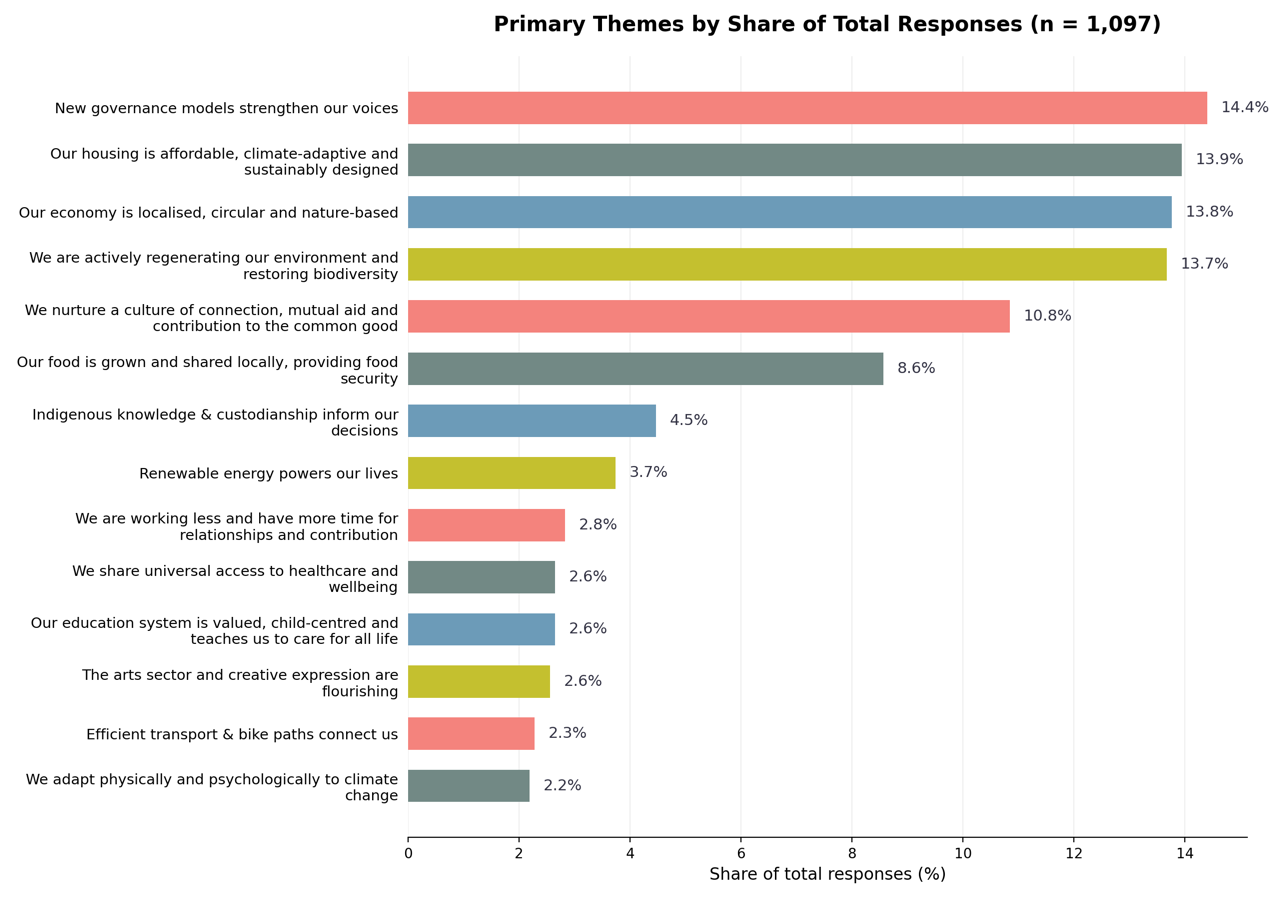
Analysis of the 1,097 responses about the future identified five leading vision elements:
- New governance models strengthen our voices (14.4 per cent).
- Our housing is affordable, climate-adaptive and sustainably designed (13.9 per cent).
- Our economy is localised, circular and nature-based (13.8 per cent).
- We are actively regenerating our environment and restoring biodiversity (13.7 per cent).
- We nurture a culture of connection, mutual aid and contribution to the common good (10.8 per cent).
Foundations
‘There are only 0.7 percentage points separating the first and fourth elements of the vision. They aren’t four competing priorities, but rather an outline of the foundations needed for a regenerative, safe and adaptive future,’ said Carmen Stewart, the convenor of Imagine Northern Rivers.
‘You can’t fix housing without planning and political reform that’s in service of people and planet. You can’t localise the economy without changing who makes decisions about land, water and energy. You can’t regenerate the environment without changing the principles of our economy. And all four sit on the foundation of the fifth – a culture of connection and mutual aid. Without strong relationships, nothing else will happen.’
This understanding of the vision to emerge from the 2025 workshop was confirmed last week. Asked what stood out in the data, one participant said, ‘Our community wants to be part of the solution… to lead it. We’re not commentators.’
Another observed that ‘the story of division is emphasised in the media, but this data demonstrates that we are in fact more united than we’re led to believe.’
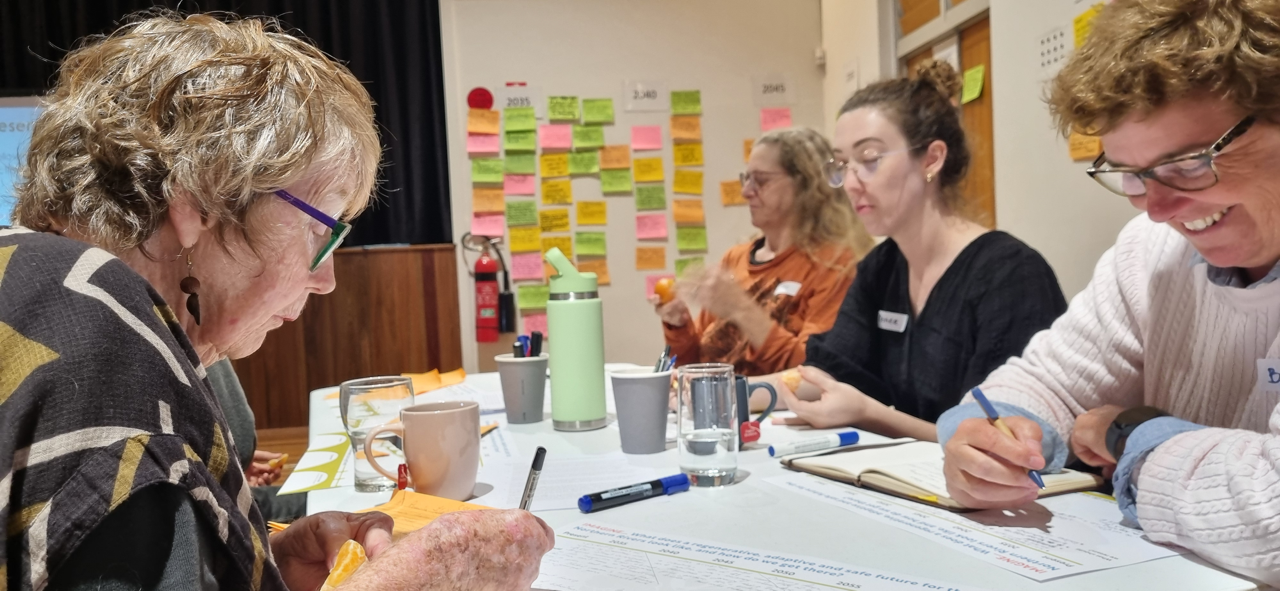
After the presentation of the Imagine Northern Rivers findings for Mullum, participants worked through a series of questions to elicit understanding of what vision elements are within community control, the conditions needed to activate the vision, and what is already underway that can be built upon.
What’s next? What’s missing?
Responses pointed consistently to Mullumbimby already having the ingredients but needing to strengthen the connective tissue.
Residents named an existing wealth of community assets such as the Mullum Community Gardens, the Food and Agricultural Co-ops, Shedding and Library of Stuff, the community pantry, Landcare, the Community Resilience Team, MDNC, COREM, the Community College, crop and food swaps, and the SEED Giving Circle, alongside a strong track record of community organising.
What’s missing, participants said, is a shared framework to weave the existing ‘good stuff’ together with the new initiatives that people are seeking to bring to life. The Transition Town model emerged repeatedly as a possible framework to connect existing and emerging projects, actions and stories under one narrative, with regular meetings, clear sequencing of actions, and the prototyping of new ideas.
Proposed next steps included establishing something akin to the Transition Town model; setting up a parallel community governing body based on agreed principles, to be tested and grown alongside existing structures; organising and mapping existing community resources; running focus groups on shared values to select a first action to prototype; and involving young people and Elders from the outset.
Several participants also committed their own contributions on the day, from catchment-scale regeneration and food security work to a proposed university-led design studio exploring bioregional governance and the rights of nature, and continued advocacy for the solar rail to connect Mullumbimby to the wider region. A community discussion to explore the Transition Town and/or Co-op models is proposed in coming months.
‘Let’s lead the agenda instead of protesting,’ one participant said.
For more information visit ittakesatown.org.au/insightsbyron.
 For four decades The Echo has printed the stories some people loved, some people hated, and some pretended not to read. If you want us to keep telling the truth, the real truth, not the sugar-coated version. We’ll need your support to keep the presses rolling.