


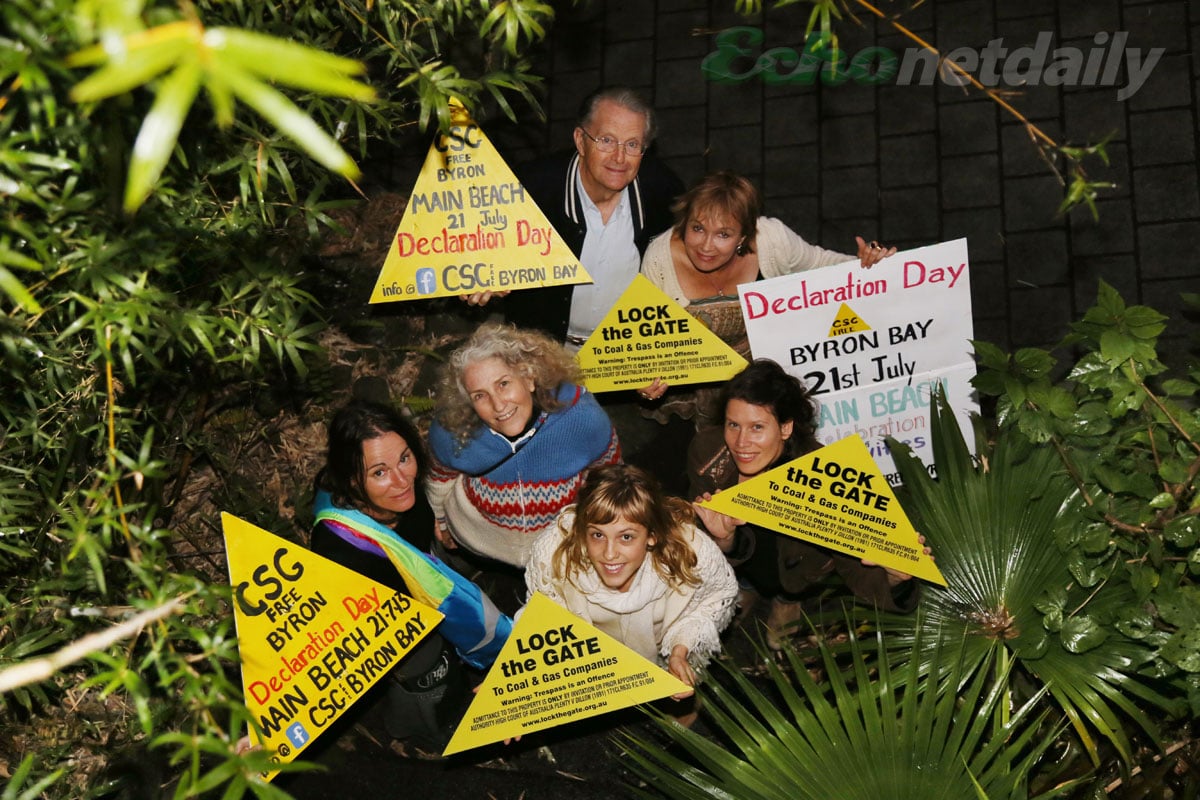
[caption]Mullumbimby residents celebrate the area being declared CSG Free. Photo Jeff Dawson
There is a serious disconnect between policymakers and community activists on the issue of coal seam gas, argues Professor David Schlosberg.
While the policy focus is on getting more gas out of the ground and supporting economic growth, activists and their supporters express concerns about the very real and also potential impacts on community life.
While governments have a dual responsibility to provide for both economic stability and the public welfare, the opposition to coal seam gas has insisted that the latter has been absent.
Those complaints and concerns of coal seam gas movements come together under a general concern for what is called environmental justice. Originating in the United States, but now used as an organising theme by movements around the world, the idea of environmental justice encompasses both a broad definition of the environment and a range of ideas about what justice entails.
While traditional environmental groups focus on the familiar issues of forests, rivers, and wilderness, environmental justice movements understand the environment as ‘where we live, work, and play’.
They insist on bringing attention to the environmental conditions in which people are immersed in their everyday lives: pollution and toxic waste in neighbourhoods, lead poisoning and asthma in children, and, yes, the threat to everyday life and the cultures of communities affected by coal and coal seam gas mining.
In the case of coal and coal seam gas mining, we see a confluence of concerns about environment. Traditional environmental groups see damage to the landscape, while farmers, ranchers, and rural community members fear a threat to their everyday way of life.
With the mining of coal seam gas affecting both definitions of environment, the result is the unique situation of environmental groups supporting farmer resistance to CSG, and farmers and rural communities shifting from their longstanding distrust of the organisations they have previously seen as enemies.
That helps explain the broad appeal of the movement against CSG.
But what about justice?
Originally, in the US, environmental justice was about the fact that more environmental ‘bads’ and risks were put on poor and minority populations. But environmental justice activists also explored why certain communities were devalued and dumped on; for many, there is a cultural disrespect at the heart of environmental injustices – some communities and ways of life were subject to discrimination, disrespect, and stereotypes.
In addition, the exclusion that comes with inequity and disrespect has also always been part of environmental justice discourse – so there is also a concern with participation as a response to injustice. The demands for community voice, and a seat at the table where projects are reviewed or decisions made, have been constant.
Beyond this what movements have meant by the justice of environmental justice encompasses a range of the basic needs of individuals and communities. Environmental justice advocates have long talked about community health, good jobs, clean air and water, and the basics necessary to live their lives – and about the environmental threats to those needs.
All of these conceptions of justice come into play in the issue of coal and coal seam gas mining. In terms of equity, some people and communities are affected more than others in the development of these energy sources, and that is simply seen as unfair.
In addition, movements responding to coal and coal seam gas mining often refer to a lack of recognition. In one sense, people feel as though their agency as citizens has been taken away.
The impression is that they and their ways of life are valued less than the stuff that is dug out of the ground. They see longstanding, iconic ideals of farming in some of the most lush and productive areas of the country being dismissed as antiquated, or underproductive, in the face of the resource boom.
This experience of dismissal and disrespect has been reinforced as their participation in the governance of their own communities has been diminished. Movement organisations see governments – state and federal – in the pocket of mining companies, refusing to address public concerns.
Worse, some are actively creating barriers to public participation – such the Queensland defunding of the Environmental Defenders Office, and the current NSW policy that prevents legal aid being used for environmental cases.
Finally, and most saliently, environmental injustice is seen in the way that the very functioning of communities and their cultures could be undermined.
It is difficult to find a more salient example than a risk to the water of a farming community, and so it should not be surprising that we have farmers, and grape growers, and horse breeders – all dependent on water – worried about the way coal seam gas mining might, quite simply, contaminate the key element that makes their way of life, their livelihoods, their cultures possible.
Until policies are proposed that take seriously the potential of coal and coal seam gas to undermine this very functioning of working communities, Australia will see a broadening movement, an alliance of groups with a range of concerns focused on the environment, on justice, and on the very legitimacy of governments that do not protect the public welfare.
These movements are in the forefront of challenging our conception of, and treatment, of the environments in which our everyday lives are immersed and on which we depend. And policymakers simply have not addressed those concerns.
David Schlosberg is Professor of Environmental Politics in the Department of Government and International Relations of the Faculty of Arts and Social Sciences, and co-director of the newly founded Sydney Environment Institute.
 For four decades The Echo has printed the stories some people loved, some people hated, and some pretended not to read. If you want us to keep telling the truth, the real truth, not the sugar-coated version. We’ll need your support to keep the presses rolling.


