


Giles Parkinson, reneweconomy.com.au
Last week, leading lights of the global fossil power industry gathered at a conference in Houston, Texas, for CERA, known in the sector as the ‘Davos of Energy’. They reportedly got the shock of their professional careers.
They had invited the most senior executives from the biggest network owner (Chine State Grid Corp) in the biggest energy market in the world (China). The organisers fully expected their Chinese guest to endorse the ‘all of the above’ marketing pitch, which is underpinning the ‘keep coal’ campaign.
No such luck. Despite prodding by leading oil industry commentator Daniel Yergin, the chairman of State Grid Liu Zhenya reportedly said the ‘fundamental solution was to accelerate clean energy, with the aim of replacing coal and oil.’
Gasp number one. And then to more stunned silence, he and State Grid’s R&D chief Huang Han dismissed coal’s claim to be an indispensable source of ‘base load’ generation.
As the network operator builds out its clean power sources, they noted, coal-fired generators could only serve as ‘reserve power’ to supplement renewables.
‘The only hurdle to overcome is ‘mindset’,’ Liu said. ‘There’s no technical challenge at all.’
The ‘base load’ mindset, though, is a pretty big and powerful hurdle. Across the world it infests incumbent utilities, the coal and nuclear lobbies, conservative politicians, energy regulators, and many in mainstream media, who are clinging to the concept of ‘base load generation’ as the last resort to try to ridicule wind, solar and other technologies.
In Australia, which has more coal generation as a percentage of its energy supply than any other developed country, this perpetuation of this idea has reached fever pitch, particularly with the imminent exit of the large coal-fired power station in South Australia.
But according to Tim Buckley, from the Institute of Energy Economics and Financial Analysis, the idea of ‘base load’ generation as an essential part of the energy mix is becoming redundant, and turning into a myth dreamed up by the fossil fuel industry to protect its interests.
‘It’s as dangerous as the marketing term of ‘clean coal’ and the idea that coal is ‘good for humanity’,’ Buckley says.
New data bears this out. In China, thermal power plant utilisation rates (capacity factors) declined from 56.2 per cent on average in 2014 to a record low of just 50.9 per cent in 2015.
‘This highlights coal is not ‘base load’, even in China,’ Buckley says. ‘It is the marginal source of supply. Coal-fired power plants aren’t designed to run only half the time, but that is what is happening in China, and increasingly that is occurring in India as well.’
Indeed, CLP, the Hong Kong-based owner of the Yallourn and Mt Piper coal-fired power stations in Australia, revealed this week that its ‘flagship’ Jhajjar coal plant in India ran at a capacity factor of just 49.9 per cent in 2015.
In Australia, it was even worse. The 1,400MW Mt Piper power station near Lithgow in NSW operated at just 45 per cent of its capacity, even after its neighbouring Wallerawang coal plant had been shut down.
Other black coal generators have been similarly afflicted, so much so that the Northern power station in South Australia is to shut permanently in May.
Grid operators also understand this. The head of UK’s National Grid says that ‘centralised energy’ will soon be a thing of the past. The Australian Energy Market Operator says that the exit of ‘base load’ coal generation in South Australia should not impact reliability or security of supply.
It does mean that supply it is dependent on other factors, including a connector to the main grid, but also a ‘different way of doing things.’ Culture, not technology, is the biggest challenge here.
A study by energy consultant Energeia suggests that wind energy will become the default ‘base load’ generation in South Australia, and dispatchable power sources – which previously dominated the grid, the markets and the business models – will have to fill in the gaps left by wind and solar.
The study conducted on behalf of South Australia transmission network operator ElectraNet, and released in December, illustrated a range of scenarios that suggested there was no room for ‘base load’ generation.
And it wasn’t needed. The gaps would be filled by flexible plant such as solar towers, or battery storage, or from gas – as long as it can compete with the new technologies.
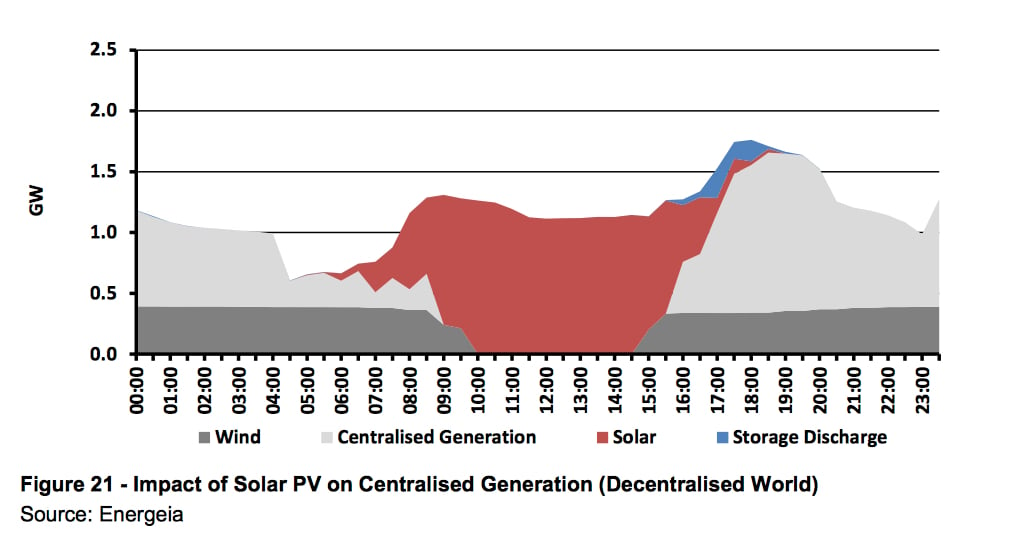
 In this first graph – it shows the ‘average daily’ supply over a year – the big change is the dominance of wind energy and the role of solar, most of this on rooftops of homes and businesses.
The impact is even more dramatic in the following graph, that shows a high uptake of rooftop solar and battery storage (although not as much as many might predict). Still, it shows that solar accounts for a large part of daytime demand.
 Part of the reason for this uptake of solar and storage is the cost of transporting that centralised power to consumers, who are being asked to pay more than $300/MWh to boil a kettle at home.
Those on time-of-use tariffs are being asked to pay more than $550/MWh – that makes solar and storage so attractive that a major study conducted by the CSIRO suggested that up to half of all generation could be supplied locally.
‘Base load is not a technical concept, it is an economic concept and a business concept of the coal industry that is no longer feasible,’ says Sven Teske, an analyst with the Institute for Sustainable Futures in Sydney.
‘Baseload is a myth, but it is so deeply rooted in the debate that it will take a number of years to change perception. It’s a bit like going from analog to digital, it is a different way of operating the system.’
He says the focus is now on renewable energy, and on flexible generation, demand management, and energy efficiency.
Teske has been working on a new analysis of the possibility of 100 per cent renewable energy generation in Australia, on behalf of advocacy groups Solar Citizens and Get Up. It will likely be released next month.
He says his study shows that renewable energy can supply 100 per cent of Australia’s electricity needs by 2035, and 100 per cent of all energy needs (including transport and heating and industrial processes) by 2050.
‘A 100% renewables Australia is definitely not a technology challenge it is a political one. And that is because it needs stable policy, something it has not enjoyed for a decade or more.’
In the meantime, the transition will bring about pain and complaint. The Australian Financial Review continues on Wednesday its documentation of the complaints from large energy users about future energy contracts.
It all rather forgets the fact that the high prices are not set by renewable energy sources such as wind or solar, but by the cost of fossil fuels, as Tasmania is finding out to its cost following the depletion of its hydro assets and the loss of the cable to the mainland.
If Tasmania had encouraged more wind and solar, it would not be paying ridiculous prices for gas-fired generation and importing 200MW of diesel gen-sets. If investments in large-scale renewables had not hit a two-year drought under federal policy shenanigans, then South Australia would not be so exposed to volatile price swings.
Buckley points out that as more renewable energy is deployed, and more storage with it, this will not just bring savings in network costs, it will also bring down the cost of peak power prices.
‘Electricity demand is variable. It is not fixed. With smart grid technologies what we need is variable sources of supply to accommodate variable sources of demand.
‘Base load is an archaic term that is no longer commercially relevant. Once that capacity is built – coal-fired generation is the most expensive marginal cost of supply because of the fuel cost, because it has to burn coal to operate.
‘We believe that with more renewables and storage, peak electricity prices will halve over the next 20 years. Once you build solar and you build storage, the marginal cost of production is zero.’
 For four decades The Echo has printed the stories some people loved, some people hated, and some pretended not to read. If you want us to keep telling the truth, the real truth, not the sugar-coated version. We’ll need your support to keep the presses rolling.


