


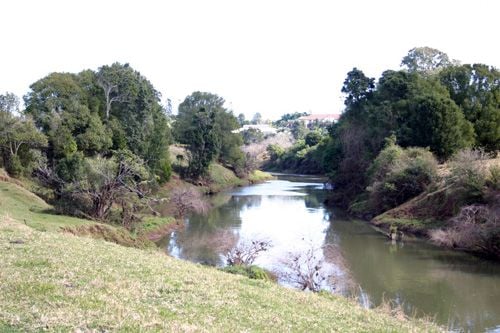
A 2015 report that measures the health of local rivers and estuaries has given an ‘F’ to the mid and lower estuarine reaches of the Wilsons River, which runs through Lismore. It is the lowest rating possible.
Byron Shire is also on the radar for poor estuary and creek health.
Utility Rous Water told Echonetdaily that the independent Ecohealth assessment examined ‘key environmental indicators throughout the Richmond River catchment including water quality, riparian (riverbank) vegetation, geomorphic (channel) condition and macroinvertebrates (water bugs), and reports on their condition.’
Data was applied to regional and national guidelines for healthy rivers, and then a scorecard given.
In the Wilsons River catchment, Leycester Creek received an F, Coopers Creek a D+, Byron Creek a D- and Wilsons Creek a C-.
The Rous water spokesperson said conditions ‘decline quickly downstream’ due to dominance of noxious invasive weeds, land clearing and grazing in riparian zones.
‘Water quality was generally very poor, although [it] was better in the upper reaches of most tributaries,’ the spokesperson added.
University of New England scientists collated information about each of the indicators from 48 sites across the Richmond catchment over a 12-month period in 2014.
The data was used to calculate scores, which were then given a corresponding grade with ratings ranging from a high of ‘A’, through intermediate ratings of ‘B’, ‘C’ and ‘D’, to the lowest possible score of an ‘F’.
‘Overall, the Richmond River catchment received a D+ rating. Mid and lower estuarine reaches of the Wilsons River achieved an overall grade of F (‘very poor’) which was driven by the dominance of invasive exotic riparian vegetation and poor water quality.
The spokesperson said the Ecohealth assessment was ‘consistent with catchment water quality risk assessments that have been conducted by Rous Water,’ which also ‘identified a wide range of threats to water quality and catchment health’.
Rous Water is currently working on a range of initiatives with catchment landholders to reverse this including weed control, management of stock access, planting and erosion control/bank stabilisation works.
100 years of decline
But, the spokesperson added, ‘the current water quality and health status within the Wilsons River catchment is a reflection of over 100 years of land use history.’
‘Effective responses to these prevailing conditions requires a whole-of-government and a whole-of-community approach and Rous Water is unable to achieve significant change on a whole-of-catchment basis by working in isolation,’ the spokesperson said.
Rous Water is involved in a series of ‘creative partnerships’ to address the decline, including the Wilsons River Tidal Pool River Reach Program, the Emigrant Creek River Reach Program, the Bangalow Landcare plantings and a long-term partnership with Big Scrub Rainforest Landcare.
Rous Water also works with Ballina, Byron, Lismore and Richmond Valley councils to ‘establish effective approaches to on-site sewage management and development within water supply drinking water catchments.’
The spokesperson said that, given the very poor Ecohealth rating, it was critical that any development in the water supply catchment ‘needs to be an acceptable incremental risk.’
‘Rous Water considers that significant new development in water supply catchments should be assessed against a test resulting in a neutral or beneficial effect to water quality within our catchment areas,’ the spokesperson said.
Drought measures
Another Rous Water spokesperson said the utility is not licensed to take water from the river in drought times.
‘Under our current license we can only take a portion of the flow in the river and must cease taking water when the river experiences lower (non drought) flows. This arrangement is to ensure that there are always adequate flows in the river to accommodate the needs of the environment and other river users,’ the spokesperson said.
‘Back in the severe drought of 2002/3 we did have an emergency license which enabled us to take water during the drought. Interestingly the water was quite reasonable quality.
‘Since then we have increased the capacity of the supply so that we can survive a very extreme drought without needing to access the river during drought times. Even so, the river remains a potential source of water if an even more extreme drought occurs in the future and our normal supplies are depleted.’
 For four decades The Echo has printed the stories some people loved, some people hated, and some pretended not to read. If you want us to keep telling the truth, the real truth, not the sugar-coated version. We’ll need your support to keep the presses rolling.


