


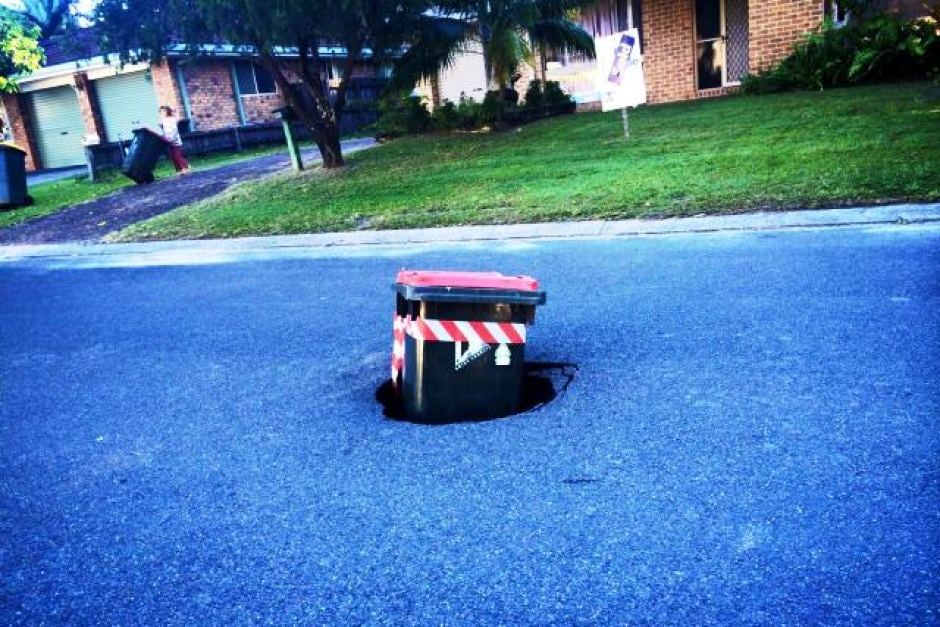
‘After weeks of heavy rainfall and flooding, many roads within Byron Shire are heavily pot-holed and falling apart.’
That unlikely confession is an official admission from Byron Shire Council that it has failed over many years to keep up with its road maintenance obligations.
But there’s a sting in the tail. The state of the roads is the reason the council sought and obtained a significant rate increase over the next three years, which, after the state of the roads themselves, is the second-biggest thing residents complain about.
‘Roads that were built many years ago on poor alignments and on poor sub-base, were never going to withstand such a harsh climate and intensification of vehicular traffic, an official council media release reads.
‘Chronic under-funding of essential road maintenance and renewal by successive councils has well and truly come home to roost,’ its mea culpa continues.
Council’s GM Ken Gainger said it has been ‘facing and dealing with the harsh reality that the only way to fix the potholes is to reconstruct many kilometres of sealed roads across the shire,’ which he adds is an expensive solution at $715,000 per kilometre.
‘A Band Aid approach of cyclic pothole repair is a road to nowhere,’ Mr Gainger ironically acknowledged.
‘It is for this reason that the council had no alternative but to push for a special rate rise through the Independent Pricing and Regulatory Tribunal (IPART) in order to make significant inroads [sic] into the council’s inherited infrastructure renewal backlog,’ he said.
‘This was a tough decision for the elected council to make and it is a credit to them that they recognised the significance of the roads problem and took what they knew would be an unpopular decision,’ he added.
Mr Gainger said a condition of IPART’s approval of the rate increase was that it would be dedicated to infrastructure renewal, which will be be audited by the Auditor General.
The council will place its annual roadworks schedule on its website so that the community can see which roads will be reconstructed and renewed across the shire and when.
‘This is all part of the council wanting to be open and transparent in its decision-making and being more respectful to its community.’
Mr Gainger said roads selected for upgrading were ‘not chosen based on political or community advocacy imperatives but rather they were selected as part of a sophisticated strategic asset management approach which analyses and prioritises works based on their condition, usage and expected lifespan.’
‘Council understands the community’s frustration with the current unsatisfactory state of our roads and has already increased annual roads expenditure from $4 million in 2012 to $16 million in 2016,’ he said.
‘Council asks that people be a little patient with the increasing number of potholes following recent heavy rains – potholes can’t be properly repaired until the wet weather subsides but rest assured that we are putting on extra crews to do this urgent work.
‘Hopefully our residents can see the efforts that we are making to provide roads that better meet community expectations,’ Mr Gainger said.
Current large roads projects in the shire include a new two-lane roundabout at Sunrise Boulevard on Ewingsdale Road, repairs to the Belongil Creek Bridge, and a tender about to be advertised for a new two-lane roundabout at the Ewingsdale Road/Bayshore Drive intersection at the Byron Industrial Estate.
The council is also moving closer construction the Byron Bay Town Centre Bypass following its successful defence of a recent Land and Environment Court appeal by Butler Street residents.
Mr Gainger added that the council was actively lobbying the NSW State Government for further roads funding and was pursuing legislative change that would support the collection of a bed tax from visitors to the area staying in Byron accommodation facilities; and enable Council to charge business rates for holiday-let establishments.
‘If our lobbying is successful, the additional revenue created would help to ease the burden of ratepayers in funding infrastructure damaged by two million tourists each year,’ he said.
 For four decades The Echo has printed the stories some people loved, some people hated, and some pretended not to read. If you want us to keep telling the truth, the real truth, not the sugar-coated version. We’ll need your support to keep the presses rolling.


