


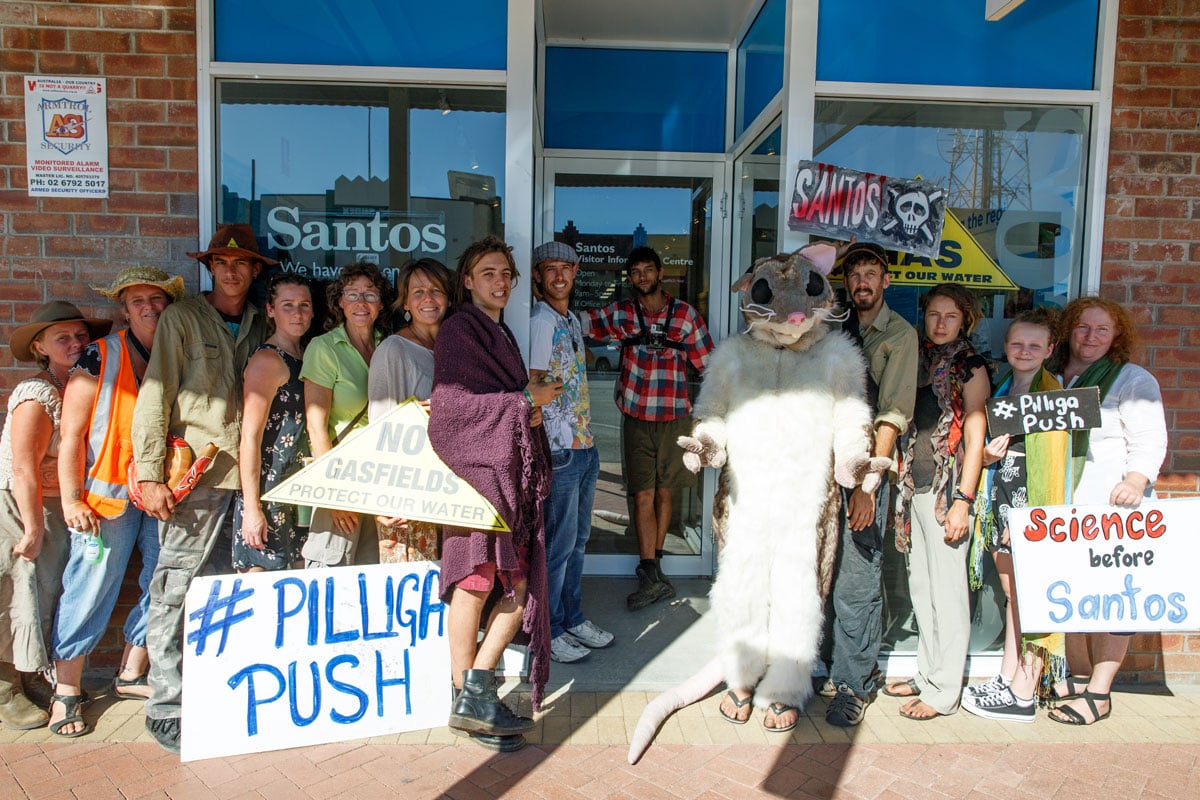
Lock the Gate Alliance says the Turnbull government’s attacks on state gas regulations are ‘cowardly attempts to distract from its own inaction at the expense of farmers standing up for their land and water’.
‘Despite all its talk about limiting gas exports, the Turnbull government still hasn’t acted to stop the big gas companies from sending most of their gas offshore and overcharging Australian customers,’ said Naomi Hogan of the Lock the Gate Alliance.
‘State gas regulations are in place because farmers across the country have been forced to stand up and protect their livelihoods and the food they produce for us all,’ she added.
‘Instead of attacking farmers, the Turnbull government should be cracking down on the big gas companies, which are ripping off domestic customers by funnelling our gas overseas.
‘Australian east coast gas prices have tripled in recent years since the three major gas export terminals came online in Gladstone with unrestricted gas exports.
‘Today’s information shows the gas companies are exporting five times more gas offshore from Queensland LNG terminals than we use domestically in the east coast gas market.
‘The damaging coal seam gas experiment in Queensland has not only driven up gas and power prices, but it has done serious and lasting damage to water resources and rural communities.
‘The Federal Government and gas companies could take simple, urgent action to bring down prices tomorrow, and yet they are using Australian food growers and local communities as a scapegoat for their failed gas export experiment,’ Ms Hogan said.
Distracting thought bubble: NCC
The Nature Conservation Council of NSW (NCC) has also weighed into the debate, saying the state government must not ‘bow to pressure from Prime Minister Malcolm Turnbull to carve up and pollute the Pilliga, the largest remaining woodland in inland NSW, for a new coal seam gas field.’
‘Trashing the Pillga forest to make a massive industrial gas field will not solve a short-term crisis caused by the Turnbull government’s incompetence in managing the nation’s energy sector,’ NCC CEO Kate Smolski said.
‘Drilling 850 coal seam gas wells in this ancient forest will threaten the recharge area of the Great Artesian Basin and jeopardise the livelihoods of farmers.
‘The project has been marred by spills and environmental breaches ever since exploration and trial drilling began.
‘If it is approved, these impacts will be scaled up massively, with potentially catastrophic consequences for wildlife and water supplies.’
Ms Smolski said the Australian Energy Market Operator had advised building more renewables was the best way to reduce demand for gas.
Meanwhile, NSW currently sources just six per cent of its energy from solar and wind.
‘Mr Turnbull’s intervention yesterday is his latest attempt to divert attention from his government’s lack of coherent climate and energy policy,’ she said.
‘First we had an ad hoc announcement of a Snowy Hydro 2.0 feasibility study. Then a thought bubble that ‘old lady’ Liddell should continue to pollute for five years beyond its scheduled closure date. Now he is pushing for more coal seam gas that won’t be operational for years.
‘Destroying NSW’s fragile environment and groundwater can’t hide the fact that Mr Turnbull lacks a credible, effective and sustainable energy policy.
‘Given the federal government won’t act to introduce sensible climate and energy policy, Premier Berejiklian must.’
The Nature Conservation Council calling on the Berejiklian government to transition NSW to a modern, clean energy system by:
- Setting enforceable targets to source 50 per cent of NSW’s electricity from renewables by 2025 and 100 per cent by 2030;
- Developing a plan for a quick and orderly phase-out of coal-fired power stations that is fair to power-station workers; and
- Creating incentives for the development of storage technologies, including batteries and pumped hydro.
States reject PM’s call
The states are rejecting calls from Malcolm Turnbull to relax restrictions on gas development as Australia faces a projected shortfall.
The prime minister received two reports on Monday showing the expected shortfall in gas for 2018 is more than three times larger than forecast earlier in the year.
Mr Turnbull and his acting resources minister Barnaby Joyce have threatened to trigger gas export controls if exporters fail to make more supply available locally.
Mr Turnbull also has the Berejiklian government in his sights, criticising NSW for not moving quickly to approve the Narrabri Coal Seam Gas Project.
But NSW Resources and Energy Minister Don Harwin rejected Mr Turnbull’s criticism, telling The Australian the state had more projects in the pipeline than any other state.
The state government has identified new areas for exploration but it would take years to yield while the Narrabri project has faced strong opposition from farming and environmental groups over the controversial practice of fracking.
The state has a ban on coal seam gas near residential areas, horse studs and wine centres.
Mr Joyce, the Nationals leader, acknowledges some farmers are against the Narrabri project.
They need to be looked after with a fair return, the state needs to get a royalty and the company extracting the gas needs to ‘make a buck’, he said.
‘I reckon if you’ve got all those three things lined up you’re going to solve a lot of your problems,’ he told ABC radio.
Victoria and the Northern Territory also have bans in place on fracking.
Victoria’s Resources Minister Wade Noonan hit back at a letter from Mr Turnbull on Tuesday, insisting the state’s ban on fracking is legislated and supported by every political party.
‘Our agricultural sector is very important to the Victorian economy and simply attacking the states such as Victoria is not showing any leadership on Malcolm Turnbull’s behalf,’ he told ABC radio.
The Business Council of Australia believes the shortfall problem is due to the states restricting supply.
‘Unless we fix that problem we’re not going to fix the entire problem in the medium term,’ the council’s chief Jennifer Westacott told ABC radio.
‘The commonwealth has to look at the means by which it can actually exert pressure on the states.’
Mr Turnbull spoke with gas companies on Monday and will talk to their bosses again during the week, seeking concrete plans on how they will avoid running out of gas for the domestic market.
If they don’t produce satisfactory suggestions, Mr Joyce is prepared to pull the trigger on gas export controls.
‘They can fix up the problems for themselves or they can have us try and fix them up for them,’ he said.
‘It would be a lot smarter if they fixed them up for themselves.’
 For four decades The Echo has printed the stories some people loved, some people hated, and some pretended not to read. If you want us to keep telling the truth, the real truth, not the sugar-coated version. We’ll need your support to keep the presses rolling.


