


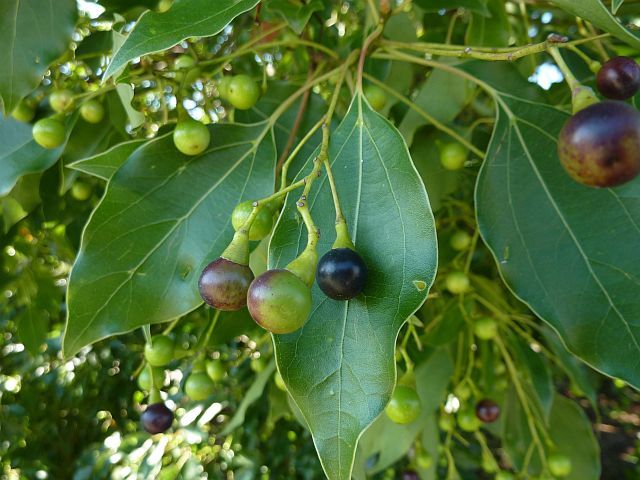
A concerted, community-wide effort is essential if the Byron Shire is to rid itself of the pervasive noxious weed camphor laurel, ecologists say.
Despite valiant attempts by individual landholders and bush regeneration groups to remove the weed in parts of the shire, its spread has continued virtually unabated over the past five years.
Managing director and principal research scientist of Biolink ecological consultants, Dr Steve Phillips, said, ‘Apart from a few small-scale reforestation programs [camphor] is not being addressed at all really.’
‘It’s ubiquitous, particularly in the Byron Shire.’
He told The Echo that without a major, long-term push from government and the community, the region’s bushy areas are at risk of becoming little more than homogenous camphor forests.
Dr Phillips said, ‘We do quite a lot of vegetation mapping and there’s just a monoculture… one hundred per cent camphor covering hectares and hectares.’
It would take a large-scale, holistic approach to address the blight, he says
‘If you worked from a centre or a core and worked your way out could probably do something,’ he said.
‘But it would require years of dedication.’
Partly integrated
Part of the reason why the challenge of camphor laurel is so large, the ecologists said, was that it was that the species was already partly integrated into the local ecosystem.
Two native bird species, the white-headed pigeon and the top-knot pigeon, have come to rely on fruit from the weed as a major part of their food source.
Camphor laurel have also created monocultures across large swathes of bushland, which means simply chopping them down affected the entire landscape.
Ecologist Damian Licari, told The Echo, ‘Removing a large number of established trees from any single area may have serious impacts in terms of erosion and degradation.’
‘It’s also not going to get rid of the camphors, because hundreds of seedlings may grow from bank of seed in the soil. And without follow-up weeding, they’ll just grow back in greater numbers,’ he said.
Costly to remove
Ecologists and regeneration experts have developed effective methods of removing the camphors in such as a way as to ensure that they are replaced with native vegetation.
However, these methods are often prohibitively expensive for landholders, upon whom the task of dealing with noxious weeds most often falls.
‘The cost, both in terms of money and time, is such that you really couldn’t expect individual landholders to address it meaningfully,’ Dr Phillips said.
‘For even a relatively small area you’re looking at between $10,000 and $20,000.’
‘I’ve had a program of removal and replacement at my place, but within two years in the area where I removed ten camphors there were 10,000 seedlings. You’ve got to be constantly vigilant.’
With landholders struggling to address the problem on their own, government help appears essential.
 For four decades The Echo has printed the stories some people loved, some people hated, and some pretended not to read. If you want us to keep telling the truth, the real truth, not the sugar-coated version. We’ll need your support to keep the presses rolling.


