


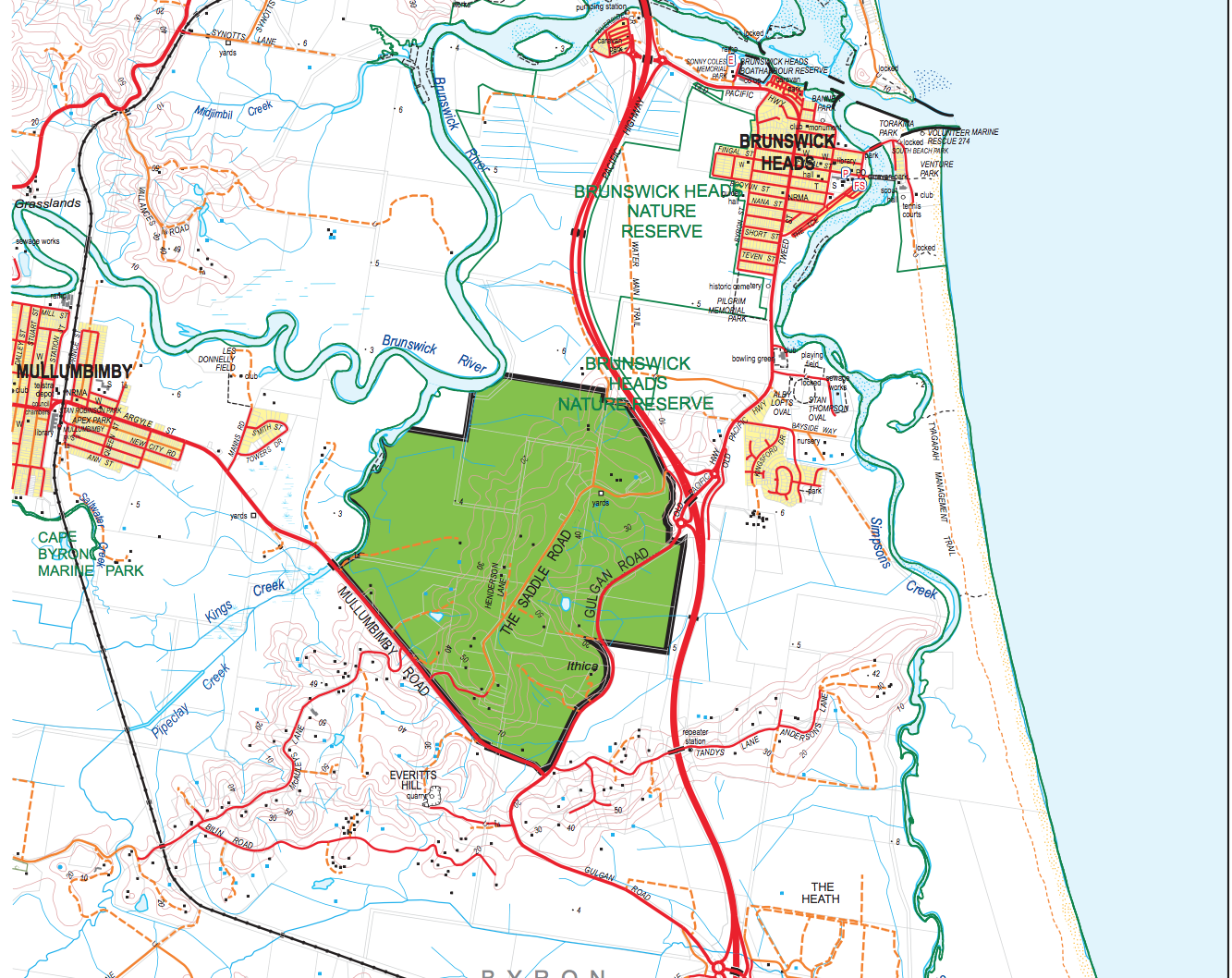
One of the planners who prepared the Saddle Road rezoning planning proposal has disputed the area, as assessed by Byron Shire Council staff.
In a letter to the council’s general manager on December 18, Stephen Connelly from Planners North wrote of his concerns ‘about a large amount of misinformation circulating in the community’.
Utilising ‘the conventional net density approach’, Mr Connelly said that their ‘approximate area calculations’ are 290ha, while council staff worked on an assumption of 315ha in their report.
One aspect of the overall rezone request is the Zone RU5 Village rezoning for the proposed Brunswick Eco Village (BEV). Council believes the area is 39ha while Planners Northers say 35.2ha.
Net v gross
Mr Connelly writes, ‘…net density refers to the number of dwellings per hectare on land solely devoted to residential development. While it includes private driveways and private open space, it does not include public roads and areas of public open space etc.’
‘At Saddle Road, the gross area of zoned land will be significantly diminished by the need to provide for roading; significant Rural Fire Service Asset Protection Zones; the retention of important paddock trees; and the integration of existing dwellings into the overall development layout.
‘Those opposing the Planning Proposal have sought to apply to the net density standards we have notionally proposed to a gross area of proposed zoning. Thus, the opponents mischievously seek to apply the density standards not to the 52 hectares of net residential area specified in the Planning Proposal, but to the gross area which includes public infrastructure, open space and the like.
‘To add to the mischievousness, they have even been bold enough to republish our potential yield scenarios based on 52 hectares to produce an estimated yield of 586. In doing this calculation, they deliberately omit the 15 per cent of the site we have set aside for ancillary uses, such as child care, neighbourhood shops and the like.
‘We would be pleased to further discuss with Council its idea in relation to density, noting that our potential yield scenario of 475 dwellings is generally consistent with that made in Council’s Preliminary Draft Residential Strategy of some 400 dwellings for the Saddle Road locality.
‘To assist with briefing staff, we have included herewith a publication by the government of South Australia which assists in understanding residential densities. You will discern from looking at the case examples in this study, our proposals are in the “very low” to “low” order of residential density.’
Expected yield
Yet local architect and urban designer David Brown challenges the expected yield from the requested rezone.
He told Echonetdaily, ‘The 475 dwellings on the 52 hectares of R2 Low Density and R3 Medium Density land represents a gross density of about nine dwellings per hectare.’
‘This assumes grossly inefficient use of the available land, which would not be tolerated by a developer. Furthermore, it would fail to provide enough revenue to fund the necessary services connections or road network. Council would not pay for them and the state has a “no cost to government” policy. End selling prices would therefore have to be well beyond levels affordable to medium let alone moderate income households.’
‘A 2011 Landcom document (Residential Density Guide for Landcom Project Teams) suggests a gross density of nine dwellings per hectare at an 87 per cent efficiency would represent a net density of around 12 dwellings per hectare. The 87 per cent figure has been a working rule of thumb for some time and is representative of a Sydney suburb such as Eastwood. More recently created suburbs achieve efficiencies of between 57 per cent and and 76 per cent with the lower rates the result of large areas of public open space… sports ovals, excessively wide roads, local parks, school grounds and community facilities for example.
‘Eastwood, developed between 1920 and 1960, is a very pleasant suburb with seven per cent public open space. Landcom’s Newbury, developed between 1990 and 2010, has 26 per cent pubic open space. The latter is not necessarily socially, environmentally or economically better.
‘All this means a much higher gross density rate will be required to make development along Saddle Road viable.
‘Something close to, or more than, the R2 Low Density 15 to 20 dwelling, and the R3 20 to 30 dwelling, net density figures would be needed. Both are more typical of contemporary greenfield development in R2 and R3 zones. With careful and sensitive design, a 75 per cent efficiency rate (note that Eastwood is 87 per cent ) is possible.
‘The R2 gross residential density would then be between 11 and 15 per hectare (for 360 to 490 dwellings), the R3 net between 15 and 22 dwellings per hectare (for 290 to 425 dwellings). The total excluding the RU5 Village area would consequently be between 650 and 875 dwellings. My suspicion, not surprisingly, is that an incoming developer would be seeking more.
‘Modest Asset Protection Zones may be required on the western boundary of the northern R2 Low Density area but, given the density of vegetation nowhere else.’
‘The retention of significant paddock trees is partly handled by the scattered R5 zones. Skilled design would ensure any remaining trees would be retained. Existing housing lots might be integrated into the whole or sold and resubdivided.
Mr Brown added, ‘The proposal’s 475 is conveniently close to the draft Residential Strategy 400 dwellings.’
‘There are no concept design drawings that might confirm the areas set aside for ancillary uses. Interestingly, their 15 per cent allocation gets close to Eastwood’s 87 per cent net to gross figure… my 75 per cent figure sounds even more reasonable as these “ancillary uses” (child care, shops, school and the like) plus public open space are the deductions made when moving from gross to net density calculations.
‘The lack of any concept designs (apart from a diagram showing a totally unimaginative internal road network) is the mark of landowners flying kites rather than putting forward plausible, well-considered proposals.
‘The South Australian document is, well, South Australian. It is misleading, irrelevant and ignorant of common practice in NSW.’
 For four decades The Echo has printed the stories some people loved, some people hated, and some pretended not to read. If you want us to keep telling the truth, the real truth, not the sugar-coated version. We’ll need your support to keep the presses rolling.


