


Hans Lovejoy
Plans to rezone and develop 22 hectares (54.34 acres) of Council-owned land next to the Mullumbimby Community Gardens has seen increased resident resistance, and last week Council staff sought to calm the waters by issuing a press release to further explain the plans.
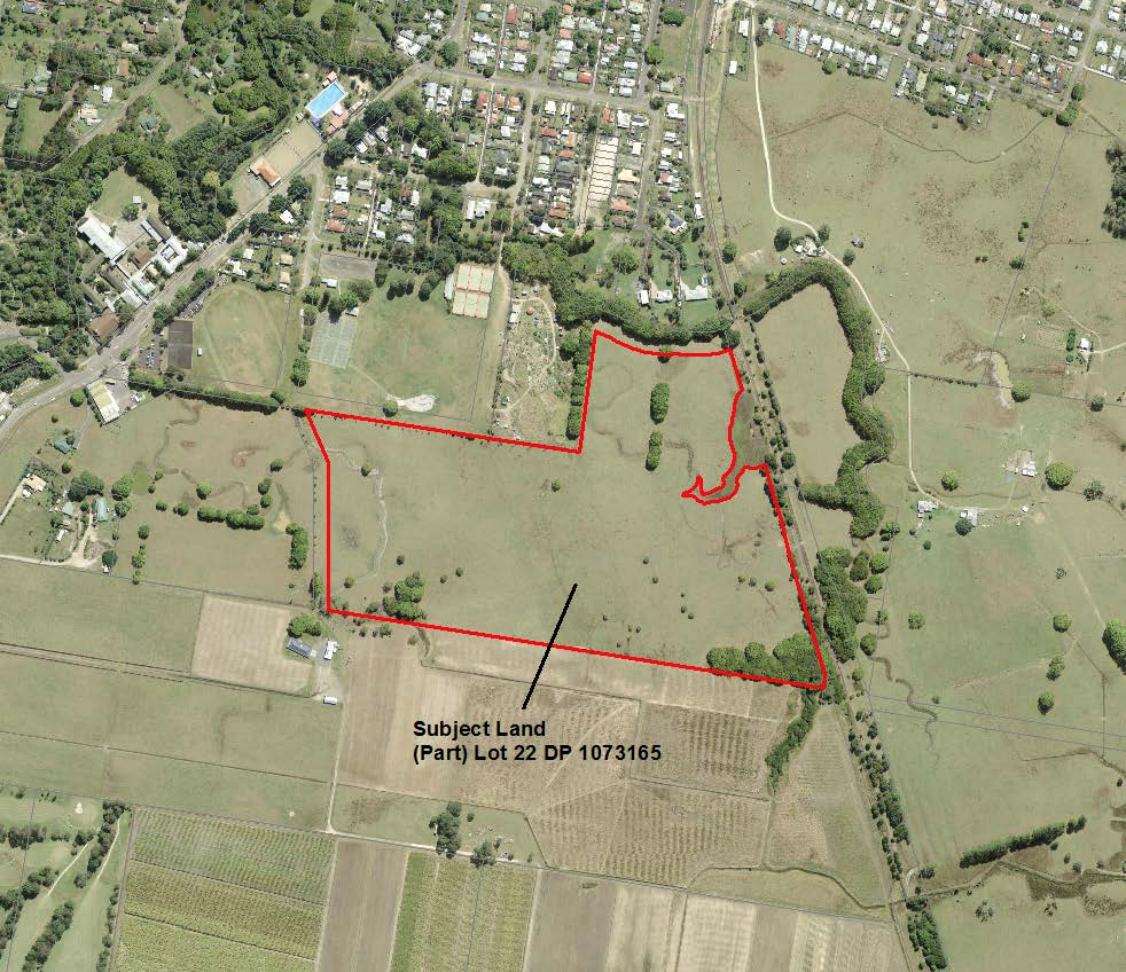
Known as Lot 22, the large flat cleared area is known to be floodprone – as most of Mullum is – and was earmarked last year by councillors as an affordable housing project.
One flooding solution, according to Council’s flood assessment report, is to import 1 – 2cm of landfill across much of the area.
While that (third) scenario claims the impacts would be negligible, the flood assessment report admits areas to the south will be affected.
Further studies are required to determine other impacts, say staff.
Currently the land is used for cattle grazing and ‘consequently is largely cleared and significantly degraded,’ according to the 2017 staff report.
Yet Council is yet to establish a framework for how it will roll out – for example no joint venture (JV) partnerships with affordable-housing providers has been sought, nor is there a masterplan or indication of what type of dwellings would be constructed.
Director sustainable environment and economy Shannon Burt told The Echo that ‘Council is determined to retain an interest in the land.’
Lot size 200m2
And while the proposed minimum lot size of 200m2 may raise concern, Ms Burt told The Echo that the changes to the LEP to allow that would only apply to the subject lands.
According to a 2017 staff report, provisions to be inserted into the Byron LEP 2014 would ‘encourage diverse and affordable housing on key sites (initially being part Lot 22 DP 1073165)… This will require a new suite of maps called the “Key Sites Map” to be included in the LEP.’
Ms Burt also added that the planning department has given positive feedback on the plans.
‘We are inviting members of the community and representatives from key stakeholder groups to work with us; to look at what Council’s vision for this land is and sit down and give us feedback, suggestions or raise concerns,’ she said.
‘While community fears about large-scale development of the land are understandable, they are not the truth in this case,’ she said in a statement.
‘Council is seeking permission from the NSW Government to rezone and reclassify Lot 22 from Public Recreation to Residential and this is causing some angst,’ Ms Burt said.
‘Council is committed to something in keeping with the surrounding local character including a diverse mix of housing types to meet the needs of a diverse community.
‘We believe Lot 22 has the potential to offer some much-needed diverse housing options to our community and housing affordability is one of the key areas of concern for residents of the Byron Shire,’ she said.
Ms Burt claims it is possible to develop a planning proposal for Lot 22, ‘based on world’s best practice designs and ideas.’
‘This includes developing options that take into account the fact that a large portion of the site is flood prone but this should not stop us looking for innovative solutions and ways to deal with this,’ Ms Burt said.
‘We are gathering concept ideas and designs for Lot 22 with the aim of transforming it into a model development that Council, and the community, can be proud of.’
Apart from posts by the Facebook group Sayno2lot22, concerns were aired last week on BayFM by former Greens councillor and hydrologist Duncan Dey.
Flooding
He told presenter Dione Green, ‘The issue is the wet nature of the site… It’s not so much the flooding which is [also] an issue’, he says. ‘It’s easy to build around flooding.
‘Waterlogging is the issue, especially in the wet season after heavy rains. It becomes a permanently damp place –it’s not a particularly good place to house people. If affordable housing, it won’t be as robust or insulated… it will be an uncomfortable place to live.’
When asked for a solution by Green, Dey replied, ‘The unaffordablity of housing relates to the unaffordablity for life.’
Dey said he is concerned that the unaffordability of housing will become ‘an excuse to go ahead with rampant development’.
‘There are many things that can be done with existing housing to make it more affordable.
‘This is a Shire scared of development – we’ve seen it all over the years – it’s been run out under the badges of being spiritual or whatever, and in the end it’s just a another subdivision.
‘It’s a big investment. The place to put that investment is on a good site, not a lousy one.
‘We should be identifying suitable places – so on a slope facing north, with good access to this or that. We should be working towards that land. Some of that land is tied up as rural [zoning] that can’t be subdivided. Rather than putting effort into waterlogged damp country, why not put the effort into liberating the so-called rural land that could be used to house people in brilliant and wonderful microclimates on good land.’
Election issue
Yet current Greens councillor Sarah Ndiaye told BayFM, ‘Obviously the water [flooding] issues need to be taken into consideration. There are mitigations that can be done.
‘This is one site, [and] there’s a lot of steps and hurdles before approved.’
She says the NSW planning department told Council there is merit in the idea, but there needs to be more process before it would be approved.
‘We are incredibly constrained to what we can do, especially with affordable housing. Affordable housing needs to fit into an already defined town footprint. And this land does. If it’s outside that, it needs to meet other criteria in terms of access to education, transport, infrastructure…
‘I am constantly losing friends from this area – we are losing the community that lives here.
‘Affordable housing was an election issue’, she said.
Malcolm Price from Social Habitat was part of community meetings last year to show and develop ideas for the site.
He told The Echo, ‘In many ways, the problem is about the two-sided dialogue that has emerged around all development.’
‘Most people acknowledge that there is an affordable-housing problem, but there is no trust, particularly in this area, that profit-driven development will deliver anything other than profit for the developer.’
 For four decades The Echo has printed the stories some people loved, some people hated, and some pretended not to read. If you want us to keep telling the truth, the real truth, not the sugar-coated version. We’ll need your support to keep the presses rolling.


