


Paul Bibby
Byron Council has been fined $1,000 over last year’s Tallow Creek fish kill, with the National Parks and Wildlife Service (NPWS) finding that it breached its licence to maintain the entrance to the vital waterway.
Thousands of mullet, bream, whiting, flathead, and eels died on June 14, 2019 after Council officers elected to artificially open the entrance to the Creek, which had been closed for eight months.
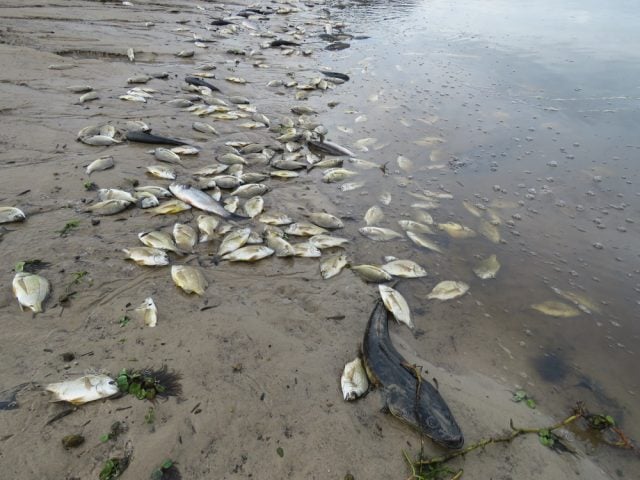
This caused an influx of water with low oxygen levels to flow from shallow areas of the creek to deeper areas as the water level in the lagoon area dropped.
As a result, more than 12 tonnes of fish died of asphyxiation.
Council voluntarily reported the incident to the NPWS for investigation, with the body finding that the mechanical opening of the Creek had been undertaken an hour and 20 minutes after the recommended time for taking such action.
It also found that the channel at the point of opening was more than double the recommended width.
Both of these actions were in breach of Council’s licence to maintain the opening of the creek.
Another independent investigation, commissioned by Council, found that there was a shortfall in the risk planning and management policies for Tallow Creek and other similar waterways.
‘The mitigation measures for managing fish kills outlined in these documents essentially involve timing openings around high tide events to minimise rapid draining,’ a Council report contained in the agenda to this week’s Council meeting states.
‘This mitigation measure alone was ineffective in this case in avoiding fish kills and needs to be combined with other measures like timing with rainfall.’
As a consequence of this finding, Council has significantly changed its approach to managing Tallow Creek, essentially abandoning the mechanical opening strategy.
‘Council will now exclusively manage the entrance of Tallow Creek by attempting to encourage ‘natural breakout’ events of the creek,’ the Council report states.
‘Council will encourage this breakout by lowering the beach berm (using an excavator) to allow overtopping during a rainfall event.
‘This mimics natural estuary opening events and aims to decrease the potential for a fish kill.’
In addition to the change in policy, Council staff took part in a retraining workshop exploring best practice for managing Intermittently Open and Closed Lakes and Lagoons (IOCLL) such as Tallow Creek.
There have also been multiple meetings with staff from NPWS, the NSW Department of Primary Industries, as well as the traditional owners and custodians of the land.
 For four decades The Echo has printed the stories some people loved, some people hated, and some pretended not to read. If you want us to keep telling the truth, the real truth, not the sugar-coated version. We’ll need your support to keep the presses rolling.


