


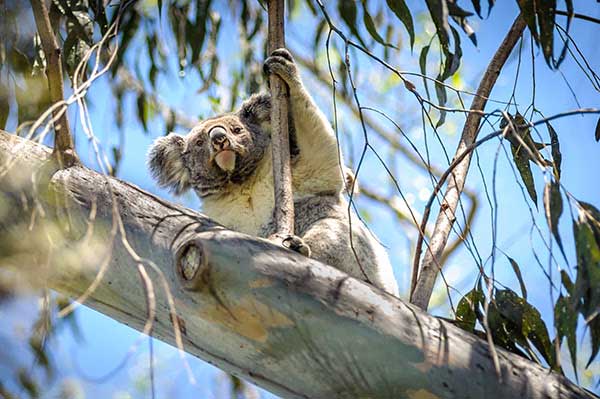
Greens MP and Committee Chair Cate Faehrmann said the Government’s response to the NSW Upper House Inquiry into Koala Populations and their Habitat, released yesterday, indicates it has no intention of acting upon many key recommendations made by the Committee in order to stop koalas becoming extinct in NSW before 2050.
‘This is an extremely disappointing response from the NSW Government and shows they have no commitment to save koalas from extinction let alone doubling their numbers by 2050,’ said Ms Faehrmann.

‘Many of the key recommendations, the vast majority of which were supported by all Committee members because they are what needs to be done to save koalas from extinction, seem to have been rejected outright. This is especially disappointing because they are all achievable if the Government had the will.
‘Of the 42 recommendations in the report, 14 were ‘Noted’ which from where I’m sitting is another way of saying ‘Rejected’. This is incredibly disappointing given how critical these recommendations are for the koala’s survival in NSW.
‘Recommendations such as the Government urgently investigating the ‘utilisation of core koala habitat on private land and in state forests to replenish koala habitat lost in the bushfires’ appear to be rejected out of hand.

Government’s response to the koala crisis falls short
The NSW Government’s response to the 42 recommendations of the inquiry is woefully inadequate, according to the Nature Conservation Council of NSW.
Nature Conservation Council Acting Chief Executive Jacqui Mumford said the government’s response is alarmingly relaxed about the looming extinction of an iconic native species.
‘There is nothing new in the government’s response, which just rehashes policies that have already patently failed to deliver the protection our koalas need.
‘Basically the government response says ‘relax, we’ve got it covered – no need to do more’.
‘But koalas are more at risk now than they were late last year because the National Party has torn down the koala SEPP and the obliteration of koala habitat continues.
‘Any response that does not stop the destruction of koala habitat for agriculture, logging and urban development falls catastrophically short of what’s required.
‘Several studies have warned that koalas will be extinct by 2050 without urgent action – we have a duty to ensure that does not happen.’
An adequate response would include: Implementing a strong, effective koala planning policy ; Committing to the creation of the Great Koala National Park proposal; Ending native forest logging, and; Ending the clearing of koala habitat for agriculture, urban development.
Relying heavily on new Koala Strategy
Ms Faehrmann said that instead of acting upon many of the recommendations that address the key threats facing koalas, the Environment Minister is relying heavily on the release of the new Koala Strategy early this year. ‘Like the old Koala Strategy, it won’t be worth the paper it’s written on if it doesn’t address the key threat to the ongoing survival of koalas in NSW which is the ongoing destruction of their habitat.’
 For four decades The Echo has printed the stories some people loved, some people hated, and some pretended not to read. If you want us to keep telling the truth, the real truth, not the sugar-coated version. We’ll need your support to keep the presses rolling.


