



On Saturday the rain stayed away long enough for Federal Senator Hollie Hughes and Ballina Shire Mayor David Wright to officially open the newly constructed shared pathway between Skennars Head and Lennox Head.
‘This wonderful joint council and federal government project will serve the tourist sector and locals for decades to come,’ said Senator Hughes.
‘I am so very impressed at the beautiful boardwalks and the sealed paths providing a cyclist dream. It showcases a beautiful part of the world,’ she said.
Mayor David Wright told The Echo the path idea had been discussed for as long as he’d been involved with council (34 years), and he was very pleased that a combination of funding sources had eventually made it possible to build two paths, one for walkers close to the coast, which is nearing completion, and the shared path to the west.
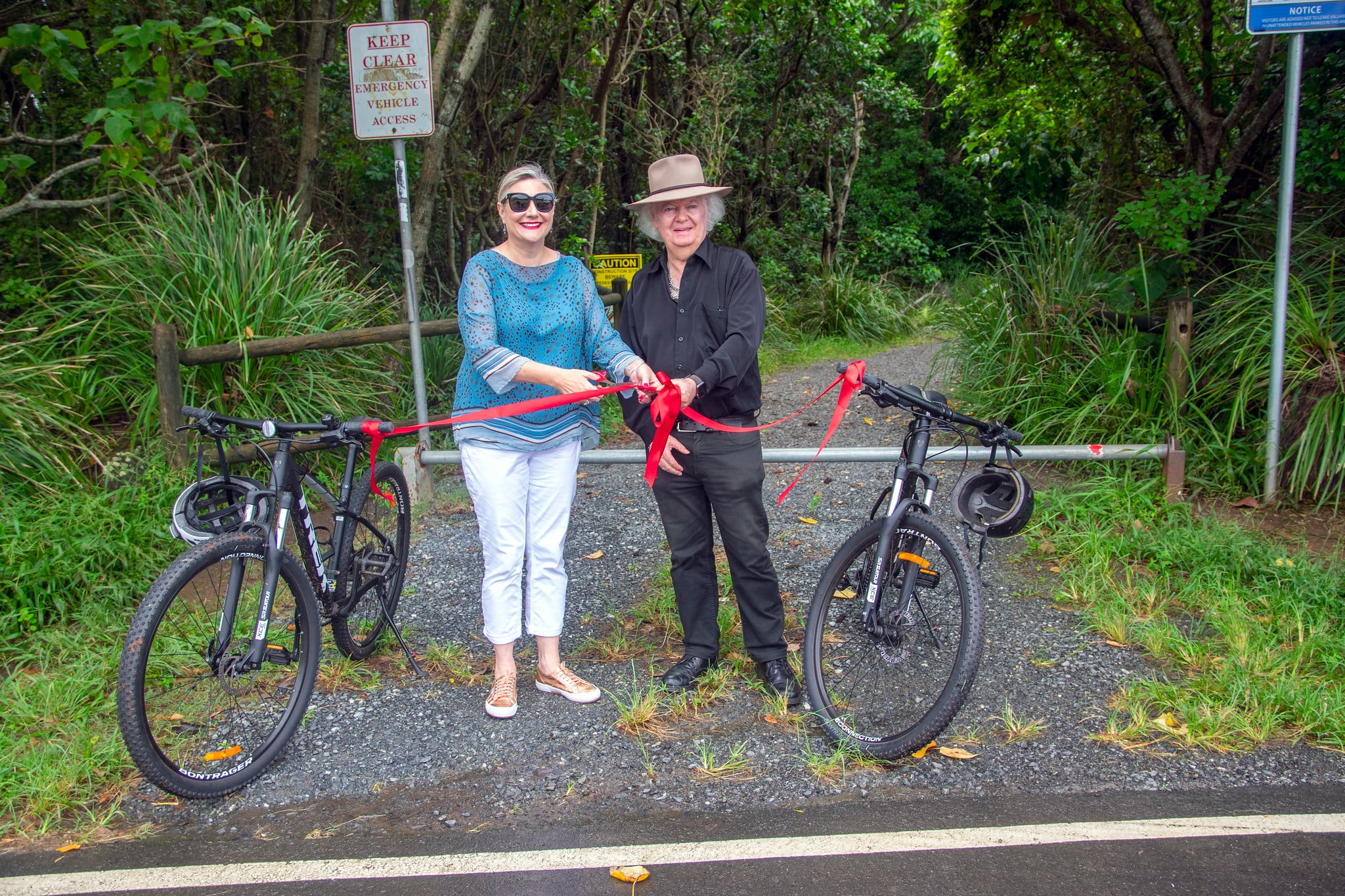
‘It’s the best thing we ever did although we copped a lot of flak.’
Mayor Wright said that the project provided commuters, recreational cyclists, walkers and runners with an alternative route to move between the two communities.
‘Or it’s a wonderful walk or cycle just for the joy of it,’ he said. ‘The walkway is already proving to be incredibly popular with runners and cyclists.’
Mayor Wright explained that the area has extensive environmental, flora, fauna, Aboriginal and European heritage values and community consultation had been an integral part of the project.
Challenging but rewarding project

Ballina Council’s Engineering Works Manager Paul Busmanis told The Echo that the shared path had been a complex job from an engineering, environmental and community liaison point of view.
He said the team had paid great attention to vegetation management and hydrology.
‘This whole coastal strip is also quite challenging from a cultural heritage point of view,’ said Mr Busmanis.
The principal contractor who did the work is B&S Landscaping and Earthworks. The B&S Project Manager is Tony Bennett. He described the building process as ‘fairly challenging’ with many wet and environmentally sensitive areas to cross.

‘With our equipment and the way we build, we try to minimise our environmental footprint as much as we possibly can,’ said Mr Bennett.
‘The whole process has been done within a five metre corridor, so we do not move outside of that.
‘We work very closely with the ecologists, and also our Aboriginal monitors.’
Mr Bennett says he collaborated with ecologist Mark Free to minimise the number of impacted trees. The result is a beautiful experience as a cyclist, with plenty of curves along the way, a mix of grades, and many beautiful mature trees.
High tech boardwalks

The lattice boardwalks over the wet areas is an Australian made CFT (composite fibreglass technology) product with an estimated life expectancy of 75-100 years.
‘Some of the piers and piles we’ve driven in these wetland areas have gone down 9.5 metres, to get set,’ explained Mr Bennett.
‘Being fibreglass, they’re totally inert in terms of chemicals and so forth, termites, the whole deal.
‘They’re coated with a highly hardened paint which is done in the workshop. It’s hardened and dried two pack epoxy based. The mesh is actually a resin mesh which has glass particles put over the top of it, like a paint, to give the slip resistance which we require,’ said Mr Bennett.

All the other components, such as handrails, are 316 stainless steel, ‘designed to be near the ocean and to maximise longevity and the investment from the community.
Mr Bennett said the feedback had been 100% positive from passing community members during the building process, which has taken sixteen months with weather delays.
‘It took us a while for us to convince a few of the environmental groups that we weren’t a bulldozer type crew that comes through and clears, bust, bash. We take our role very seriously with the environment,’ he said.

The precision cutting of the boardwalks was done on site, with the ability to remove sections individually if needed.
Local workers
Mr Bennett is proud to say he used all local contractors and workers on the construction of the path, with eight people working at the peak.
His team also did the path past Flat Rock featuring all the indigenous history and culture signs.
‘We worked very closely with the indigenous section of the community here, we’ve got a great relationship with them since 2016. We communicate well and take what they have to say into consideration before we even put a bucket into the ground.

‘I’m pretty green myself. When I look at a tree I don’t just look at a tree. When a contractor takes on a project like this, they’ve got to be prepared to go the yards in that regard. It’s not just a matter of putting a path in,’ he said.
‘This is a community path, it’s community-based. It’s environmentally-based and also culturally-based. So we try to encompass all these things.’
Different levels of government working together
Senator Hollie Hughes said the project was ‘a perfect example’ of how federal government co-operation with a local council could provide ‘a winning outcome for an entire community.’
The Australian Government provided $880,000 with Ballina Council funding the remainder of the $1,915,701 project. The Federal Government funds were provided under the $222.3 million Regional Jobs and Investment Packages Programme.

‘Ballina Council should be praised for their magnificent efforts to provide such a vital and picturesque link between Skennars Head and Lennox Head,’ said Senator Hughes.
Hollie Hughes is the Patron Senator for the North Coast of NSW, as well as the Hunter region. ‘Yes, it’s a tough job but somebody’s got to do it!’
‘But seriously, these are both areas that are really driving that economic recovery as we come out of COVID, are really part of driving that economic recovery,’ she said.
‘We’ve seen over summer that it’s been a boon for these local areas, that people have chosen to holiday at home, and in their own state.
‘The fact that people haven’t been able to travel overseas means a lot of people have discovered their local areas, and what’s in their own local back yard, I think some people have been pleasantly surprised.’
Senator Hughes said the federal government was focused on investing in infrastructure which provides job creation, with the bonus in this case of building something which allows people to get close to nature and be less car dependent.

‘Yes, people want to be able to get out and do things when they’re on holidays, and have more physical activity,’ she said.
‘I’ve got the kids here with me this weekend, and anything I can do to get them off screens is a huge benefit.
‘It’s great to get them out to places like this where they can walk along the coast, whether it’s the whale season or whatever’s happening.
‘I’ve got an autistic 11 year old who’s got his shark puppet here, he’s pretty big on the sharks!’ said Senator Hughes.
With shark tourism not exactly on council’s agenda (yet), Mayor Wright said the next stage for the Lennox paths would be to finish the coastal path, then improve the car parking and path sections around Pat Morton lookout.

‘We still plan to finish the top of the path and link it with the next section, because when it’s really pumping there’s so many cars parked up there it’s dangerous, he said.
‘We don’t want to tell people they can’t go and surf, so we’re doing the carpark.’
Mayor Wright said he was very grateful to the federal government for their ongoing financial support. ‘We need all this money to help the people, Ballina’s growing very fast, and we need to make sure the infrastructure matches that growth,’ he said.
 For four decades The Echo has printed the stories some people loved, some people hated, and some pretended not to read. If you want us to keep telling the truth, the real truth, not the sugar-coated version. We’ll need your support to keep the presses rolling.


