


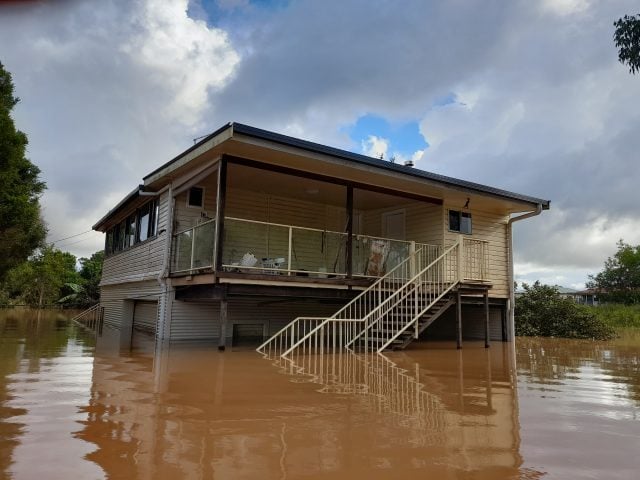
The Lismore City Council has voted against asking the federal government and NSW Northern Rivers Reconstruction Commission [NRRC] for prioritised land buybacks and swaps after devastating floods earlier this year.
Greens Councillor Adam Guise put forward the motion at June’s ordinary council meeting, which turned out to be another past-midnight bureaucratic challenge by the kindest terms.
‘We are at the bottom end of a water cycle,’ Cr Guise said, ‘we can’t engineer our way out of this’.
‘We need to acknowledge our precarious place, living on a floodplain,’ Cr Guise said.
‘I live on the floodplain, many people do, we do business on the floodplain,’ he said.

‘It’s with a sad and heavy heart, as a person who wanted to grow old in Lismore,’ Cr Guise said, raising the issue of buybacks and land swaps, ‘but I recognise climate change’.
‘This is no longer a viable option,’ Cr Guise continued, ‘I want us to advocate to a new government, not like the tired government that abandoned us in our time of need’.
‘We need nation-building money,’ Cr Guise said.
Mayor’s team goes against the flow on post-flood rebuilds
Cr Guise also called on councillors to ask for support ‘investigating engineering solutions such as floating houses, flood resilient design, home relocations, house raising and pre-flood evacuations of people and property’.
But the mayor’s majority team of six, voted in thanks largely to the power of voting one for Mayor Steve Krieg, voted against the motion.

There was surprisingly little debate compared to other contentious items such as a proposed housing estate in Goonellabah and suggested changes to the codes of practice for ordinary meetings.
Yet the vote against buybacks and land-swaps was significant in many terms.
The Tweed Shire Council appeared to be lobbying in the opposite direction, with Mayor Chris Cherry later meeting with new Labor Prime Minister Anthony Albanese to press for more land-swap project funding in her shire.
Ultimately, head of the NRCC, David Witherdin, had the power to revoke land on behalf of the state anyway.

Lismore left languishing after catastrophic floods
Mr WItherdin was in charge of the entire rebuild process from a state government perspective, although the NRCC was to have a board and was to be informed by local governments and communities.
The NRCC powers as outlined by the government earlier this year clearly included the power to compulsorily acquire land and powers to build new projects without local government consent on public land.
Lismore was twice flooded with catastrophic impacts in early 2022, leaving many residents and business owners traumatised and uncertain whether to rebuild.

Debates were still alive on local social media groups as to whether it was best to stay or go, with some suggesting a new town could be built on higher ground in Goonellabah.
Over in Queensland, it seemed the government had moved ahead with land-swap and house-raising schemes along with new flood-proofing projects.
But as one of Australia’s oldest regional cities, Lismore seemed more difficult to relinquish.
The glory of Lismore
The riverside town had a long and complex history since European settlement, and had the urban architectural history to show for it.
Many of the city’s buildings were architectural gems, rare reminders of a barely recognised Australian Art Deco period, not to mention a haven for Queenslanders and other earlier century treasures.

The city’s laneways had taken on a more modern urban grit cool of their own, complete with grand-scale street art worthy of any European tourist hot-spot.
Alongside the empty shops and homelessness, hipster and artisan boutiques were popping up for a brief period of glory in Lismore before the 28 February floods hit.

The careful attention to tasty treats and hand-crafted indulgences fit in beautifully beside the traditional country-style offerings of scones, tea and cakes, sewing supplies, gadget stores, cheap fashion outlets and migrant endeavours in a way only Lismore could pull off, so unpretentious as it was.
The rural town has always attracted and welcomed otherwise misfits – the annual Tropical Fruits festival celebrates a thriving LGBQTI+ community; refugees from various countries around the world have settled there; Nimbin’s alternative culture is a mere 20 mins away; and of course, there are the farmers, factory workers and many artists.
The city has long been a tragic example of potential, with earlier plans suggesting the same consultants who’d led the laneway revival in Melbourne were interested in working on Lismore.
Mayor’s team against land-swaps and buybacks
But with prolonged delays accessing financial support or even guidance from either state or federal authorities, many in Lismore have expressed a distinct sense of abandonment in local social media groups.
Some share daily recounts of personal flood experiences, many written by otherwise ordinary civilians with no prior publishing experience.
All are harrowing testimonies to endurance and hope.
The Lismore City Council voted 6-5 against expressing support for land buybacks and swaps after 2022’s catastrophes.
The mayor’s team of six voted against: Crs Steve Krieg, Peter Colby, Andrew Bing, Andre Gordon, Jeri Hall, and Erika Jensen.
Greens Crs Adam Guise and Vanessa Ekins voted for, along with Labor Cr Darlene Cook, Our Sustainable Future member Elly Bird and Independent Cr Big Rob.
 For four decades The Echo has printed the stories some people loved, some people hated, and some pretended not to read. If you want us to keep telling the truth, the real truth, not the sugar-coated version. We’ll need your support to keep the presses rolling.


