


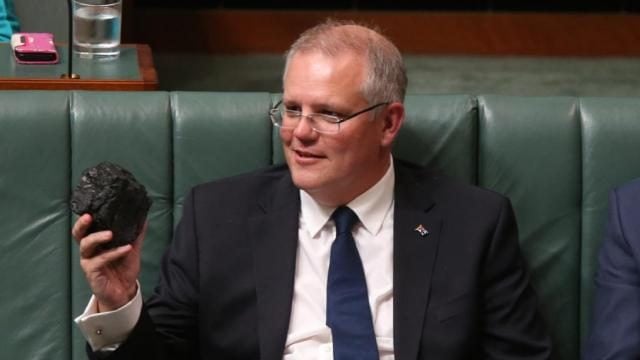
How time flies. On February 9, 2017, the then federal treasurer, Scott Morrison, rose from his parliamentary front-bench seat and delivered one of the more colourful, albeit disturbing, stunts in modern Australian political history.
‘Don’t be afraid, don’t be scared, it won’t hurt you, it’s coal,’ he said, clutching a lump that had been coated with lacquer so not to dirty his $1,500 designer suit.
The defiant performance that mocked the fear of climate change drew guffaws of laughter from his Liberal and National party colleagues, as he accused the then Labor opposition of ‘coal-o-phobia’.
How times change and how times don’t change!
In 2017, global carbon dioxide (CO2) emissions were 405 parts per million (ppm) and today they are about 424ppm and well on the way to 550ppm by mid-century. Anything over 350 ppm is considered a dangerous level for future climate and that compares with pre-industrial levels of 280ppm. At this rate of increase, which is tracking above the worst-case scenarios modelled, the world is on target for at least a three degree increase, and possibly four, of average global warming by late this century and with that – according to the International Panel on Climate Change (IPCC) – will come massive environmental, social, and economic change for the worse.
Heading to dangerous levels
The world has already reached 1.5 degrees above pre-industrial levels and some scientific journals say that figure could be two degrees above in as little as six years from now.
And in Australia since 2017? A coal export boom. Especially so in the key producing states of NSW and Queensland. With production topping out so far at about 335 million tonnes in 2023, with about 40 per cent in NSW and Queensland taking 50 per cent.
But that boom shows no signs of coming to an end anytime, with Environment Minister Tanya Plibersek’s approval this week of extensions to three existing coal mines in NSW making a mockery once more of climate science and the dire warnings of people as diverse as Pope Francis and the head of the UN Antonio Guterres about the need to cut greenhouse gas emissions in order to preserve a stable, inhabitable planet.

Annual coal revenues more than tripled since 2016
Even though the rest of the world has begun to take steps to transition away from a carbon economy, Australia is still riding on the coat-tails of an industry that with the best of help from both major political parties, the Murdoch media and the Minerals Council of Australia, is going absolutely gangbusters in terms of being a machine to print money, with the latest figures showing annual coal revenues up from $38 billion in the year just before Morrison’s stunt to $163 billion in 2023.
So, if you’ll pardon the pun, let’s drill down further into what makes this industry tick and why you, the citizen of this beautiful place (planet and country), are getting metaphorically screwed on several fronts including coal miners not paying any tax, and leaving a legacy not only with a fractured climate and atmosphere but also with a fractured landscape.
If you want to see this close up, I suggest a drive to the Hunter Valley. The mines there can clearly be seen from space. Save yourself the trip and the petrol, and instead check out Google Earth and the enormous open-cut coal mines that appear like sores that have erupted from the living landscape itself.
They’re all there – and they are big – and 17 of them are due to close over the next two decades as the coal is mined out – representing about two thirds of the valley floor in some areas of the Upper Hunter.
Rehab challenge
While there is a feeble attempt to restore the land to its once-productive glory, due to the nature of mining – stripping the topsoil away (overburden is the industry term) and the release of toxic chemicals, such as mercury from the coal itself, that poisons the watercourses that once ran though the area – nothing will ever be the same again.
What can we do in this situation? Expand coal mining yet again – but this time on an even bigger scale – one that dwarfs the existing open-cut coal mines in the Hunter Valley.
Psychology and sanity may seem like terms that have little to do with mining engineering but bear this in mind with the joint venture Hunter Valley Operations – or HVO for short.
The HVO coal-mining project is two open-cut mines about 25km from the town of Singleton and would be the biggest-ever coal project in the history of NSW, with about 400 million tonnes of coal and about 1.2 billion tonnes of emissions over the life of the mine – equal to eight times the annual emissions of all of NSW.
Given the NSW government’s ambition of net zero by 2050, this proposal has some serious implications for global climate.
But it gets worse. The joint owners of the project (Yancoal and Glencore) are serious but legal avoiders of tax in this country – Glencore has been involved in corruption issues in Africa. Not only does the Australian taxpayer miss out on the massive boom-time profits from these two corporate miscreants, they also face the massive bill for mine reparation at the end of these coal mines’ economic life given that their corporate owners can legally walk away from their responsibilities with little consequence.
And what type of coal is to be mined? Thermal coal – that is used for electricity production. A commodity which is going to face an economic squeeze with the worldwide growth of renewable energy.
For Yancoal and Glencore and the other coal miners, it’s a case of grab and plunder what you can and bugger the consequences. While the taxpayers won’t benefit, the (mostly overseas) shareholders will.
Join Rising Tide at the 2024 Peoples Blockade of the world’s Largest Coal Port. Help build an unstoppable mass movement for climate defence. 19th – 28th November. Find out more at http://www.risingtide.org.
 For four decades The Echo has printed the stories some people loved, some people hated, and some pretended not to read. If you want us to keep telling the truth, the real truth, not the sugar-coated version. We’ll need your support to keep the presses rolling.


