


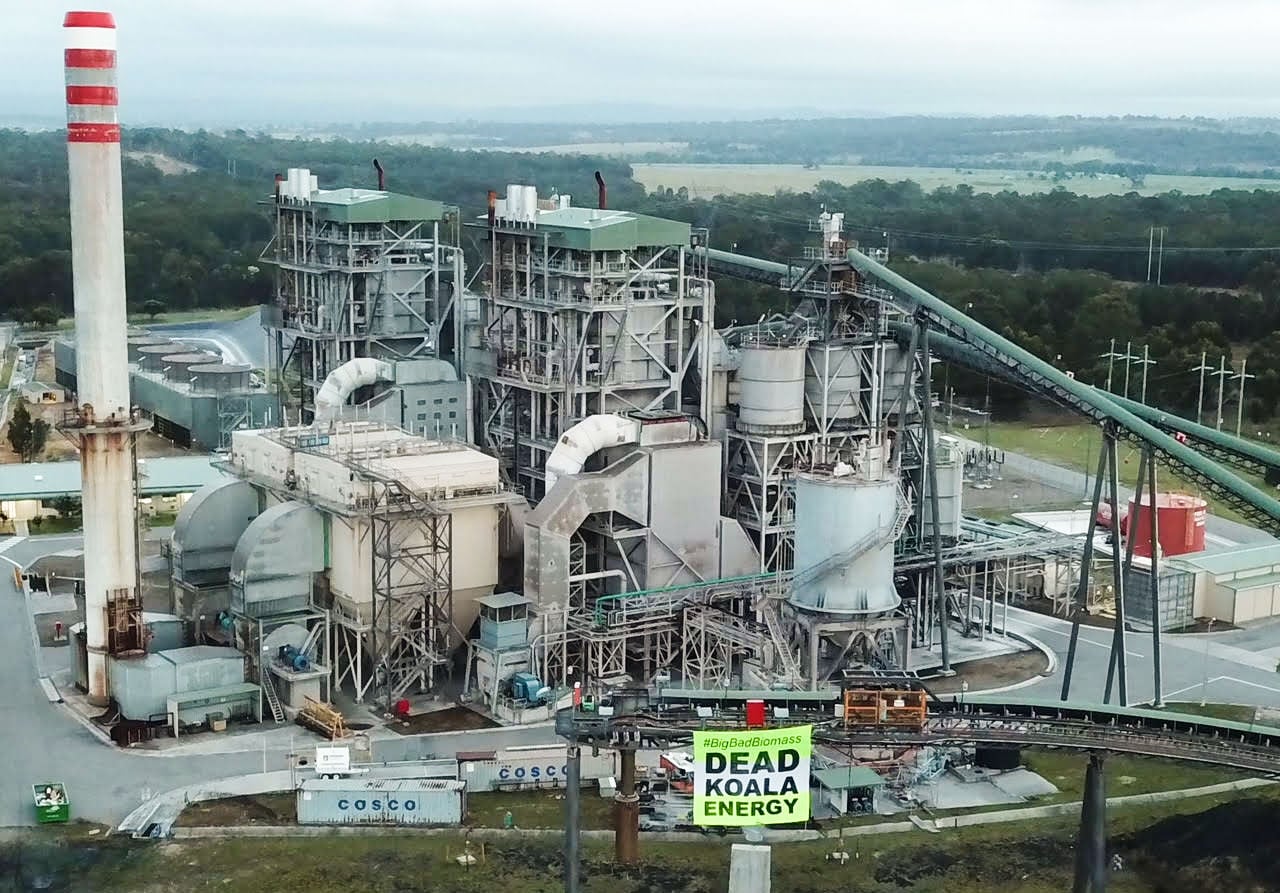
The Independent Planning Commission (IPC) has rejected Verdant Earth Technologies’ biomass power plans at Redbank Power Station on the same day the government released the country’s first National Climate Risk Assessment which highlighted Australians are at risk from more frequent and severe flooding, cyclones, heatwaves, droughts and bushfires.
The government released the landmark report on September 15 modelling three global warming scenarios – 1.5, 2 and 3 degrees Celsius.
The report ‘warned, among other things, that more than 1.5 million Australians are at risk from rising sea levels by 2050,’ according to Crikey.com.
‘The National Climate Risk Assessment also said heatwave deaths in somewhere like Sydney would rise by more than 400 per cent in the 3 degree scenario and double in the 1.5 degree scenario, the ABC reports. And as the BBC points out, Australia has already reached warming of above 1.5 degrees.’
Yesterday also saw the IPC reject the Verdant Earth Technologies’ biomass power plans at t he long-mothballed Redbank Power Station near Singleton to burn 700,000 tonnes of native vegetation each year to produce energy instead of coal tailings as fuel.
Madness
‘Burning forests produces higher CO2 emissions than burning coal, so it is madness to replace coal with wood to generate electricity as it undermines our transition to a low carbon economy,’ said North East Forest Alliance (NEFA) spokesperson Dailan Pugh.
‘It is particularly galling that in this case the proponents claimed that burning 850,000 tonnes of biomass per annum would result in no CO2 emissions at all, when in fact the power-plant would release 1.3 million tonnes of CO2 through its smokestacks each year, thereby significantly increasing atmospheric carbon when we urgently need to be transitioning to non-polluting solar and wind power.
Clearing vegitation not planting it
‘This is compounded by the fact that the biomass was intended to be obtained by clearing native vegetation, which is contrary to the need to restore and increase native vegetation as it is the only means we have of removing carbon from the atmosphere at scale.’
The Commission also received 591 unique submissions, of which 28 (4.7 per cent) supported and 559 (94.6 per cent) objected to the Project.
‘The Commission refused the Application, finding that ‘the Application has not, as it should have, addressed potential adverse impacts of the Project relating to its fuel strategy’ and that it will ‘establish a new commercial incentive to increase land clearing’, the adverse impacts of which ‘have not been assessed by the Application in its current form’,’ stated the IPC in their ruling.
Rejected on environmental grounds
‘It’s a relief that this disastrous and illogical plan to burn woodlands and forests for energy has been firmly extinguished by the IPC,’ said Dr Brad Smith, Nature Conservation Council of New South Wales’s (NCC) Policy and Advocacy Director.
‘The IPC has made the right call in listening to the experts and rejecting this proposal on environmental grounds.
‘After years of fighting against this disturbing proposal, in all its forms, this decision is a win for nature, communities and climate,’ said Dr Smith.
‘Now it’s up to Environment Minister Penny Sharpe to close the loopholes that allowed this proposal in the first place.
‘Verdant Earth wanted to truck thousands of tonnes of native vegetation, for hundreds of kilometers, cleared under sketchy rules that the government is looking to change, and throw it into a furnace. We worked with experts to make sure the IPC knew that there would be 45 native plant species and habitat for threatened animals directly endangered by the proposal – that’s why it has been refused,’ he said.
‘The Commissioners agreed that the project would create a new demand for clearing rural bushland and increase the rates of habitat loss, which are already too high.
‘This project would have released huge amounts of pollution into the atmosphere. The residents of the Singleton area can breathe a little easier knowing this plan has gone up in smoke. We are so pleased that this project, which has been hanging around for years, has been given such a resounding refusal.’
 For four decades The Echo has printed the stories some people loved, some people hated, and some pretended not to read. If you want us to keep telling the truth, the real truth, not the sugar-coated version. We’ll need your support to keep the presses rolling.


