


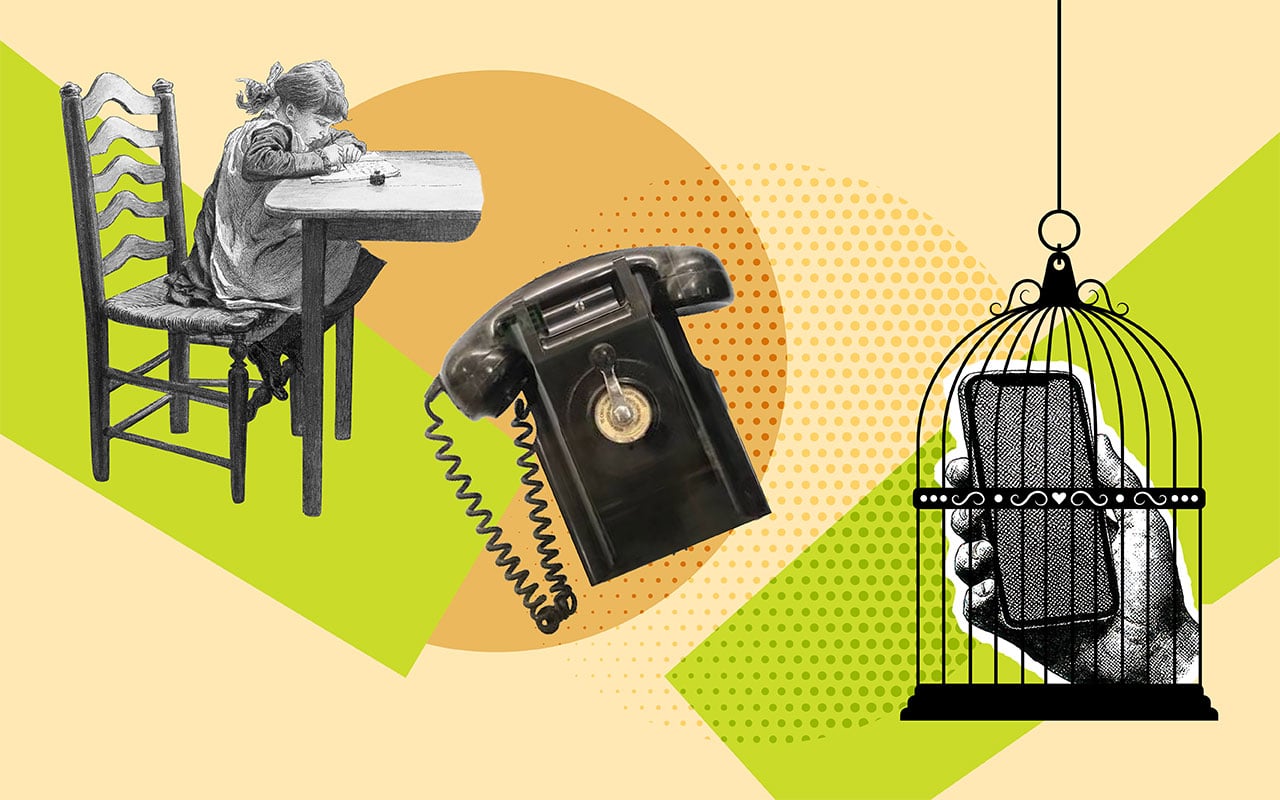
When I was a child we didn’t have a phone. We couldn’t afford it. If we needed to make a call we went next door to the Clancys’ house and sat at their kitchen bench, lifted the receiver, turned the Bakelite handle three times, and waited for the operator. My school friend’s mum, Maureen worked the switchboard at the local post office and she’d ask for the connecting number. I’d say ‘324’ and she’d put me through to my Grandmother, or one of the three people I knew who had a phone. Sometimes you could just say their name because Maureen knew everyone in the district.
A phone was an emergency system. You didn’t ring to chat. It was to deliver a message. Someone was sick. Someone was requesting assistance. Someone was dead. Our lack of a phone was further proof that we were poor. But Mum was a widow, and a phone was an indulgence. Contact with the outside world came by actually going outside – to the shops, to the pub, to church. If you wanted to stay in touch with friends and relatives elsewhere you wrote letters. And they turned up daily in the metal box on my fence. I loved letter writing. Ever since I was a little girl I wrote letters. I sent my other Grandmother, the one that lived 90 minutes away, long letters about my week. I shared stories of my pony rides in the bush, a hidden creek I’d found, a drawing I’d done at school, and included a dried flower I’d grown and pressed in a book. I didn’t send photos because we didn’t have a camera either. And when we did have one, Mum would only ever have a roll of 24 which would last 12 months. The decision to take a photo was made at special occasions, where we would stand in a group after a family lunch and squint into the sun. Most of the memories of my early life are just that – memories. I don’t have photographic records.
If I wanted to know something about the world, I would go next door to the Clancys’ again and borrow their relevant Encyclopedia Britannica. All the knowledge we needed was contained in this set of books that was sold by door-to-door salesmen to parents eager to support their kid’s education. Animals, biology, ancient and modern history could be looked up alphabetically, the correct book chosen – E for Egypt, and the entire ancient civilisation would be divulged with two pictures and about 300 words. That was my access to knowledge.
Every night we ate dinner and watched the ABC news on a small black and white television. That was how we were informed about politics and world affairs. I didn’t understand it, but it felt important so I watched quietly, waiting for the story of hope that came at the end about a dog who ran away and came back.
To listen to music I chose from one of about 20 albums and opened the lid on the stereogram, set the dial to 33 and placed a shiny, black vinyl disc on the turntable. Shirley Bassey, Glen Campbell, Johnny Matthis, Chad Morgan. It wasn’t an impressive collection. The radio, which we listened to every morning was 4SB. A country radio station that did hospital calls. ‘This one’s for Mavis, she’s just had a hysterectomy’, and then they’d play a Slim Dusty song. I didn’t scroll on YouTube. I closed my eyes, and I used my imagination.
I’m 58 and it seems incomprehensible how much has changed since I was eight. Now we all have a phone, and it’s not a phone, it’s a device. It’s technically a supercomputer that gives us access to all the information to nearly everything that has ever happened. It streams news. It plays music – not 20 crappy albums – virtually everything ever recorded. It stores thousands of photos and videos that I take every day of things as meaningless as where I parked my car. It holds my banking, my credit cards, my digital ID, it hosts platforms to connect me with friends but also strangers. It gathers my data and sends me advertisements of sensible leather boots ,that I buy while I’m lying in bed. It shows me reels of luxurious holidays, exposes me to the outrage of those who farm hate. If I wanted to I could use this device to surveil my kids. Although we are all surveilled through the massive legal infrastructure of commercial data tracking, cellular network logs and targeted software. My device has maps to help me when I’m lost. Yet we are so lost. We have so much information, yet we are so misinformed. We have so much connection, yet we are so lonely. We use the phone to keep us safe, yet it puts us at risk. We no longer get bored. Instead we are anxious, overwhelmed and sad.
The device meant to save us, has enslaved us.
I think back with irony to the moment when things changed, my short legs swinging on the stool in the Clancys’ kitchen, telling my Grandmother the good news. ‘We’re getting a phone!’
Mandy Nolan’s column has appeared in The Echo for almost 25 years. She is a writer, comedian and artist, is the preselected Greens candidate for Ballina and was the Greens candidate at the past two federal elections.
 For four decades The Echo has printed the stories some people loved, some people hated, and some pretended not to read. If you want us to keep telling the truth, the real truth, not the sugar-coated version. We’ll need your support to keep the presses rolling.


