


Dame Dr Jane Goodall, environmentalist, specialist in apes and their behaviour, particularly Chimpanzees, and peace envoy to the world died last night.
As the Jane Goodall Institute Australia noted on its website today, Jane was ‘a remarkable example of courage and conviction, working tirelessly throughout her life to raise awareness about threats to wildlife, promote conservation, and inspire a more harmonious, sustainable relationship between people, animals and the natural world. She passed away in her sleep’.
Jane showed more than 70 years ago that humans are not the only tool-making animals based on her observations of chimpanzees ‘fishing’ for termites with a stick or piece of grass in the wild. And she demonstrated many parallels between Chimps and their behaviour, and our own.
Dr Richard Gates, from the Evans Head Living Museum, said today:

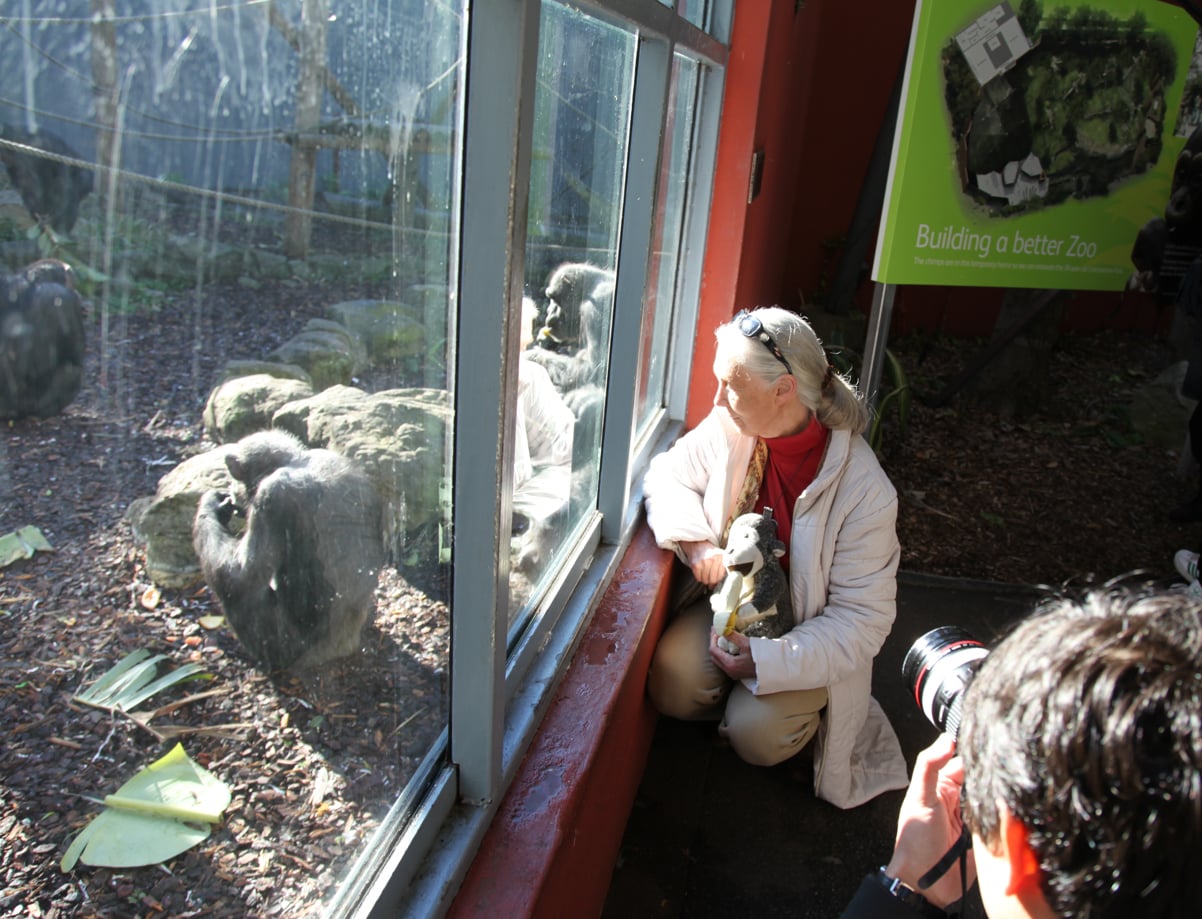
‘I met and interviewed Jane at Taronga Zoo in Sydney on World Environment Day in June 2011. She was visiting the Zoo to announce a continuing partnership with Taronga and its work with her Institute, not only in Rwanda, but of a new project in the Democratic Republic of Congo.
‘I was there on behalf of the Gaia Committee, a Sydney-based committee of women raising funds for the victims of the Fukushima nuclear power plant disaster in June 2011, to record Jane’s visit and her support for their project. At that time the French film GAIA had been released and there were special showings around Sydney theatres as part of the fund-raising effort.
‘I was also there because of my own research interests in mammalian brains, including apes, and the relationship between brain and behaviour and what we might learn about humans given our close genetic connection to them. We are, after all, specialised hominid apes not all that far removed in evolutionary time from a common ancestry.
‘I spoke with her about my experience of the ape collection of a particular Australian zoo which had had many complaints about the “bad behaviour” of its inmates, new to their collection, which concerned them. There had been letters to the press about excrement throwing and sexual activity as examples of the “bad behaviour”.

‘After many hours of observation I found that the only time they seemed to engage in the “disturbing” behaviour was when groups of school kids visited the zoo and cheered them on much, it would seem, to the delight of the apes. The “cheering” on was reinforcing the behaviour of what seemed to be a bored group of animals. No reinforcement, no ‘disturbing’ behaviour.
‘But what was also interesting and disconcerting was that the older members had also had had psychosurgery (lobotomies) in the 1950’s, not to tame their behaviour, but to give budding neurosurgeons experience before exercising their psychosurgery skills on humans, a common practice at the time in psychiatry. These apes were not likely to act out as they had had psychosurgery and were not interested in doing much of anything. The outcome of all this was that the zoo, to its credit, changed the settings for the primates and created a much more complex environment to deal with the boredom problem. And the psychosurgery practice had stopped many years before.
‘I raised this history with Jane and she indicated that the practice had happened elsewhere.
‘I also raised with Jane the issue of environmental destruction and she was quite emphatic that if we continued in the “downward spiral” of “selfishness” we were headed for “catastrophe”. But she added that we should not give up hope and must continue to speak up and educate people about what was happening with the world. At the time of her death she was on yet another speaking tour.
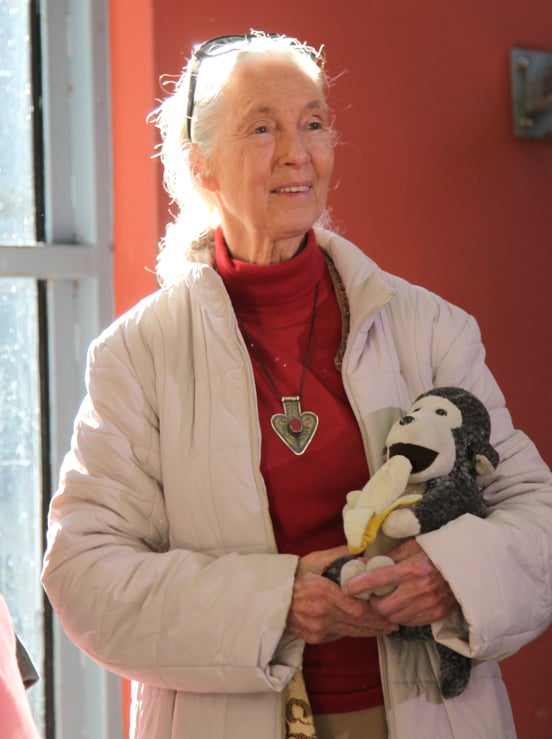
On the day of the 2011 interview Jane sat outside the enclosure for the Chimpanzee collection with her cloth Chimp she carried with her. And we were all engaged by the loud noises and displays of a very active group of our close relatives who seemed to recognise Jane from previous visits and clear affection for them.
Jane’s presence in the world will be sorely missed but she has left a memorable legacy over several generations which cannot be ignored. And that legacy has a firm foundation in science. RIP.

 For four decades The Echo has printed the stories some people loved, some people hated, and some pretended not to read. If you want us to keep telling the truth, the real truth, not the sugar-coated version. We’ll need your support to keep the presses rolling.


