


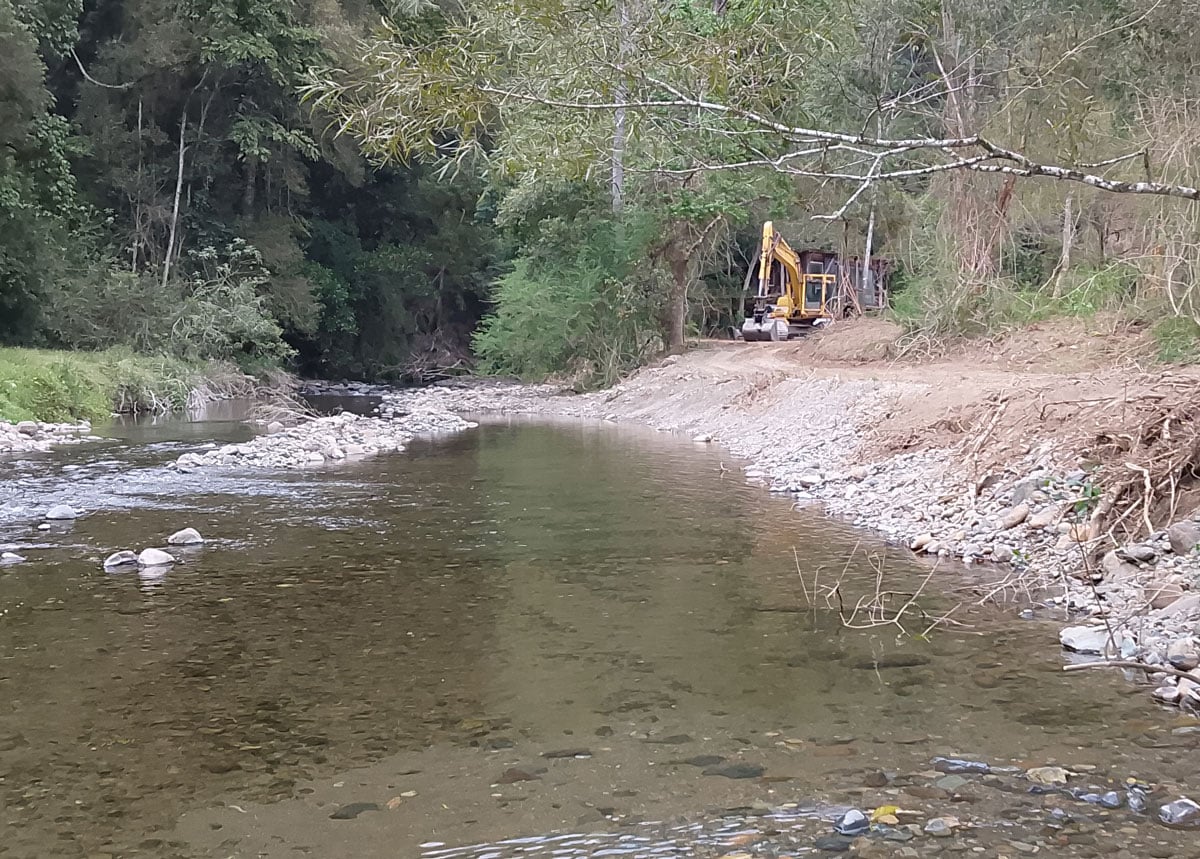
The alleged unlawful destruction of waterway near Bellingen – a significant tributary of the Bellinger River – is under investigation by regulators, with claims by residents it has impacted the drinking water supply for all municipal water users from Bellingen to Urunga.
Such breaches of environmental laws carry heavy penalties. Water pollution offences under the protection of the Environment Operations Act 1997 (NSW) can attract on-the-spot fines up to $30,000.
Ecologist, Mark Graham, told The Echo he lives on the Bishops Creek multiple occupancy (MO) in Upper Bellinger Valley, and says his MO neighbours have undertaken the unauthorised works, which involved a 20 tonne excavator, bobcat and tractor over two and half months.

He says the creek has been scraped and diverted to form a dam.
‘I used to drink from this important water catchment’, he told The Echo. ‘Now it’s undrinkable’.
C3 Environmental Zone
‘They have cleared a Lowland Rainforest Endangered Ecological Community and Threatened Species habitats within C3 Environmental Zone’.
‘There are a litany of alleged environmental offences’, he said.
‘Bishops Creek (Lot 50 DP 811685) is the largest private property at the top of the Bellinger Valley’.
‘The property provides the only lowland vegetated linkages between the New England National Park Gondwana Rainforests of Australia World Heritage Area and Bellinger River National Park, a reserve identified as the top candidate for future inclusion within the Gondwana Rainforests of Australia World Heritage property.

‘For several months now, heavy machinery vegetation clearing, creek and landform modification works have been underway at Bishops Creek.
‘The entire property is zoned C3 Environmental Zoning under the Bellingen Local Environment Plan (LEP).
‘Bishops Creek is a major tributary of the Bellinger River and the drinking water supply for all municipal water users from Bellingen to Urunga. Most works are prohibited in this zone and all works require the consent of Council to be lawful. All works in the riparian (creek) zone are controlled activities and require NSW Government approvals. The Natural Resource Access Regulator (NRAR) is the regulatory authority for unlawful riparian works.
‘These works have: cleared and destroyed hundreds of metres of creek bank vegetation, including substantial areas of Lowland Rainforest Endangered Ecological Community; substantially excavated within the creek bed (a fifth order protected stream), and constructed embankments and dams, constructed new stream channels and diverted stream flows; destroyed and degraded the habitats of multiple threatened species including the Critically Endangered Bellinger River Snapping Turtle and the Endangered Giant Barred Frog; badly polluted the drinking water supply for Bellingen and Urunga’.
Weed management program?

He also made the remarkable claim that the works were proposed by fellow MO owner and ecologist Peter Knock, who works for the Nature Conservation Council of NSW. Graham also says the works were commissioned by the ‘Bishops Creek Committee’ of Bishops Creek Pty Ltd.
The Echo contacted Nature Conservation Council of NSW to verify the claims, and a spokesperson replied that they understood the works were part of a weed management program.
They added that Graham was possibly ‘Pursuing a personal vendetta’ with the claims, yet were unable to provide any details of the weed program.
Nature Conservation Council of NSW Chief Executive Officer, Jacqui Mumford, later told The Echo, ‘As this is an ongoing investigation by NRAR we can’t provide comment on this specific matter.’
Graham told The Echo there were no permits, yet believes it was under a ‘flood recovery controlled activity’ approval. He said all correspondence and evidence has been sent to the Natural Resources Access Regulator (NRAR).
In a statement provided by the landowners to The Echo, they said, ‘The Bishops Creek Community has a long-standing relationship with managing weeds on the property for at least 15 years of direct programs and for 39 years as a major component of the deed of agreement for the Multiple Occupancy (MO) approval to manage suppress and improve the property over time’.
‘The community have worked with Bellingen Shire Council Invasive Plants Inspector closely in recent years targeting specific high profile environmental weeds (including some of the specific examples below).
- Coral tree (Erythrina sp) community funded
- Historic plantings of clumping Bamboo (community funded)
- Long-leaved willow primrose (Ludwigia longifolia) community removal with council support
- Madeira vine (Anredera cordifolia) Local Land Services funding to employ certified contractors
- Kudzo inspections by council (zero found)
- Seeded Banana (Musa sp) recently detected that council has offered direct injection equipment to help eradicate
- Large Leaved privet (Ligustrum lucidum) external funding
- Small-leaved Privet (Ligustrum sinense) ongoing management and suppression
‘As part of this work, Bush Regeneration contractors recommended and supported by council to have a property wide weed management plan. This was instigated and championed by one of the shareholders who is a regional Landcare coordinator. This was presented to the September AGM. It is still in draft format with just some minor inclusions to be added specifically around the intent to manage the property and some property history to understand the weed ingress and required management overtime.
‘The work to remove small-leaved privet at one end of the valley was all outside the water-front land buffer guideline under the Water Management Act 2000.
‘Bishops Creek is a sensitive and dynamic zone. There have been major flood amage blowouts in the two major floods in 2022, and the major flood in 2025.
‘But all our actions have been in the vein of protecting the creek banks where possible, to maintain access for shareholders’, the statement reads.
A resident from the MO, Peter Knock, later told The Echo, ‘The community is fully co-operating with NRAR at this early stage of the investigation. They have however advised us that it is inappropriate for any comment on the process and to allow it to run the course. So we will be adhering to thier advice on this matter’.
Investigations
NRAR has confirmed they are investigating.
A NRAR spokesperson told The Echo, ‘The NSW Natural Resources Access Regulator (NRAR) confirms that an investigation into alleged breaches of the Water Management Act around Bishop’s Creek is ongoing. We cannot comment further on an active investigation or give any timeframe for its conclusion’.
According to www.nrar.nsw.gov.au, they are an independent law enforcement agency that ‘ensure that water laws are enforced’.
When asked about the alleged clearing and damming, a Bellingen Shire Council spokesperson told The Echo they received a community complaint regarding creek modification works undertaken on Darkwood Road, Thora.
‘Staff attended the site to investigate and document the matter and promptly notified the relevant state authorities, including the Natural Resources Access Regulator (NRAR – formerly the NSW Environment Line). Given the impacts identified in relation to Biodiversity Values Mapping under the Biodiversity Conservation Act, Council also referred the matter to the NSW Environment Protection Authority (EPA)’.
• The original story had quoted Nature Conservation Council of NSW Chief Executive Officer, Jacqui Mumford, as providing the statement which was, in fact, from the landowners.
 For four decades The Echo has printed the stories some people loved, some people hated, and some pretended not to read. If you want us to keep telling the truth, the real truth, not the sugar-coated version. We’ll need your support to keep the presses rolling.


