

26.1 C
Byron Shire
October 27, 2026

Innovative flat-pack design bridge installed in Tweed Shire

Latest News

Where’s the funding for critical community help?

Neighbourhood and community centres are struggling to keep their doors open and are cutting services because they don’t have ongoing core funding to cover staffing and operating costs.

Other News

Thylacines to haunt Lismore’s Quad after dark

Most visitors to Lismore’s Quad after dark are looking for dinner or a way home. From October 31, they may also find a thylacine.

Preschools urged to join Lismore rally over funding concerns

Northern Rivers preschool staff and families are being urged to rally outside Lismore MP Janelle Saffin’s office amid concerns that new state funding rules could threaten community preschool services.

Cadwallader calls for government airport funding

Mayor of Ballina Sharon Cadwallader has called for a fairer airport funding partnership for the Northern Rivers, contrasting the Commonwealth’s reported $5.6 billion investment in Western Sydney Airport with Ballina Shire Council funding almost three-quarters of its airport’s recent runway upgrade.

Man dies following single-vehicle crash – Chinderah

A man has died following a single-vehicle crash near Chinderah today.

Coffee with a cop coming to Goonellbah

Lismore locals are invited to pull up a chair, enjoy a conversation, and connect with local police officers at Goonellabah Shopping centre next Tuesday morning, 3 November 2026.

Can you help buy a bus for the local youth?

Byron Youth Service is calling on the community to support their campaign to buy a bus that is desperately needed so young people can access much-needed services.

Photo supplied

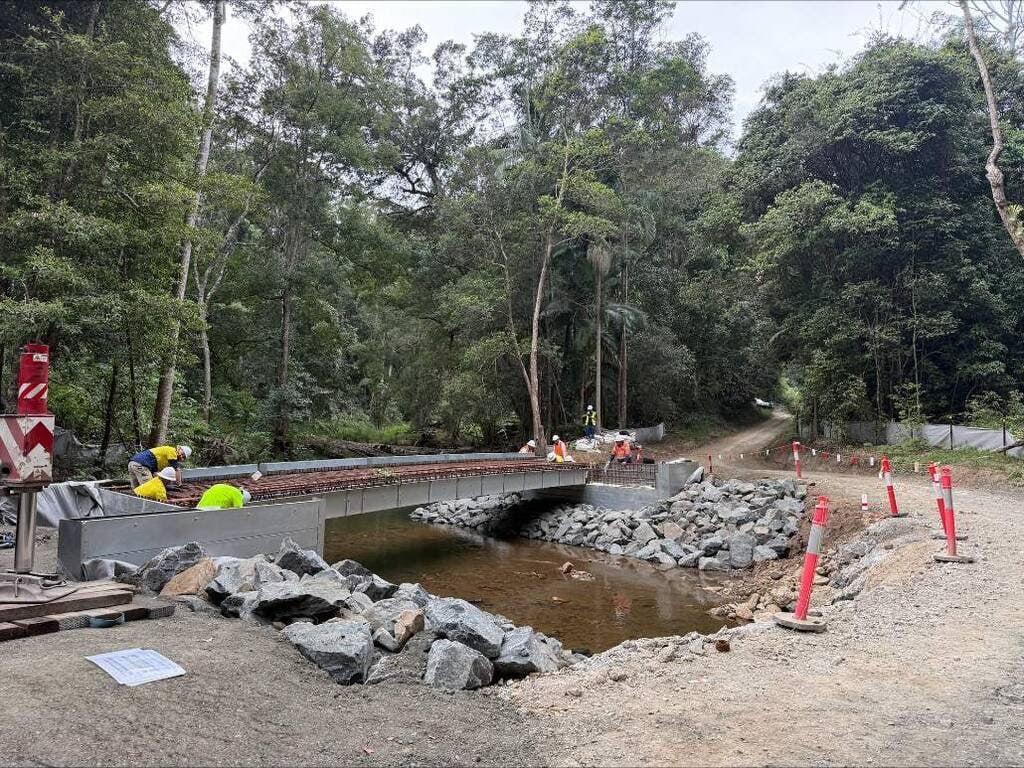
An innovative bridge is being installed at Rowlands Creek, in the Tweed Shire hinterland.

Tweed Shire Council said in a media release that it is the longest of its type for the Tweed Shire – ‘a flat-pack design that cuts construction time in half and keeps jobs local’. 

‘Helping to protect threatened species near a National Park boundary, the bridge is engineered to withstand the kind of floodwaters that destroyed the previous culvert crossing. 

‘The 13.7 metre bridge arrives on-site ready to assemble. The abutments go in first, anchored deep into the bedrock on each bank. Once they’re secure, the steel spans are lifted into place by crane. After that, the concrete truck rolls in to pour the deck and the structure is completed. Work started in February and completion is due in June, weather permitting. 
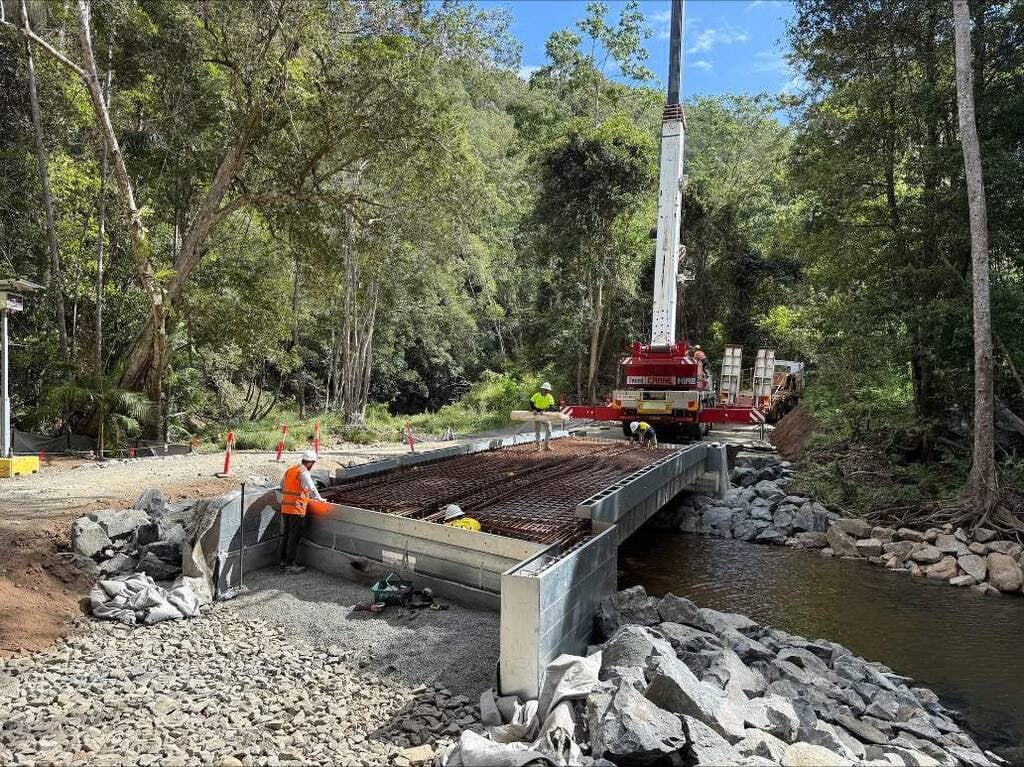
Photo supplied

‘At a remote site like Rowlands Creek, constructing a bridge would normally take several months. Using a prefabricated flat‑pack design has cut the overall construction time in half, with the bridge span itself completed in just two weeks.

‘Precision fabrication takes place in a controlled yard rather than on a remote creek bank, meaning the structure arrives on site ready to install, without sacrificing quality. The remaining construction time is focused on essential site works such as foundations, bank protection and approach works needed to support the bridge and prepare it for future floods. 

‘Mullumbimby-based Ireland Civil is doing the installation as part of a $2.1 million contract, covering three bridge replacements across the Shire. Because the complex fabrication is handled off-site by Inquik Bridging Systems, local crews can take on the build without specialist equipment. The knowledge stays in the prefab yard. The construction jobs stay in the Tweed. 
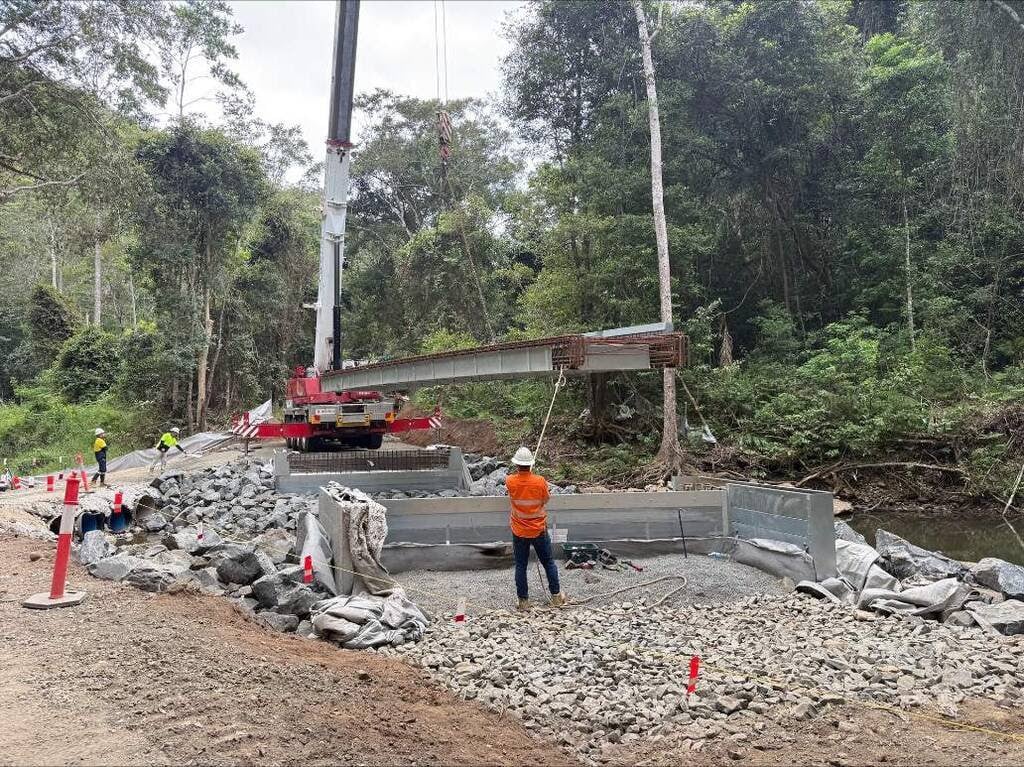
Photo supplied

‘Roads and bridges, people drive past them every day and don’t give them a second thought,’ said Kurt Heidecker, Tweed Shire Council’s Project Director of Flood Restoration.  

‘But when you get into the detail of how they work, every one of these projects has something in it. This one has prefabrication that changes what’s possible in remote locations, is engineered to withstand floods that can strip a landscape bare, while not affecting native species. There’s more going on here than most people realise,’ he said. 

Tweed Council say, ‘The Rowlands Creek site borders a national park, adding an extra layer of environmental responsibility to the project. The bridge has been designed and built to protect the Giant Barred Frog and the Southern Purple Spotted Gudgeon fish, vulnerable and threatened species found at this crossing.  

‘The previous flow through culvert pipes created a narrow, fast channel that small fish and amphibians couldn’t swim against. This new open bridge span preserves natural water flow, allowing species to move freely through the waterway. 

‘The bridge is replacing a structure that didn’t survive the floods, and the site tells the story. Cleanup workers arriving on site after the 2022 flood described a landscape stripped of all vegetation by floodwaters that were unbelievably deep, fast and high velocity. 

‘This new bridge is designed for that. The abutments are drilled into rock. Massive boulders line the banks for scour protection. And when floodwater rises, the bridge goes under with it —protected by galvanised steel formwork that absorbs and spreads the impact when debris strikes, rather than damaging the concrete bridge abutments. 

‘It’s a really neat solution,’ Mr Heidecker said.  

‘The fish can travel as they need to. The structure is built to handle what this creek throws at it. And we’ve got a local company doing the work.’ 

More information – tweed.nsw.gov.au/flood-restoration-works



For four decades The Echo has printed the stories some people loved, some people hated, and some pretended not to read. If you want us to keep telling the truth, the real truth, not the sugar-coated version. We’ll need your support to keep the presses rolling.


If you are a local business owner help us and in turn we help you. All The Echo asks for is advertising, not a free ride. It is every advert in The Echo and on www.echo.net.au, which creates the space for all the stories and coverage of community events, happenings and concerns.

If you are a reader you can become a sponsor of The Echo. Your support keeps the us independent.

Even a small one-off or regular donation from you will help keep the echo’s independent voice alive and strong.

Support Us

Become one of the supporters who helps keep independent, local journalism alive in the Byron Shire by contributing anything from as little as the cost of a coffee each month.

You're Wonderful, Thank you for supporting independent journalism in the Byron Shire

You’re supporting The Echo, thank you

Your contribution is keeping independent, local journalism alive in the Northern Rivers.

Because of supporters like you, we can keep every story free for everyone — no paywall, no exceptions. Your money goes directly to funding our newsroom of 40-odd local workers covering the stories that matter to this community.

Tell us what you think, give us your opinion

The Echo loves your letters and comments and is proud to provide a community forum on the issues that matter most to our readers and the people of the NSW north coast. So don’t be a passive reader, email us your epistles at editor@echo.net.au.

The letters deadline for The Echo is noon Friday. Letters longer than 200 words may be cut. The publication of letters is at the discretion of the letters editor. Please remember to include your full name, address and telephone number.

Online comments are no longer available.

A year in review

Byron Shire Council has published its Annual Report for 2025 to 2026, highlighting a year of what it describes as significant achievements in delivering infrastructure flood recovery works, environmental protection, and community programs.

Celebration of culture and Country

Almost 100 First Nations artists, musicians, performers, makers and cultural practitioners will come together on the banks of the Clarence River this November for Art on Bundjalung; a free celebration of creativity, culture and Country.

Ballina students dive into water science

Local Ballina Shire primary school students rolled up their sleeves and put water science into action as part of Rous County Council’s inaugural Young Water Leaders event.

Grim numbers from horse racing industry

The annual DeathWatch Report by the Coalition for the Protection of Racehorses (CPR) reveals that the home state of the upcoming Melbourne Cup, Victoria, was responsible for 30 percent of the at least 160 racehorses who were killed from racing across the country in the 2025/26 Australian racing season.