


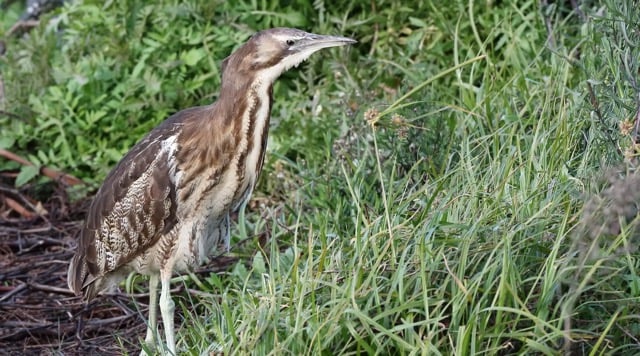
For those with patience, who are happy to spend long hours around freshwater wetland habitats, a reward in the form of a bittern sighting might be forthcoming.
If not an actual sighting – as these birds blend seamlessly into their surroundings – then perhaps its call.
Bitterns, along with herons and egrets, are members of the Ardeidae family, ardea being the Latin word for heron.
All are waders, who dedicate their lives to hunting for food in wetlands.
They are united in form by their mostly long, flexible, serpentine necks; slender bodies; long, stilt-like legs and elongated, sharp, straight bills.
They are potentially lethal bills, if you are their prey.
Of the three Ardeidae family members, bitterns are the most elusive, being beautifully camouflaged and highly secretive.
They are known to be nomadic, having to move from one habitat to another in response to water volume fluctuations, which may be caused by drought, flood, or human activity.
Worldwide, there are 12 bittern species and of those, four are found in Australia, with three living here in the Northern Rivers.
Three local species
Ranging in size from smallest to largest, those three are: the endangered Australian little bittern (Ixobrychus dubius) – 30cm long and 85g in weight; the vulnerable black bittern (Botaurus flavicollis) – 54-66cm in length and 400g in weight; and the endangered Australasian bittern (Botaurus poiciloptilus), with a length of 66-76cm and weighing up to 1.4kg.
With their distinctive plumage and calls, our three bittern species, once seen or heard, are relatively easy for the keen observer to identify.
They nest in dense, undisturbed wetland vegetation, such as sedges, thick reeds, rushes or riparian thickets.
Nests are fashioned deep within these plants, whose structure affords security from predators, stable temperatures for eggs and chicks, and dependable, readily accessible food.
Little and black bitterns may also nest in trees. Their reliance on secluded, vegetated pockets directly links the health of bittern populations with the existence of intact wetland habitat.
Bitterns guard their secrets closely. It’s not just their ability to blend with reeds and sedges – they can remain undetected by freezing on the spot in an elongated stance, bill pointing heavenwards.
Or they can flatten themselves on the ground, remaining motionless for as long as is necessary.
Field ornithology
In 2012, in volume 29 of Australian Field Ornithology, ecologist Peter Menkhorst published a paper titled ‘The food and foraging rate of an Australasian bittern’.
The paper was based on nine-and-a-half hours of observation, spread over four separate visits to the same site, where a particularly cooperative adult bird permitted him to observe its behaviour.
Menkhorst’s bittern had chosen a 1.3km stretch of bank bordering a water channel at a treatment plant south of Melbourne along which to forage.
In his vehicle on the opposite bank, Menkhorst followed the bird, observing it through binoculars and taking photos as it went about its daily business: resting, preening, travelling, hunting, feeding and, occasionally, showing signs of disturbance.
During that time, the bittern caught and ate 17 growling grass frogs and one common galaxias – a native fish. He described the bittern as walking ‘slowly and purposefully’, its body almost horizontal to the ground, noting that ‘its long toes and slow, high-stepping gait facilitated this movement.’
Methodical and purposeful
He further described the bird’s hunting behaviour as being ‘methodical and purposeful, seemingly with intense concentration, and continued until a capture was made.’
At up to 75mm long and 35g in weight, adult growling grass frogs put up a jolly good struggle to avoid capture, ‘kicking with their hind legs and gripping with their digits’, all the while emitting a ‘high-pitched squeal’.
Each time the bittern caught a frog, it carried the prey in its bill from the thickly vegetated bank to be ‘dunked several times in the water’ – presumably to wash away the film of mucous covering its skin.
Menkhorst describes the bittern subduing the frog ‘by mandibulation before being positioned for swallowing head first’.
In our neck of the woods, the places most likely to appeal to a bittern, and where bitterns have previously been observed include: the Marshalls Creek floodplain, Byron and Tyagarah wetlands, Rocky Creek Dam and upper catchment wetlands, and the Clarence floodplain wetlands. Black bittern nests have been observed in trees bordering Wilsons Creek.
Byron Bird Buddies participates in the annual Australasian Bittern Survey conducted by Birdlife Australia. If you would like to take part in the survey, or if you have wetlands on your property and want to be involved, please contact us at: [email protected].
 For four decades The Echo has printed the stories some people loved, some people hated, and some pretended not to read. If you want us to keep telling the truth, the real truth, not the sugar-coated version. We’ll need your support to keep the presses rolling.


