


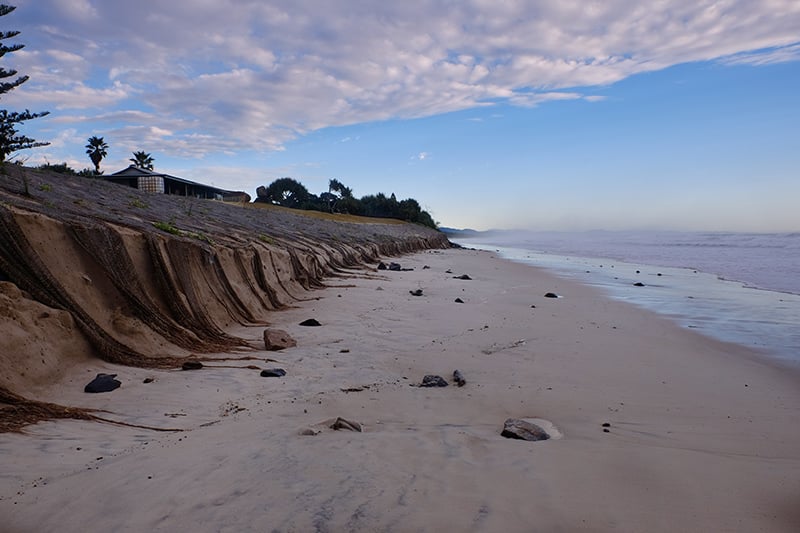
Sunlight sparkles on the sea, where lazy swells gather momentum to form perfect waves before playing out onto the deserted shore.
Two vehicles pull up at the top of the dunes, their occupants and three dogs leaping out in excitement.
In their rush to reach the water, the sign at the beach entrance goes unread: ‘Birds nesting on this beach are very vulnerable and easily disturbed. Please keep away from the nesting birds. Please keep dogs under close control.’
The dogs follow their humans for a splash in the sea before their noses lead them to a breeding colony of Little Terns.
Some birds sit on eggs or newly hatched chicks in small scrapes in the soft sand above the high tide line.
Others hasten after older chicks, who have recently learned to walk and run.
As the dogs approach, the terns’ piercing alarm calls go unheeded. In minutes, this year’s potential breeding success has bombed. Refreshed and oblivious to the carnage, the bathers emerge from the sea, whistle for their dogs and stroll back to their cars.
22 tern species
Of Australia’s 22 tern species, three are seen regularly on our coastline.
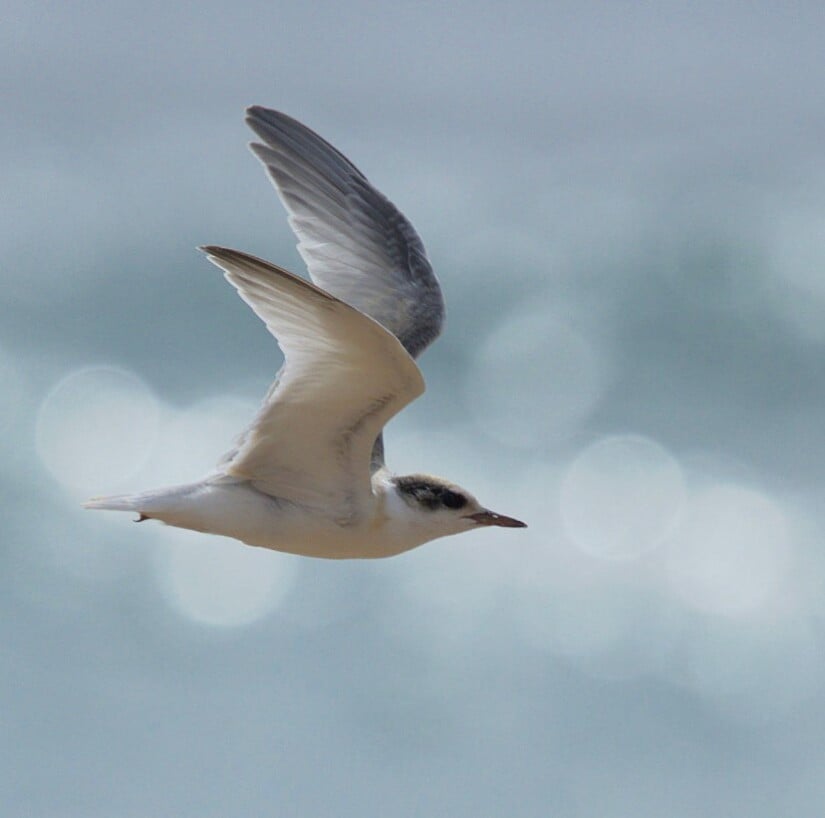
The Greater Crested Tern (Thalassius bergii) is our most common and only resident species, nesting on offshore islands including Nguthungulli (Julian Rocks) and the Three Sisters.
The migratory Common Tern (Sterna hirundo) and migratory Little Tern (Sternula albifrons) visit between October and April.
Little Terns once bred in the Belongil estuary and while they still breed in many places along the coast, large, stable colonies have become rare. Other species occasionally seen on the Byron coast include Caspian Terns (Hydroprogne caspia) – the world’s largest tern – Whiskered Terns (Chlidnonias hybrida), perhaps arriving from inland wetlands, and Australian Gullbilled Terns (Gelochelidon macrotarsa) who may show up after breeding on inland swamps and floodplains.
Sometimes marine species such as Sooty Terns (Onychoprion fuscatus) and Black Noddies (Anous minutus) are blown in from the Coral Sea, enriching the diversity of seabirds on our beaches.
There’s also the rare Arctic Tern (Sterna paradisaea), which can be seen en route from its Arctic breeding grounds to Antarctica – an astonishing round trip of 70,000–80,000 kilometres.
Endangered
For Byron Bird Buddies, the endangered Little Tern holds a special place.
It features in our logo and is part of our origin story.
Efforts to protect the Belongil Estuary as a shorebird and tern feeding and breeding area began in the 1970s, including monitoring and tagging birds. In 2003, with support from Byron Council and the Department of Environment and Conservation, Belongil Bird Buddies was created to formalise these protection efforts.
By the time a secure fence had been erected around a suitable nesting site, the Little Terns had already moved on. In 2007, the group became Byron Bird Buddies, the focus expanding to monitoring, conservation and community education for all Byron Shire bird species.
Little Terns migrate from China, Japan and Southeast Asia to forage and roost along our coastline, linking our beaches with faraway places.
In Australia, two regional groups occur: the Tasman Little Tern, which breeds along the east coast, and the IndoPacific Little Tern, which breeds in northern Australia and WA. Because Little Terns also breed in Japan, our summer flocks can include birds from multiple regions, displaying a mix of breeding and nonbreeding plumages.
Breeding season
When wooing a prospective partner, males offer a fish in a courtshipfeeding display as proof of their ability to provide for a family.
Eggs are laid in small depressions in the sand, called scrapes, sometimes decorated with beach wrack such as seaweed, shells or pebbles. As eggs and chicks blend into the sand, they become virtually invisible. Adults forage in shallow waters, generally no more than 50 metres from their breeding or roosting site.
While Little Terns roost on our beaches and feed offshore, their numbers continue to shrink. As with many shorenesting birds, their survival depends on human behaviour.
Offleash dogs are one of the biggest threats, along with predation by cats, rats and foxes. Litter, climate change and development pressures further erode habitat.
Thankfully, all is not lost. Elisabeth Island, Lake Macquarie, has become one of Australia’s largest Little Tern nesting sites.
Its success – driven by strong council and volunteer participation, restricted access during breeding season, targeted predator management and community education – shows what’s possible.
With similar commitment, the fate of Little Terns and other shorenesters in our shire could be reversed.
Terns cross oceans to reach our beaches.
The least we can do is give them the space they need to survive. Keeping dogs leashed, respecting signs and keeping a distance from nesting birds are simple actions that make a profound difference.
 For four decades The Echo has printed the stories some people loved, some people hated, and some pretended not to read. If you want us to keep telling the truth, the real truth, not the sugar-coated version. We’ll need your support to keep the presses rolling.


