


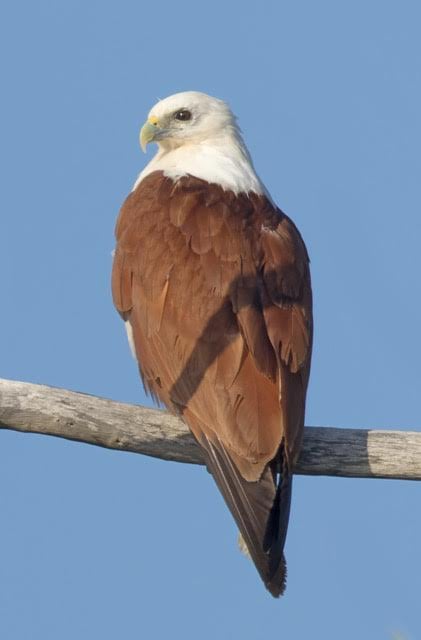
Photo Bruce McNaughton
We are trudging along the beach, heading back to the carpark after a delightful morning of birdwatching at the fringe of a mangrove swamp when the aerial drama unfolds.
What had started as a small speck in the clear blue sky slowly morphs into the magnificent form of an osprey, clasping a fish with its strong, sharp talons.
The osprey is purposefully heading for a safe place to devour its hard-earned meal when – seemingly from nowhere – a brahminy kite swoops at astronomical speed, claws extended, and with a flurry of feathers causes the osprey to drop its prey in fright. In a split second, the brahminy kite is gone, carrying its ill-gotten trophy into the distant yonder.
Kleptoparasitism
My friend and I gawp at each other in sheer disbelief. In the flash of an eye, we’ve just witnessed an act of avian kleptoparasitism, where one bird has stolen food from another.
Even though the brahminy kite was clearly smaller than its hapless victim, it used its honed tactics of speed, agility and precision, along with a carefully crafted ambush, to steal a free meal in mid-air.
Brahminy kites (Haliastur indus) are one of 36 Australian raptor species, raptors being birds of prey and apex predators. Their strength, medium-to-large size, keen eyesight and razor-sharp talons combine with a hooked beak designed for biting, ripping and killing prey.
Nineteen (possibly 20 – has anyone seen a red goshawk lately?) of those 36 species are found here in the Northern Rivers, including the largest – the wedge-tailed eagle, with an impressive wingspan of 2.3m – and the smallest – the comparatively petite Australian hobby, with a 68-87cm wingspan.
Raptors rule
Raptors rule the skies and top the food chain. In addition to fish, they hunt and eat other vertebrates – such as reptiles, mammals, amphibians and smaller birds – and are opportunistic scavengers whose diet also includes carrion, or decaying flesh. With these food choices, raptors play an integral role in controlling population numbers and maintaining a balanced ecosystem.
While the food snatch scene we’ve just witnessed replays in my mind, my friend is following the brahminy kite’s flight path with her binoculars. ‘I think the brahminy is flying towards the mangroves,’ she says. ‘Come on, let’s go back.’
We turn around to retrace our steps and are just quick enough to catch a glimpse of the kite’s beautiful white head and chestnut-coloured back before it enters the confines of the mangroves.
Our pace slows, as we pick a path through the mud and mangrove roots, hoping to track the bird from a safe distance.
Kite’s messy nest
And we’re in luck, soon locating the unmistakable sight of a brahminy kite’s nest, high up in a mangrove tree. We stop walking and observe from a safe distance. The nest looks as though it’s been hastily thrown together, with bits of driftwood and an assortment of sticks, twigs and dried-up seaweed discernible. The nest sits, seemingly precariously, in the fork of the tree.
Atop the messy nest stands the brahminy kite, gently tearing thin strips of flesh from the stolen fish.
‘Feeding a chick!’ my friend whispers excitedly. And sure enough, there it is, eagerly watching and waiting for its meal. We don’t have a clear view of the actual feeding, with numerous branches and leaves obscuring the scene, however it’s a joy to witness the parental care that goes into food preparation for the chick.
Before long, the feeding stops, and the adult flies off with the shredded remains of the fish, its chick settling back down in the nest. Moments later, a second kite arrives, carrying something indistinguishable to offer the chick. Too much, too late perhaps, as no interest is shown in this second offering and eventually the adult flies to a nearby tree and devours its prey.
My friend motions that it’s time to go and we quietly take our leave. ‘The first bird was the mother,’ she said. ‘Did you notice she was larger than the second one? And I think they might be first-timers because that nest had been made from scratch, not refreshed.’
Brahminy kites can be aggressive in their defence of nests and chicks, and this aggression can also include the nest surrounds. So, while it was a little frustrating not to have had a better view of the proceedings, it was more important to tread lightly and observe from a respectable distance.
These beautiful coastal birds breed here between April and October.
Their range extends right across the eastern, northern and western Australian coastline from mid-NSW to mid-Western Australia.
They are easily identifiable, with a white head and chest; chestnut-coloured back; short, featherless legs; lemon-coloured beak and watchful, dark eyes.
The tail is short with a white fringe at its tip and the wingspan is about 120cm. The call of the brahminy kite is a long, descending wail, providing another clue for identification.
Thankfully, the conservation status of these birds is secure for now, however they are impacted by habitat destruction, entanglement in fishing lines and ingestion of fish hooks.
If you are interested in raptors, you are most welcome to join us on Sunday, October 26 at Raptor Expo.
For more information about the expo, please check out www.facebook.com/share/p/19xaZdJXTR or to register, email [email protected]. Numbers are limited, so try to be an early bird!
♦ Rosy Whelan is from Byron Bird Buddies.
 For four decades The Echo has printed the stories some people loved, some people hated, and some pretended not to read. If you want us to keep telling the truth, the real truth, not the sugar-coated version. We’ll need your support to keep the presses rolling.


