


Tweed Shire Council is appealing for community help after a spate of deliberate destruction of trees on public land across the Tweed, including the poisoning of mature Norfolk pines at Cabarita Beach and damage to established trees at a local cemetery.
The attacks have drawn strong concern from across the community, and Council is urging anyone with information to come forward.
The most recent attacks have struck right along the coast. On the Cabarita Beach coastal walkway, two mature Norfolk pines were cut down and left at the site, and a Pandanus — a slow-growing, iconic coastal species — was destroyed nearby.
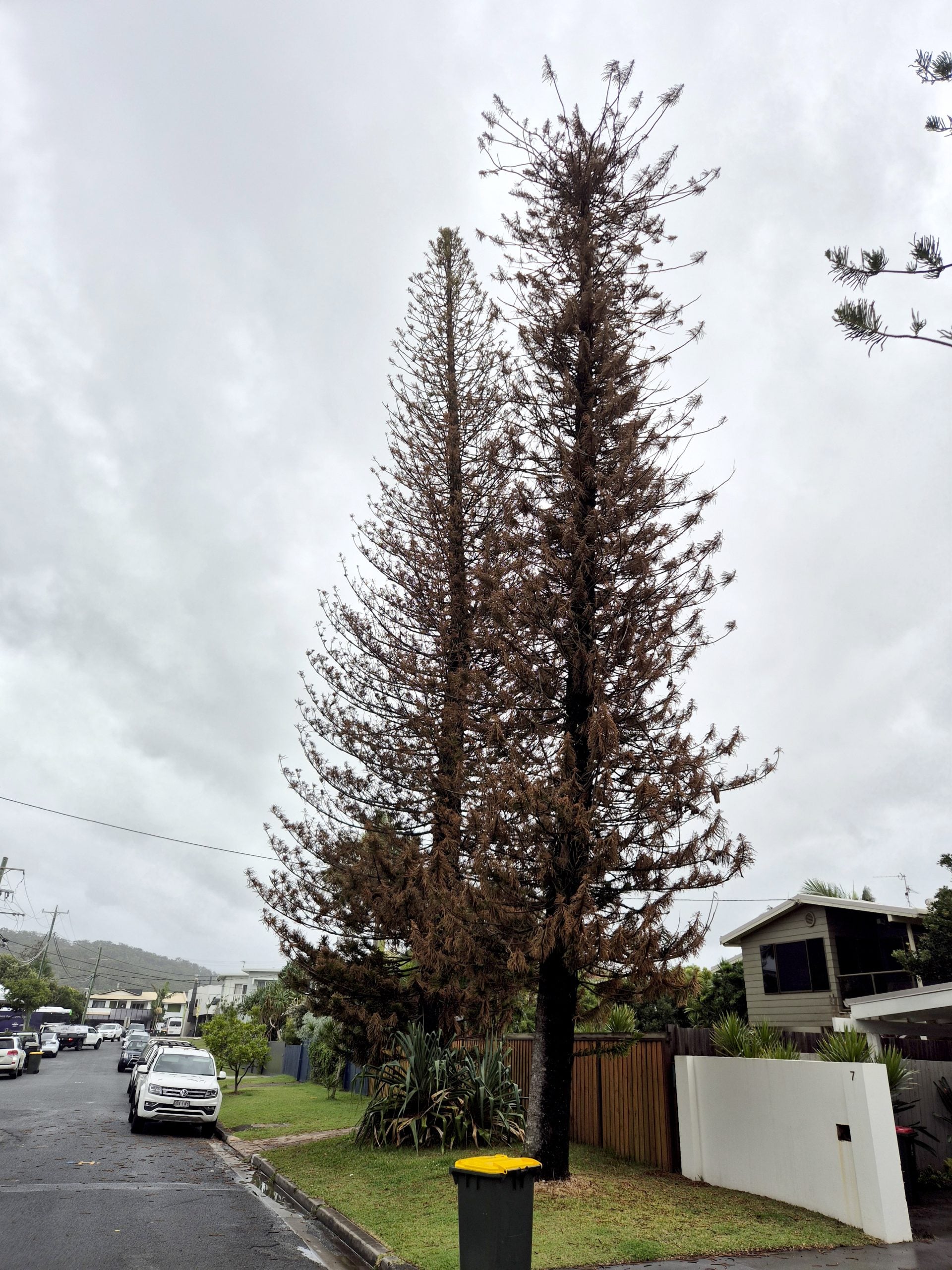
At Palm Avenue, Cabarita Beach, two more mature, healthy Norfolk pines on the Council road reserve have been poisoned and are not expected to recover.
And at Tweed Heads Lawn Cemetery, two old growth gum trees near gravesites were found dying from the same kind of deliberate damage.
The Cabarita Beach incidents have happened over recent weeks. The cemetery damage was discovered a few months ago. There is no clear pattern to when or where these attacks happen.
More than a tree
‘We’ve seen a real spike in this kind of damage, and every case is a loss the whole community wears,’ said Murray Smith, Tweed Shire Council Manager Parks and Active Communities.
‘A mature tree can take decades to replace. When someone destroys one, they’re taking something that belongs to all of us.’
The Cabarita Beach walkway is one of the coast’s best-loved public places, a path thousands of people walk, where families stop and surfers watch the break. The trees taken from it belonged to all of them. The damage has struck a nerve, and the people who use these places every day are the ones now asking who would do this.
Rachel Maiden from Cabarita Beach said the recent acts had angered locals. ‘Whoever did this clearly has their own interests at heart and doesn’t care about the community. This matters to everyone, not just because of how it looks, but because our native wildlife needs somewhere safe to live,’ Ms Maiden said.
Trees do the quiet work
The loss is more than visual. Trees on public land hold our coastline together, anchoring soil against erosion on exposed headlands and riverbanks. They shade our parks and cemeteries. They provide food and homes for native birds and animals.
Slow-growing coastal species like the Pandanus can take decades to reach the size that makes them landmarks.
Norfolk pines have shaped this coastline for generations. Their tall, unmistakable silhouette has long served as a natural landmark. Colonial estates planted them as eye-catchers that doubled as markers for ships at sea, and along the coast fishermen relied on them as beacons to find their way home in poor weather.
They also carry memory. Across Australia, communities planted Norfolk pines as living memorials to the soldiers who never came home from the First World War, each tree a tribute to an individual life.
The Tweed has its own: the Cudgen First World War Memorial Avenue on Collier Street, where a row of Norfolk pines was first planted in 1918, each one bearing the name of a local soldier who died. More than a century on, those trees still stand behind the war memorial where the community gathers to remember.
For the Tweed’s First Nations people, trees have held meaning far longer still. Even the palms along our waterways carry that history: the names ‘Piccabeen’ and ‘Bangalow’ come from Aboriginal words for water carrier, after the way the palm’s leaf bases were used to carry water and its sheath was woven into containers called pikki.
‘Trees were important geographical features in our Songlines, landmarks you could see and travel by, the large figs especially. Our people used trees, but we very rarely killed them. Trees are an important part of our culture,’ Uncle Franc, Bundjalung Elder said.
Zero tolerance
Most people would never harm a tree on public land. For the few who do, Tweed Council takes a zero-tolerance approach under its Vegetation Vandalism on Public Land Policy, which sets out how Council investigates and acts on these incidents.
Penalties depend on the circumstances, the species, the location and the legislation that applies, and fines can reach thousands of dollars. Offenders may also be ordered to pay for restoration. The damage carries a public cost too: removing and replacing the poisoned trees at Tweed Heads Lawn Cemetery alone is expected to cost ratepayers around $5,000.
‘Cemeteries are places people come to grieve and remember. These trees are part of what makes that possible, the shade, the calm, the sense of a place being cared for. Losing them takes that away from grieving families,’ Greg Puch, Council’s Cemeteries Business Coordinator said.
‘We know how much our community values these trees, because we’re hearing it loud and clear. If you’ve seen something, or you have footage that might help, please pick up the phone,’ said Murray Smith.
Anyone with information, including photos, video, dashcam or security camera footage, or reports of suspicious behaviour, can contact Tweed Council on 02 6670 2400 or lodge a report here.
 For four decades The Echo has printed the stories some people loved, some people hated, and some pretended not to read. If you want us to keep telling the truth, the real truth, not the sugar-coated version. We’ll need your support to keep the presses rolling.


