


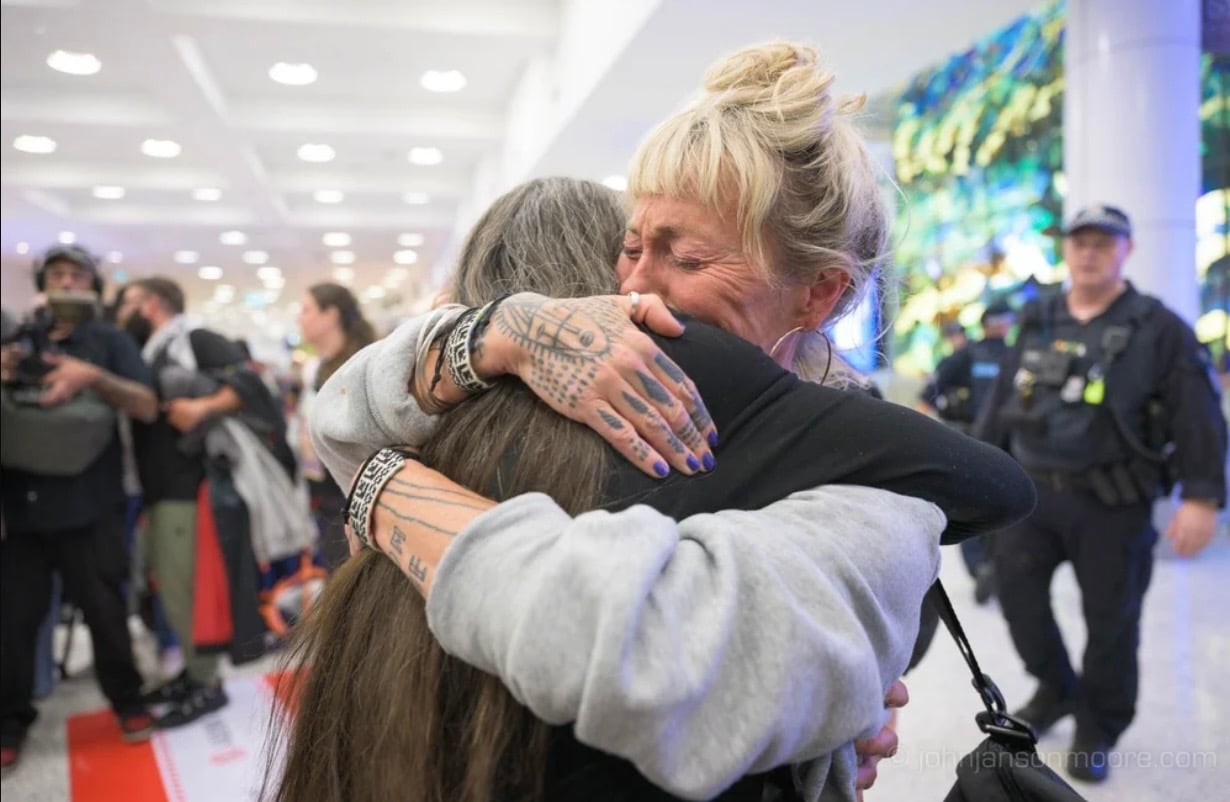
It hit me like a lightning strike. It was the latex gloves that did it.
Those pale blue five fingered clinical sheaths made me want to vomit.
Last Tuesday, having just been repatriated from my time on the Global Sumud Flotilla, I was at Tweed Valley Hospital getting a forensic medical examination for my sexual assault at the hands of the Israeli occupation forces.
The soldiers in balaclavas and gloves, three times my size, screaming ‘Welcome to Israel. You are going to really enjoy this!’
And now I knew why.
No DNA. No evidence of their crimes. They broke my coccyx as they punched, kicked, slapped and dragged me, cable-tied and ankled-shackled, through the darkened hell of the torture chamber on their prison boat.
And now I realised, as the nurses examined my body, taking swabs, that these type of latex gloves were worn by the perpetrators to hide their crimes. This was planned, was systematic, and came from the top.
Albanese’s friends and allies were enacting their genocidal violence on the 430 of us, just as they do every day to the 10,000 Palestinians in prison without charge, 350 of them children.
I felt a calm in that examination room that I hadn’t felt during the weeks I was sailing towards Gaza. The tenderness and care of the nurses. The cheese sandwich they gave me after my hunger strike. The fact that they believed my story. The way the doctor moved my matted hair out of my eyes.
It was not the calm of peace, but a calm that arrives after the violence has finished introducing itself. The screams of broken ribs. Tasers to the face. Rubber bullets shot at close range. The barks of prison dogs. Of fluorescent lights that never truly sleep.
Of shipping containers straining with huddled freezing bodies wailing, air that thrums with every horrific sound except the ones you most need to hear. Your daughter. Birds from home. Lawnmowers. Kettle boiling.
Refuse indifference
When I joined the Global Sumud Flotilla, I carried with me a simple belief: that human beings have a responsibility to refuse indifference. I carried hope, outrage, solidarity, and the conviction that borders built on suffering should never be allowed to become invisible. I did not carry the expectation of torture and rape.
The journey began on the open azure water of the Mediterranean Sea.
The sea was vast, breathing beneath us like a living thing. There was something sacred about being surrounded by 51 other flotilla boats. We sailed with hope. But we could taste the imminent risk.
Our stubborn dream that ordinary people could challenge extraordinary injustice.
We came from different countries, different languages, different lives. Some were seasoned activists. Doctors. Journalists. Mothers.
Others had never done anything like this before.
But on that flotilla, we became something larger than ourselves. We became witnesses. But bearing witnesses is dangerous.
Brutal interception
Our interception on 18 May was shocking and brutal. It happened with the suddenness of a storm.
The Israeli soldiers careered towards us in high powered Zodiacs. They opened fire above our heads. Then came the commands, the weapons, the khaki uniforms, the crazed, breathy confusion.
Our bodies slammed on to the deck. Cable ties. Smacks to the head. Humanity reduced to procedure.
The sharp realisation that the world can change completely in an instance.
Minutes dragged like anchors. I stopped measuring time by the sun and began measuring it by sounds: The howls of comrades in our makeshift hospital. Gunfire. ‘Head down, shut the fuck up, behind the black line or I’ll kill you.’
Sang in whispers
But human beings are stubborn. Our spirit is difficult to imprison. We sang in whispers. Glanced at each with love. Held onto each other in freezing wet cramped containers to ward off hyperthermia.
I found a paracetamol deep in my pockets and was able to give it to Engin, a young German artist, whose ankle was shattered from the impact of a rubber bullet.
There is a Palestinian word that encapsulates our ability to survive this killing machine. Sumud.
Resiliance. Steadfastness is not a grand gesture. It is not the roar of a crowd or the headline in a newspaper.
Sometimes Sumud is simply refusing to let your humanity be taken from you. It is saying your friends’ names over and over when you are delirious and terrified. It is sharing the scant amount of water that they threw at us. It is offering comfort when you have little comfort to give. It is laughing when laughter might incur another beating. It is singing ‘Bella ciao’. Very quietly.
What is freedom
On that prison boat I met parts of myself I had never met before. Fear, certainly.
But there was also clarity. The kind of clarity that arrives when everything unnecessary has been stripped away.
The important things.
The voices of people I love. My daughter’s smiles. The sky. The smell of rain.
I thought often about freedom. Not as an abstract principle, but as something physical. Something intimate. Freedom is sunlight on your face. Freedom is deciding when to sleep. Freedom is calling your mother just to say hello. Freedom is opening a door and finding that it opens. Freedom stopped being a political concept and became a human one.
And I thought constantly about Gaza. That was the paradox that haunted me.
Even in detention, I knew my experience was temporary. I knew there were people enduring realities far harsher than my own.
I knew there were families trapped beneath siege, beneath bombardment, beneath the relentless machinery of dehumanisation. My prison had an exit. The thousands of Palestinians in prison live without release dates, without international attention.
That knowledge sat heavily in my chest. It still does.
When news reached us that people around the world were speaking our names, demanding our release, refusing to forget us, something shifted.
Solidarity crossed the walls. That is the remarkable thing about solidarity. It travels. It slips beneath doors.
It moves across oceans. It survives censorship. It reminds isolated people that they are not actually alone.
I felt connected to strangers I would never meet. People marching. Raising their voices. Writing letters. Making phone calls. Holding vigils. Demanding sanctions.
In prison, those acts were not symbolic. They were lifelines.
Eventually, the doors opened. The killing machinery that had swallowed us released us. I walked out carrying the same body, but not the same self.
Some experiences divide life into before and after.
This was one of them. I left with deeper grief than I had arrived with. But I also left with deeper conviction.
Because the Israeli prison system and their use of torture failed in the way systems of repression often fail. It revealed too much.
It exposed the fear that power has of witnesses.
It exposed the lengths institutions will go to silence conscience. And it revealed something else: The extraordinary resilience of ordinary people. The refusal to surrender dignity.
The quiet insistence that human beings deserve freedom.
The belief that solidarity is stronger than isolation. The understanding that dignity cannot be granted by governments and cannot be permanently taken away by prisons.
A reminder that freedom is always somewhere beyond the walls. A reminder that justice, however delayed, remains worth pursuing. A reminder that Sumud is not merely resistance. It is love refusing to disappear.
 For four decades The Echo has printed the stories some people loved, some people hated, and some pretended not to read. If you want us to keep telling the truth, the real truth, not the sugar-coated version. We’ll need your support to keep the presses rolling.


