

20.3 C
Byron Shire
October 20, 2026

Happy 100th, Mullumbimby hydroelectric power station!

Latest News

Cinema: NAZA

A must-see, award-winning documentary investigating AI warfare in Gaza. Fresh from winning the Special Jury Prize at the 2026 Venice International Film Festival, NAZA, the latest documentary from Academy Award-winning filmmakers Yuval Abraham and Rachel Szor (No Other Land), examines artificial intelligence and surveillance in Israel’s military operations in Gaza.

Other News

Restricted mobility

Our mobility choices are an expression of our freedom of movement. Yet, not everyone in our community is able...

Mayor Sharon Cadwallader announces bid for state seat of Ballina 

Ballina Mayor Sharon Cadwallader will contest the state seat of Ballina as an independent, arguing that local ratepayers are carrying costs that should be met by the NSW government.

Bruns residents and Reflections struggle to find common ground

Brunswick Heads residents called on their local MP Tamara Smith for a meeting to discuss the fences that Reflections Holiday Parks have erected around the park area where the community planted native cypress pines commemorating the Battle of Lone Pine in WWI, which has been utilised by the community for over 60 years for recreation.

Calls on NRPP to defer consent for Mullumbimby’s 57 Station Street DA on Monday

At Thursday’s Byron Shire Council meeting there were multiple calls for a deferral of the 57 Station Street, Mullumbimby car park development application.

Cheaper school pool access proposed as Byron faces financial squeeze

Byron Shire’s schools could receive cheaper access to Council pools for swimming and water-safety programs under a proposal going before councillors on October 15.

Push for free conservation rezoning as report reveals Byron habitat protection gap

Byron Shire landholders could be offered a free pathway to stronger conservation zoning under a proposal coming before today’s Council meeting, following a report identifying significant gaps in protection for the Shire’s valuable habitat.

View of power station floor showing later diesel generators with original hydro turbines to rear. Photo wikipedia.org

In the hills just outside of Mullumbimby a vital, but oft forgotten piece of the town’s history, is quietly celebrating its 100th birthday.

Officially opened on March 6, 1926 the Mullumbimby hydroelectric power station now lies dormant and almost completely untouched on land off Wilsons Creek Road.

For decades, this remarkable piece of infrastructure formed the backbone of the region’s electricity supply, keeping the lights on in Mullum, Byron, Bangalow and other local towns.

Third scheme in Australia

‘At the time it was just the third municipal hydroelectric scheme in Australia,’ Susan Tsicalas from the Brunswick Valley Historical Society told The Echo last week.

‘When they put it in, it was because it was the cheaper option out of wood and coal,’ Ms Tsicalas said. ‘It was designed by William Corin, who also worked on plans for the Snowy Mountains Hydroelectric Scheme.’

The idea for the project dates back to 1909, when land along Wilsons Creek at Lavertys Gap was reserved to develop a water supply for Mullumbimby.

Local councillor W. E. Selwood, who later became Mullumbimby’s Mayor, proposed that the water scheme could also be used to generate electricity.

In 1923, the Mullumbimby Municipal Council engaged Corin to design a hydro-electric power project that would harness the flow of Wilsons Creek.

Construction began in 1924, with water from the creek diverted through a race and tunnel and then carried down a pipeline to a power station located further downhill.

From there, it drove Pelton turbines that generated electricity.

Electric lights powered by the scheme were first switched on in December 1925, and the station officially commenced operation on 6 March, 1926.

Having initially powered Mullumbimby unassisted, the plant was later supplemented with power from diesel generators during periods of low water flow.

The system was gradually expanded, and by the late 1950s the station’s combined hydro and diesel generating capacity had increased to roughly 3.15 megawatts.

The facility was also connected to the wider electricity grid in 1938, allowing it to operate as part of a broader regional power network. ‘It was an important piece of local infrastructure,’ Ms Tsicalas said.
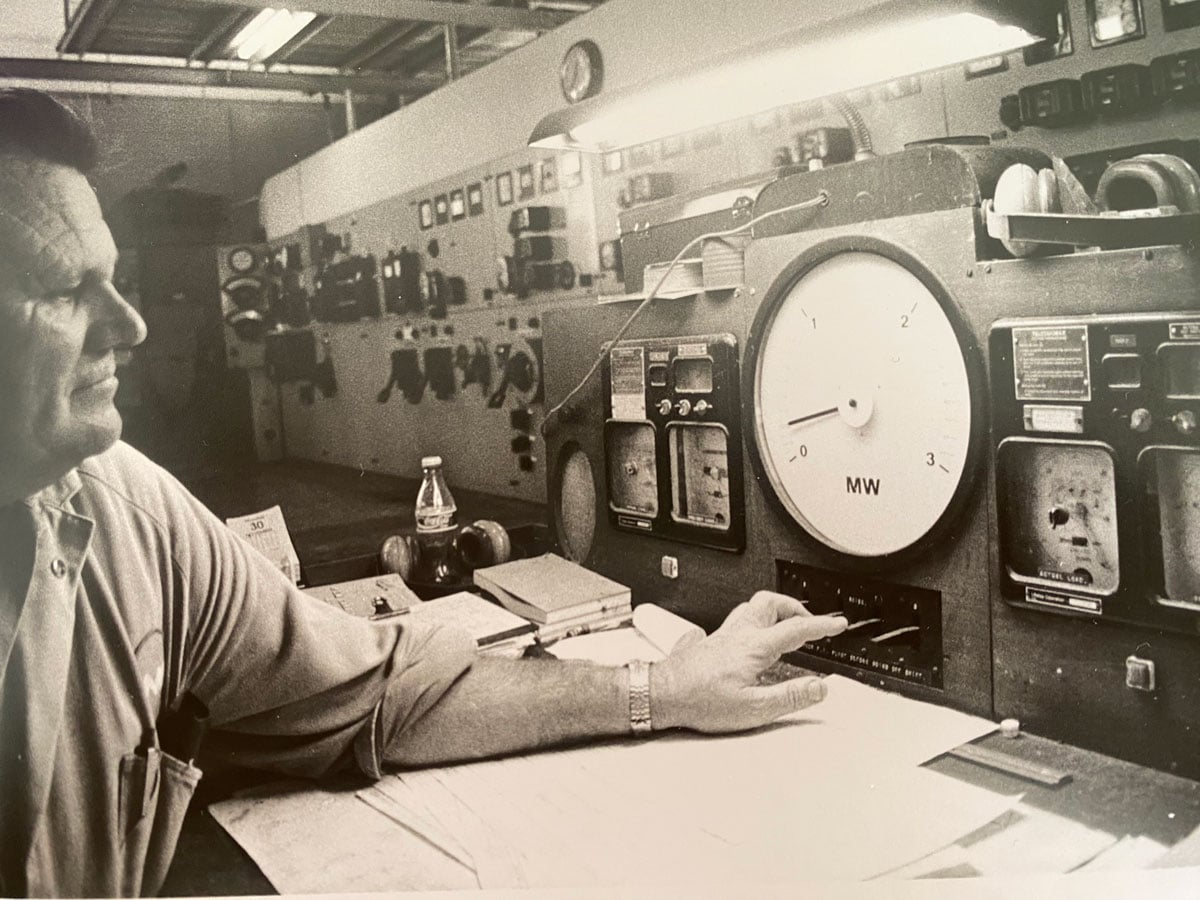
A power station worker. Photo supplied

Source of income

‘The Mullumbimby Municipal Council ran it and it was the Council’s main source of income because the other council’s had to pay a fee for the right to use the power.’

But as the decades passed it became increasingly clear that the power station simply wasn’t keeping up with demand.

‘There wasn’t enough water moving through the Wilsons River to generate the power needed as the grid expanded to accommodate growth,’ Ms Tsicalas said.

Heritage listing

Hydroelectric generation largely ceased during the 1960s, and the station was eventually decommissioned in 1990. Despite ongoing discussions about returning the station to active use as a source of sustainable and renewable energy, the facility is now essentially a historical artefact.

A heritage listing put in place in 2014 means that it cannot be demolished or significantly changed. But the owners – Essential Energy and Byron Council – forbid anyone from going beyond the large metal gates and fencing which surround the facility.

‘Robyn Gray and Ray Musgrave managed to get it heritage listed, but you can’t go and bloody see it!’ Ms Tsicalas said.

‘We’re told that there are community safety issues – asbestos etc. I understand that. But what’s the point of it being state heritage listed if you can’t go and see it?

‘I’d like to see it being opened up a couple of times a year under controlled circumstances and with the proper maintenance. You could have bus trips a couple of times a year. There’s a couple of guys who worked there who are still around who could guide the tours.’

But for now, at least, the gates of the old power station remained closed, leaving this grand old relic to sit in silence the world continues to power along all around.



For four decades The Echo has printed the stories some people loved, some people hated, and some pretended not to read. If you want us to keep telling the truth, the real truth, not the sugar-coated version. We’ll need your support to keep the presses rolling.


If you are a local business owner help us and in turn we help you. All The Echo asks for is advertising, not a free ride. It is every advert in The Echo and on www.echo.net.au, which creates the space for all the stories and coverage of community events, happenings and concerns.

If you are a reader you can become a sponsor of The Echo. Your support keeps the us independent.

Even a small one-off or regular donation from you will help keep the echo’s independent voice alive and strong.

Support Us

Become one of the supporters who helps keep independent, local journalism alive in the Byron Shire by contributing anything from as little as the cost of a coffee each month.

You're Wonderful, Thank you for supporting independent journalism in the Byron Shire

You’re supporting The Echo, thank you

Your contribution is keeping independent, local journalism alive in the Northern Rivers.

Because of supporters like you, we can keep every story free for everyone — no paywall, no exceptions. Your money goes directly to funding our newsroom of 40-odd local workers covering the stories that matter to this community.

Tell us what you think, give us your opinion

The Echo loves your letters and comments and is proud to provide a community forum on the issues that matter most to our readers and the people of the NSW north coast. So don’t be a passive reader, email us your epistles at editor@echo.net.au.

The letters deadline for The Echo is noon Friday. Letters longer than 200 words may be cut. The publication of letters is at the discretion of the letters editor. Please remember to include your full name, address and telephone number.

Online comments are no longer available.

Interview with Genevieve Clay-Smith, director of Boss Cat showing at the Byron Bay Film Festival

When Sonja (Olivia Hargroder) loses her mother without warning, the only steady presence left in her life is her grandmother, Doris. But Doris’s idea of stability means dismantling everything Sonja has built. For Sonja, who lives with Trisomy 21 (Down syndrome) and has spent her life fighting to be underestimated by no one, Doris’ plan feels less like protection and more like erasure. Directed by Genevieve Clay-Smith, Boss Cat is a vibrant, big-hearted Australian dramedy about independence, family and self-determination, anchored by a fearless lead performance.

Something for everyone at the Picture House

From Australian superstar musos, to brand new documentaries, to comedians at the top of their game, there really is something for everyone at the Brunswick Picture House.

Thirty-six unmissable films

The 2026 Russell Hobbs British Film Festival features an unmissable line up 36 films, including five retrospectives which will screen from 28 October to 29 November at Palace Byron Bay and Ballina Cinemas.

A timeless story of self-discovery

A husband with a promotion, two adorable children and a lovely new house. Nora thought she had it all. But did she? What was the discontent that was whispering to her in the shadows?
