


Giles Parkinson, RenewEconomy
‘They told us we were crazy’: it’s a phrase you often hear from Dr Dieter Salomon, the Australian-born mayor of the German city of Freiburg, a city so much at the vanguard of the green transformation that is currently underway in Germany that it calls itself, Green City Freiburg.
It probably feels that it needs the extra words to reinforce the point, because green, or at least green energy, is now mainstream in Germany.
Salomon, who was born in Melbourne but moved back to Germany with his family at the age of 3, has been mayor of this city of 220,000 people at the edge of the Black Forest since 2002.
And in many ways, the story of Freiburg and its attitude to renewables, energy, and sustainability, is a microcosm of what is now occurring in the broader economy.
It goes back to the 1970s, when an unlikely coalition of farmers, many of them wine makers, academics and students forced the state government to cancel plans for a new nuclear power plant at Wyhl, just 25kms north of the city.
It was a ferocious battle, culminating in a showdown that attracted a rally of 50,000 people.
It remains, Salomon says, the only nuclear power plant that has been successfully prevented from going ahead, even though the country has now committed to closing all by 2022.
‘The prime minister of the state (of Baden-Württemberg), told us we were crazy and said that if we don’t build this plant the lights will go off,’ Salomon says in his offices in the heart of the Medieval old quarter of the city.
‘That was 40 years ago, people still remember that comment because the lights haven’t gone off.’
More than a decade later, the ‘crazy’ accusation was levelled at the city again, this time by the local newspaper when the council decided, six weeks after the Chernobyl nuclear disaster, to install a long term program to wean the city off nuclear and fossil fuels, and into renewables, energy saving, and energy efficiency.
‘They told us it was a crazy decision,’ Salomon says. Despite preventing a new power station, the local utility still relied on nuclear for 90 per cent of its electricity needs.
‘They told us it was not possible.’ Now, the local utility contracts almost all its outside needs from hydro-electric sources in Austria.
Spirit of defiance
Freiburg argues that it earns its ‘Green City’ sobriquet from that initial spirit of defiance against nuclear and its subsequent focus on innovation, and sustainability.
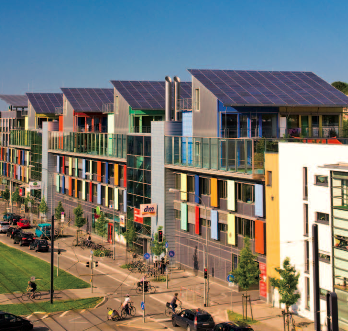
It boasts a carbon neutral quarter known as Quartier Vauban, where in some sections the citizens voted against the use of cars; the ‘Solar City’ and ‘Sun Ship’, a residential area that features ‘energy plus’ housing, meaning the houses and adjoining commercial buildings produce more solar electricity than they consume during the year.
There is the famous ‘Heliotrop’, a unique circular home that rotates so that it’s massive solar PV array and solar thermal collectors can follow the sun.
The town has more than 100 ‘passive houses’, has retrofitted a high-rise residential building to ‘passive house’ status; and new homes have a requirement that restricts the consumption of heating oil to 1.5 litres per square metre per year.
That compares to the average consumption of 30 litres/sqm/year a decade ago. Space heating in Germany consumes twice as much energy as electricity.
New housing projects are not begun until a tram line is built. The city estimates that 30 per cent of journeys are done by public transport and 27 per cent by bicycle.
Car movements account for just 30 per cent of movements within the city. It is building three new tram lines to ensure that every home is within 500 metres of public transport.
Freiburg has also become a hub of innovation and industry. I lunched at Solar Fabrik, the first carbon neutral solar module manufacturing facility.
The city is also the home of numerous research facilities, most notably the Fraunhofer Institute for Sustainable Energy, which has grown from 60 people to more than 1,300, and is the second largest solar research institute in the world.

‘Freiburg was quite different from rest of Republic,’ Salomon says. ‘They thought we were the crazy guys from the Upper Rhine Valley. But now it is mainstream.’
But, he concedes, ‘a lot of people complain that we don’t do enough, that what we have done is nothing, that we have to do more.’
Indeed, despite its credentials, Freiburg now trails other cities in the deployment of renewables. It gave itself what seems to be a modest target of generating 10 per cent of its own electricity needs through renewables by 2010, but came up well short.
It has six turbines on the hills overlooking the town, and solar PV on the stadium, and virtually every other public building that can support it, as well as many private homes.
Combination
But it still only generates 6 per cent of its own electricity needs through these means. Despite being in the sunniest region in Germany, there is just not that much wind and sun to power the city within the narrow boundaries of the city, and few biomass or hydro opportunities.
About 50 per cent of its energy needs (mostly heat) comes from combined heat and power plants.
Now it has set a target of 100 per cent renewables for the Freiburg region, which includes the surrounding areas that have 650,000 people.
It aims to do this by 2050. It will use the open spaces and resources of the surrounding areas for more wind turbines and solar farms, biomass plants and run-of-river hydro.
And, Salomon hopes, geothermal. (Some smaller towns scoff at such targets, saying that they have already reached 100 per cent renewables, or even more, in some villages. The region of Emmendingen, which forms part of Freiburg and has 25,000 people, aims to be 100 per cent renewable by 2030.)
Salomon was elected mayor in 2002 – the first Green mayor of a large city in Germany, and re-elected in 2010 (they have eight year terms). He’s what is known an a ‘Realo’, as opposed to a ‘Fundie’, or fundamental Green that refuse the corridors of power.
It’s been a battle that has raged with the Green Party since it was founded more than three decades ago. The Green Party shared power with the Social Democrats in Berlin a decade ago, and the same arrangement is in place in Badem-Würrtemburg, where Freiburg is located. The state’s capital, Stuttgart, also has a green mayor.
But at the federal level, the Greens have snubbed the opportunity of forming a Coalition with Angela Merkel, despite being the first party approached.
Rejecting nuclear
Some say it is because the Fundies rule again in Berlin, others say it is because the centre-right has stolen its thunder by rejecting nuclear and supporting renewables.
Still, others are frustrated that the Greens are not sharing power, because the energy transition would likely be quicker than with a centre-right/centre-left coalition.
For Salomon though, being Green and in government is ‘quite normal. When I was re-elected three years ago, I represented the mainstream of Freiburg.’
He says he needs to be a ‘realo’ in more ways than one, because his party has just 13 out of 48 councillors. There are 10 parties represented in the council. ‘I have to have majority support in the council or I cannot govern,’ he says.
Salomon is confident that the Energiewende, the national energy transition that will see it phase out nuclear altogether by 2022 and become a nation predominantly powered by renewables, will succeed.
This is despite a lot of vested interests trying to make political capital out of rising electricity prices.
‘A lot of countries are looking at Germany,’ Salomon says. Some of them don’t want us to reach our targets, others are hoping that we do. When it works in Germany, a lot of other countries are going to copy it.
‘I know some countries think we are crazy, including the British. But now they are building new nuclear power plants with the French and the Chinese. The money they guarantee for every kilowatt hour is more than we pay for solar. Now, that is really crazy.’
 For four decades The Echo has printed the stories some people loved, some people hated, and some pretended not to read. If you want us to keep telling the truth, the real truth, not the sugar-coated version. We’ll need your support to keep the presses rolling.


