


Paddy Manning, Crikey business editor
At first glance, prime minister Tony Abbott’s deregulation agenda would appear to play into the hands of companies like Santos, which is battling to win approval for its contentious coal seam gas project at Narrabri.
But it might be a case of careful what you wish for, if Santos’ path to approval at Narrabri is secured by restricting shareholder activism or nobbling the regulatory regime put in place to protect precious groundwater resources like the Great Artesian Basin against coal seam gas development.
Santos is reeling from reports in The Sydney Morning Herald earlier this month confirming that high levels of uranium and other contaminants were found in groundwater under its CSG operations in the Pilliga state forest, billed as the first confirmed instance of aquifer contamination by the coal seam gas industry in this country.
That claim is debatable: QGC admitted inducing connection between beneficial and salty aquifers at its Myrtle-3 well near the Bridles property in Queensland, as the ABC’s Four Corners covered in 2011, but it’s not.
Whether it’s the first or second or some other number is irrelevant, however. We often hear loose claims from pro-gas lobbyists about how there is no confirmed instance of aquifer contamination by fracking anywhere in the world.
They can’t say that anymore.
Santos says it self-reported the contamination to the Environment Protection Authority, and was fined $1,500, and the presence of uranium was publicly reported by The Courier in Narrabri last August.
Santos blames the contamination on its former partner Eastern Star Gas, which was chaired by former Nationals leader and deputy PM John Anderson.
Undoubtedly Eastern Star has a lot to answer for, although it’s long been a mystery how Santos knew so little about standards at a project it held a 20 per cent stake in.
In any case it’s old history now: in mid-2011 Santos bought the rest of Eastern Star in a deal valuing the whole company at $924 million.
It has been blaming them ever since a series of spills were revealed by the SMH at the substandard Bibblewindi storage pond within the Pilliga forest, that is to be replaced.
The timing of the latest contamination could not be worse, it comes only days after Santos signed an MOU with the NSW government to fast-track approval for the Narrabri project.
Santos’ attempt a damage control, arguing the contamination was found in a perched water table which was not used beneficially, unravelled quickly when it was pointed out the EPA considered it an aquifer and there were indeed bores drawing from it.
Wilderness Society national director Lyndon Schneiders warned this week Santos was becoming a ‘corporate pariah’ and called on it to:
‘cut its losses and look for a plan B that does not rely on coal seam gas. Otherwise, the company may join the failed timber giant Gunns as one whose driving ambitions led to its demise on the backs of delays, bad press and environmental risk.’
TWS and GetUp have organised 161 shareholders to file a resolution calling on Santos to pull back from Narrabri and, unrealistic as that may seem, given the money involved, it will be put to shareholders at the company’s annual general meeting in Adelaide in May.
Santos responded on Tuesday that it respected shareholders’ right to file the resolution while noting the call was from just 0.0475 per cent of its shareholders.
The test, however, will be how much support the resolution gets from shareholders. Crikey understands some concerned overseas shareholders have already scheduled meetings in April to find out what the fuss is about.
GetUp campaigner Paul Oosting previously worked at TWS and was instrumental in the corporate campaign against Gunns and its $2 billion Bell Bay pulp mill, successfully targeting not only Gunns shareholders but lenders, investment banks and offshore customers.
Sustained campaign
It is not there yet, but Santos could find itself the focus of a similarly determined, sustained campaign by very experienced opponents with local support, as The Australian Financial Review’s Matthew Stevens wrote, the farmer Ted Borowski who locked himself onto a large truck in the Pilliga recently was ‘plainly no dreadlocked ring-in’.
Mistaking genuine, broad community opposition for fringe extremism is exactly the wrong path to go down.
The oil and gas industry constantly attacks those crazy activists who are ‘strange!’ and very worried about climate change.
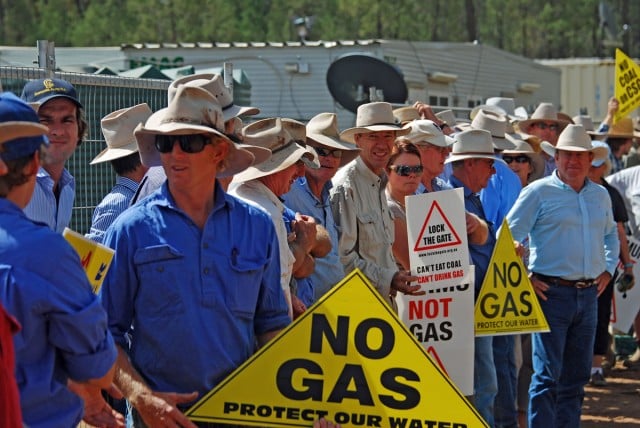
But the industry’s real problem on the ground is local farmers who are nobody’s fool, nobody’s tool, but are informed and concerned about groundwater impacts of CSG and land-use which is often simply incompatible with agriculture.
Perhaps, with support from the federal government, Santos can brazen it out where Gunns failed.
Santos turned 60 this week, is now a top 20 listed company and has a market capitalisation of more than $13 billion.
There is some $20 billion invested in the Gladstone LNG project, which Santos has a 30 per cent stake in and operates in joint venture with Malaysia Petronas (27.5 per cent stake), Total (27.5 per cent) and Korea’s Kogas (15 per cent).
Gunns, by comparison, grew rapidly through an overly ambitious, debt-fuelled acquisition of the forestry operations of North and Boral, and at its peak never had a market capitalisation much over a billion dollars.
Parallels with forestry
Although the scale is different, Oosting sees clear parallels between Santos and Gunns, when the forestry company was riding high on the back of strong state government support and ‘became more and more locked into an unsustainable project’.
The decision of the Tasmanian Labor government to sideline the Resource Planning and Development Commission and fast-track the Gunns pulp mill only galvanised community opposition, Oosting told Crikey: ‘Everyone could see it was a project that hadn’t followed due process.’
Similarly at Narrabri, Oosting fears, despite community opposition, the NSW government is ‘prepared to give Santos what it wants’.
Some 40,000 of GetUp’s 600,000-strong member base have signed an online petition for Santos to pull out of Narrabri, Oosting says.
Santos certainly has a lot riding on Narrabri, particularly because its Gladstone LNG project is short of gas, like all three of the big CSG-LNG projects, as Citi broker Dale Koenders wrote on Monday.
Santos’ returns on investment in the GLNG project are likely to have halved since it made a final investment decision in 2011, falling from 11-14 per cent to below 7 per cent, a devastating analysis by Mark Samter of Credit Suisse showed last week.
The upshot of Samter’s note? From here on in, ‘the trend in the Santos share price will be down’.
Santos is trying to convince the NSW government it needs to approve the Narrabri project to ensure the state’s own energy security and put ‘downward pressure’ on soaring gas prices.
Crikey recently critiqued the energy security argument here, here and here.
There is certainly far more gas at Narrabri than NSW will ever need, fuelling persistent suspicions much of it must eventually head north to Gladstone. Samter values Narrabri at some $700 million, or 72c per Santos share, the stock was trading at $13.29 last Friday, but has 100 per cent risk weighting on the project, writing ‘the recent environmental issues must raise some serious questions about the political challenges to commercialising that gas’.
Approval push
The push for an approval at Narrabri is gathering momentum.
After touring with Santos, BCA president and National Commission of Audit chairman Tony Shepherd threw his support behind the project.
Under the MOU, Santos is guaranteed a decision by January, once the application is finally lodged mid-year.
The position of the federal government will be crucial.
The Australia Institute released a report on Tuesday, including results from a November survey showing 71 per cent of people want federal rather than state regulation of CSG, and 56 per cent think there should be more regulation while only 7 per cent think there should be less.
Launching the report was former federal independent Tony Windsor, who used the balance of power in the last Parliament to establish an Independent Expert Scientific Committee, the so-called Windsor Committee, to intervene in the approval of large coal and coal seam gas projects with cross-border impacts, underpinned by voluntary agreements with the states and an assurance of $200 million in funding.
The IESC can stop the clock on state approval processes using a ‘water trigger’, for example, the impact on nationally significant systems like the Great Artesian Basin or the Murray Darling.
Windsor told media he was gravely concerned at the possibility the federal government would both defund and ‘gut’ the committee, as part of its push to cut costs, remove red and green tape and eliminate duplication between the Commonwealth and states to have a ‘one-stop shop’.
Water trigger doomed
In an interview, Windsor told Crikey he feared the government would keep the water trigger in name only, effectively handing responsibility for assessment back to the states, which are not equipped to do the complex bio-regional assessments the IESC was established to do.
‘I think the language of Abbott and (agriculture minister Barnaby) Joyce and (environment minister) Greg Hunt has been that they don’t see the necessity for the Commonwealth to do the work,’ he said.
Windsor says he faced the same problem with former PM Julia Gillard and ‘had to drive this very hard’.
At a time when the reputation of the NSW government has been tainted by corruption inquiries, Windsor hopes Commonwealth involvement and funding for the committee will be maintained.
‘That was exactly the problem with (corrupt former Labor politicians Ian) Macdonald and (Eddie) Obeid; the states are so captured by industry, there can only be one outcome,’ he said.
Windsor won’t say whether the Santos Narrabri project should go ahead, but believes the company is ‘risking by feel, they have no idea of the connectivity issues’.
His main concern is to ensure there is an assessment process the community has confidence in, and state governments have lost community trust.
‘I wouldn’t proceed until the objective scientific work is done,’ he said, adding: ‘It’s in the interests of the industry to slow this down.’
The IESC did not feature in last Wednesday’s Omnibus Repeal Bill, although it did remove a Water Act 2007 provision requiring an independent committee to assess subsidence mining proposals.
A spokesman for Barnaby Joyce, who now holds Windsor’s old seat of New England and will bear the brunt of any local angst over the Narrabri project, says he’s not aware of plans to overhaul the IESC but it will be interesting to see whether funding is maintained in the coming budget.
Greg Hunt, who is responsible for the legislation, did not respond to a question from Crikey on the future of the committee.
 For four decades The Echo has printed the stories some people loved, some people hated, and some pretended not to read. If you want us to keep telling the truth, the real truth, not the sugar-coated version. We’ll need your support to keep the presses rolling.


