


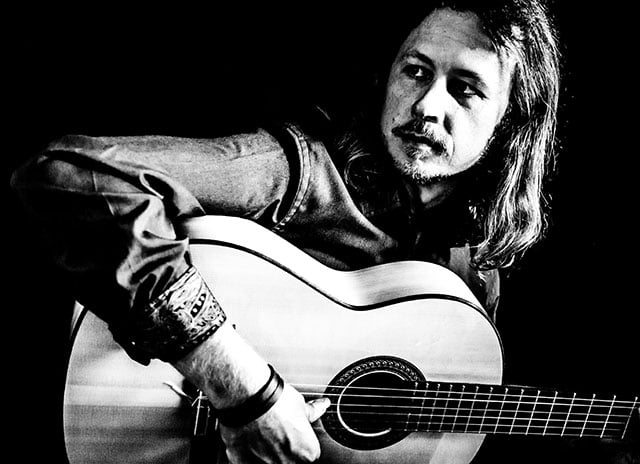
ARIA-nominated flamenco guitarist Damian Wright of Bandaluzia brings his flamenco genius to Bangalow this week.
With a performance that pays tribute to the tradition’s historical origins and to the most contemporary and his personal interpretations of this incredible artform. He spoke with The Echo about his upcoming show.
What is it that is unique about flamenco guitar? How did that style of playing evolve?
I think the unique aspects of the flamenco guitar are its intricate strumming techniques called rasgueados, which are immediately identifiable as flamenco and give the opportunity for the player to develop rich rhythmic patterns and textures. The other aspect is the role of the guitar, not only as a soloist or accompaniment to the singer but also its unique role in accompanying flamenco dance and the interplay between the two. Flamenco guitar playing evolved a lot through concepts introduced by some of the greats of the artform, especially Ramon Montoya and Paco de Lucia, taking ideas from classical and jazz guitar as well as further developing unique techniques already found in flamenco, including the many uses of the pulgar (thumb technique), which is a direct descendant of the Arabic lute tradition.
Has it changed much with contemporary players?
It’s exciting times in modern flamenco guitar playing with phenomenal young guitarists such as Diego del Morao and Dani de Moron coming from a background saturated in tradition but having found exciting and fresh ways of playing flamenco. In their playing you can hear a richness of harmony and rhythmic creativity that is drawing from a wider field of musical influence than previous generations and at the same time is continuing the tradition in an identifiable way.
How much of you can you bring to the flamenco style but still keep the signatures of the tradition?
Flamenco has its specific forms and traditions that are its essential characteristics and have evolved from the experiences and personalities of the flamenco artists of Andalucia.
That being said it has also continued to be a progressive music through all stages of its existence and especially in the last 50 years or so it has extended the palette of colours. I try to connect to who I am as an artist, what motivates and influences me in a larger musical sense, and to incorporate this into my performance while keeping the characteristics of the artform intact. With my ensemble Bandaluzia we have added influences from as far wide as Debussy, Radiohead and contemporary dance etc…
Why is it so passionate? Does a player experience intense feelings when the song they are playing expresses them?
I think as a result of the circumstances of the gypsy people, the general hardship of the people of Andalucia 150–200 years ago, flamenco developed not only as a way pf celebrating festivities within the family or community but of also as a cathartic outlet, by poetically expressing the dire situation of the people. This in turn creates a sentiment that to this day we can all tap into to some point and I think that makes the feeling in the music and dance eternal. Any performance of flamenco requires the artist to transmit this to the audience for its ‘magic’ to occur, for the audience to connect to that source.
What have been your recent gig highlights?
I loved performing at the Adelaide Guitar Festival last year. Just having a festival dedicated to the celebration of guitar at that level and among some of the world’s greatest guitarists was a great experience. Performing my solo show at the Rajasthan International Folk Festival in a 600-year-old fort was unforgettable.
How did studying with Pepe Justica in Spain influence your playing?
Pepe was a great maestro for me in that he really instilled the importance of technique and clarity in my playing, always trying to create melodies and phrasing that have flow and using an emphasis on technique to give ease in expressing musical ideas as opposed to solely a means to speed.
Tell me about the workshop. Who should attend?
In the workshop I’ll be presenting the flamenco guitar, its origins, the unique techniques associated with the style, simple musical examples and their connections to the culture of flamenco. There will also be a great emphasis on the rhythm in flamenco through palmas (percussive handclaps). Anyone with an interest in flamenco can attend – no prior flamenco experience necessary as much of the workshop is based on the culture of the artform with musical examples catered to the individual’s ability.
What should we expect for your local gig?
I’m really excited to be presenting my solo show in the Byron area. My idea for this solo tour was to present the great variety of musical styles that are found in flamenco and perform these contrasting styles with sharing a touch of the history and personal connections and thoughts on the world of the flamenco guitar that I love so much.
Damian Wright performs at the Bangalow Catholic Hall on Friday at 8pm. Tix are $20 and can be purchased on www.trybooking.com/RXXA or at the door.
Workshop is Saturday 11am–12.30pm with tickets on www.trybooking.com/RXXC RSVP essential.
 For four decades The Echo has printed the stories some people loved, some people hated, and some pretended not to read. If you want us to keep telling the truth, the real truth, not the sugar-coated version. We’ll need your support to keep the presses rolling.


