


Charles Boyle
Toxicologists calculate the potency of a poison using the LD50 Test (Lethal Dose 50 per cent), which measures the amount of venom required to kill 50 per cent of a sample population.
With snake venom, live mice are the unit of measurement. Based on LD50, the world’s deadliest snake is Australia’s Inland Taipan aka Fierce Snake (Oxyuranus microlepidotus). A single maximum dose of its venom can kill more than one million mice or nearly three hundred adult humans. It is by far the world’s most toxic snake venom, even more toxic than sea snakes.
Despite its name, the Fierce Snake is shy, reclusive and calm and only inhabits the sparsely populated Simpson Desert. Ironically, there has never been a single recorded human death from the bite of a Fierce Snake. By comparison, Russell’s Viper (Daboia russelii) kills an estimated 25,000 people in India and Asia each year.
Australia’s 3,000 annual snake bites result in 500 hospital admissions and, on average, two deaths. Of our thirty-five fatal snakebites since the year 2000, 50 per cent occurred at home, 75 per cent of the people bitten were male, and 20 per cent were bitten while handling or attacking the snake. Bad news if you’re a man trying to kill a snake at home.
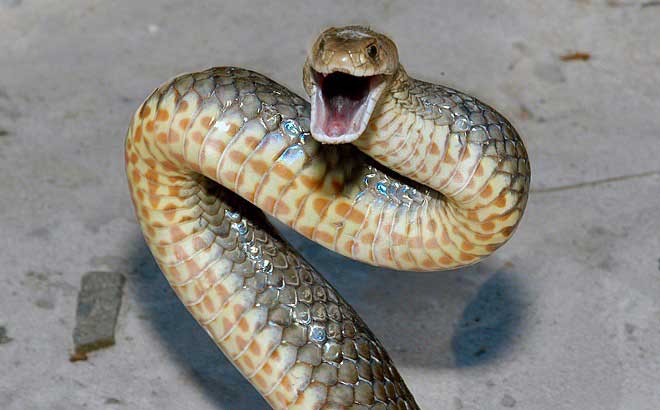
The big three venomous snakes responsible for recent Australian snakebite deaths are the Eastern Brown Snake, the Western Brown Snake and the Coastal Taipan. (The Death Adder has only caused two confirmed deaths since 1930.) It’s official: Australia’s deadliest snake is the Eastern Brown Snake (Pseudonaja textilis), responsible for 60 per cent of our snakebite deaths. Pseudonaja means ‘false cobra’ while textilis, meaning ‘woven’, was applied by French zoologist André Duméril who was reminded of fine stockings by the scales of the specimen he first described in 1854. What was he thinking?
Based on the LD50 test, the Eastern Brown Snake has the world’s second-deadliest venom after the Fierce Snake. Unlike the chilled Fierce Snake however, the Eastern Brown has a fearsome reputation for speed, aggression and a bad temper.

Special size for us
They are found throughout eastern Australia and Papua New Guinea in habitats ranging from beach to desert, but avoiding dense rainforest. They are a swift, slender snake growing to 1.5 metres in length – except here in the northern rivers where the world’s biggest Eastern Browns can reach 2.7 metres.
As the name suggests, the upper parts of an Eastern Brown vary from golden tan to dark chocolate, and the pale yellowish belly is often blotched with orange or grey.
They are highly specialised daytime predators, beautifully designed to hunt mice and rats. Their taste for rodents draws them to human habitations, from farms to urban areas, and this brings them into conflict with people who are active in the same places at the same time.
Snake surprise
When Eastern Brown Snakes encounter people they invariably try to hide or flee. If cornered, approached or attacked they will give a warning display; if that is ignored they will defend themselves with lightning-fast, accurate strikes delivering a venom specifically designed to kill mammals. If you try to attack an Eastern Brown Snake, assume you will be bitten.
If you surprise an Eastern Brown (or any venomous snake) – Freeze: Do Not Move – and give the snake a chance to leave. Snakes only respond to stimulus; if you don’t move, you’re not a threat.
If bitten
If you do get bitten, the usual rules apply. The venom is carried in lymph; so keep the victim still to stop the venom spreading. DON’T wash the wound – the venom needs to be identified later. DON’T tourniquet. DO bind the area/limb with a pressure bandage, winding up towards the heart then back down over the bite to the end of the limb. Get medical help urgently – there is an effective antivenom for both people and dogs and it’s likely you’ll survive.
Before the advent of antivenom, Brown Snake bites had a 10 per cent fatality rate, owing to their short fangs and a habit of only injecting venom in 30 per cent of bites. But a severe bite is to be greatly feared. The venom, called textilotoxin, includes a neurotoxin that shuts down the nervous system and an anticoagulant that turns mammalian blood to glue. Symptoms begin with diarrhoea and dizziness, leading to kidney failure and convulsions, then paralysis and cardiac arrest.
These snakes were part of the Australian ecology long before humans appeared and will probably be here long after we have gone. They are experts at avoiding people, but if you do chance to meet an Eastern Brown, be respectful and don’t panic. Take a quiet, still moment to contemplate your acute proximity to an extremely violent death in the form of our graceful, elegant northern rivers rat-catcher – and be grateful they hunt rodents, not us.
 For four decades The Echo has printed the stories some people loved, some people hated, and some pretended not to read. If you want us to keep telling the truth, the real truth, not the sugar-coated version. We’ll need your support to keep the presses rolling.


