



Simon Holmes à Court
State government cabinets around the country will meet today to finalise positions on the National Energy Guarantee (NEG) before Friday’s CoAG meeting.
The ministers have been given little opportunity to understand this complex beast. The ‘Final detailed design’ paper – which is neither final nor detailed – was released just five days ago. A worksheet with many of the numbers behind the modelling was published late on Friday. The devil is still very much in the yet-to-be-developed detail.
Last Tuesday 23 energy researchers from 11 universities wrote to the state energy ministers asking for the release of ‘the ACIL Allen modelling [of the NEG] in full, including all assumptions … and to provide access to the modelling team’ so that the work may be properly peer reviewed – a fair ask given that the NEG is the most significant change to the National Electricity Market since its implementation in 1996.
At least one energy minister did write to the Energy Security Board. Energy researchers and ministerial advisors have been poring over the numbers over the weekend, but short of time and without access to the modelling team, many mysteries remain.
The following is a summary of the published NEG model results – despite the name, there is no ‘guarantee’ within the NEG, and nor can there be of any model’s results.
Statistician George Box is famous for the aphorism ‘all models are wrong, but some are useful’. Nobody expects the modelling to play out exactly, but we would expect the modelling to make a clear case for the NEG.
The first thing to notice is that while ACIL expects the amount of renewable energy to almost double by 2030 – Australian Energy Market Operator (AEMO) reckons it’ll triple – ACIL predicts that very little growth is due to the NEG.
On the government’s current timeline, the NEG starts in the 2020–21 financial year, or FY21. (Curiously, compliance for the first year can be deferred.) While there’s a lot of renewables to be built in the next three years – 8.1GW – very little will be built under the NEG, as can be seen in this, the saddest of charts:
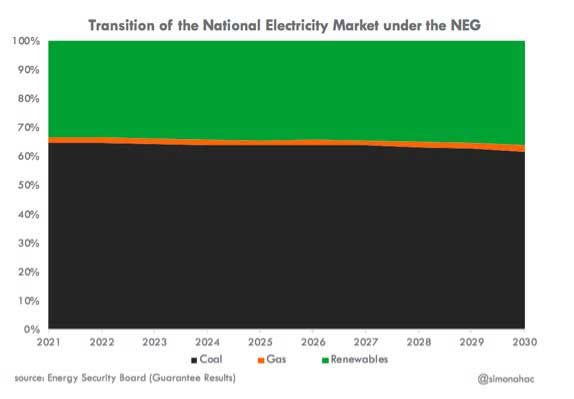
It’s hard to see above, but during the decade of the NEG there is a little growth in renewables, almost all of which comes from rooftop solar – just 830MW a year, about half the current rate.
Death of the large-scale renewable
The most surprising outcome is the predicted death of the large-scale renewable industry – the modelling forecasts only 14MW of large-scale wind and solar over nine years. (For context, Australia is installing about that much every week of both wind and solar. 14MW is equivalent to four current model wind turbines).
Even though there’s an emissions intensity scheme (EIS) at the heart of the NEG – shhhhh! – it shouldn’t come as a surprise that the emissions intensity barely moves once the NEG comes into effect in 2021.
NEGs alternate universe
Surprisingly the modelling assumes that there is currently no storage in Australia. In this alternate universe, Australia’s three pumped hydro plants don’t exist – Tumut 3 (600MW), Shoalhaven (240MW) and Wivenhoe (480MW).
There are no new mega-batteries, of the likes of Hornsdale (100MW) or Dalrympe (30MW).
The plethora of planned pumped hydro projects aren’t going to happen – Kidston, Goat Hill, Cultana, Shoalhaven Stage 2, Tasmania’s Battery of a nation – except for the 2GW Snowy 2.0 project. Apparently household batteries won’t materialise, despite thousands already in use and tens of thousands planned in South Australia’s Virtual Power Plant alone.
Last week the front pages of the nation’s most serious papers were splashed with claims that the NEG would reduce the average annual residential electricity bill by $550. (Déjà vu anyone?). The ESB claims that these savings are from reductions in the costs of wholesale electricity and ‘green scheme subsidies’.
According to the AEMC’s Residential Price Trends Report, the average Australia is paying 13.23¢/kWh for wholesale energy and 1.62¢/kWh for environmental policies, totalling 14.85¢/kWh.
At $550 for an average household consuming approximately 5,000kWh a year, the wholesale energy and ‘green scheme subsidies’ savings average 10.9¢/kWh – a saving of some 74 per cent!
Australians would all rejoice if half of our electricity bills dropped by 74 per cent, but I doubt anyone actually finds this claim credible.
(Modellers: Please accept my apologies if I’ve misinterpreted your work, it’s the best I could do with the little information and the little time afforded by this extraordinary process. I would greatly appreciate a clear explanation of how the fantastic claim of $550 per year in savings was determined.)
Claims unrealistic
Energy researchers are scratching their heads trying to understand these claims. With almost nothing being built, neither falling technology costs nor additional supply can take the credit for moderating prices. Instead, a fairly weak case is made that the NEG will increase the volume of contracting (for the same volume of energy) and that this will save the market $27bn.
The modelling has not made a strong case that the NEG reduces prices.
What of reliability? The modelling provides absolutely zero information on reliability, not surprising given that AEMO predicts the network will exceed the 99.998% reliability standard in every region over the next 10 years. The Reliability Guarantee only kicks in if the standard is expected to be breached. The modelling has not even bothered to make the case that the NEG improves reliability.
Increased emissions
So what of emissions, the third leg of the energy trilemma?
Under the neutral (‘no NEG’) scenario, emissions will decrease by 0.9Mtpa from 133.9MTpa in FY22 to 133.0Mtpa in FY30.
Under the NEG scenario, emissions will actually increase by 1.09Mtpa from 128.7Mtpa in FY22 to 129.7Mtpa in FY30.
The numbers do show some greater emissions reductions under the NEG in FY21. A little over half of this appears to be due to the effects of Demand Side Response. If we accept this at face value, the NEG reduces annual carbon emissions by approximately 3.3Mt – averaging just 0.33Mtpa per year over the decade.
In a comparison with short-lived carbon price and the Renewable Energy Target, the NEG does not fare well. The modelling has not made a strong case that the NEG will reduce emissions.
To meet our international commitments, we need to reduce emission by approximately 170 million tonnes of CO2 per year – the NEG is set to achieve only 1.9 per cent of the heavy lifting.
Some four years after the termination of the highly successful carbon price, and close to the fulfilment of the triumphant renewable energy target, the states are under immense pressure to wave through a policy that looks set to fail to deliver on price, reliability and emissions.
The immense pressure is unwarranted. The Friday deadline is artificial. The weak target doesn’t come into place until 2021. The states can take a month or three to study the mechanism, conduct their due diligence and fix any fatal flaws.
A state wanting to be cooperative could even step up to run a trial of the NEG, using play money, to ensure that the mechanism actually works as intended. (Remember folks, this mechanism has never been trialled anywhere!)
While due diligence and a trial might take a while, there’s plenty of time while Energy Minister Josh Frydenberg does the hard yards: negotiating a credible emissions target through his divided party room, a fragile lower house and a mercurial senate.
Simon Holmes à Court is senior advisor to the Climate and Energy College at Melbourne University and can be found on Twitter @simonahac
 For four decades The Echo has printed the stories some people loved, some people hated, and some pretended not to read. If you want us to keep telling the truth, the real truth, not the sugar-coated version. We’ll need your support to keep the presses rolling.


