



Robert Goodwill is a keen cyclist who lives in Skennars Head. He’s been shocked by the lack of awareness of minimum passing laws in the Northern Rivers since he moved here from Cairns eighteen months ago.
In NSW, the law is that cars need to give cyclists one metre of space when the speed limit is 60 km/hour or under, and 1.5 metres when the limit is over 60 km/hour.
Mr Goodwill told Echonetdaily that in Queensland there are very similar laws to NSW, but the stakeholders ‘have all got together to help raise that awareness and enforce it.’
In the Northern Rivers of NSW, by contrast, ‘there’s no enforcement, no awareness and no education; no signage, no messaging, nothing.’
How does the public education system work in Queensland?
Robert Goodwill said that in Cairns there are numerous reminders to share the road, mainly via bumper stickers, but also ‘signs on the back of municipal buses, and overhead signs on the DMR roads, like the Bruce Highway.’

He said that as a cyclist he noticed the result – fewer aggressive drivers coming too close and breaking the law, and many more doing the right thing.
‘There’s much better awareness,’ said Mr Goodwill.
‘The Queensland law was enacted in 2016. We’re nearly three years into the law here in NSW, but there’s no visibility, because Transport for NSW has made a conscious, formal decision not to educate drivers about cyclist safety; that is safety for cyclists from drivers.’
Mr Goodwill rides all over the Northern Rivers on a regular basis, from Ballina up to Tweed Heads.
His first port of call to get something done about the driver education situation was his local council. ‘But what I’ve been told quite clearly by Ballina Council is they cannot produce any messaging about cycling safety without clearing it through RMS, which has been subsumed into Transport for NSW, so they’re doing nothing,’ he said.
Mr Goodwill says he got a similar response from Byron Council. He thinks it’s unfair that the official government messaging puts all the onus on cyclists rather than drivers for road safety. ‘Yes, the messaging from the Centre for Road Safety, which is a body of Transport for NSW, is victim-blaming, and blaming the cyclists,’ he said.
‘Now they’re moving on to blaming pedestrians.’
A matter of life and death
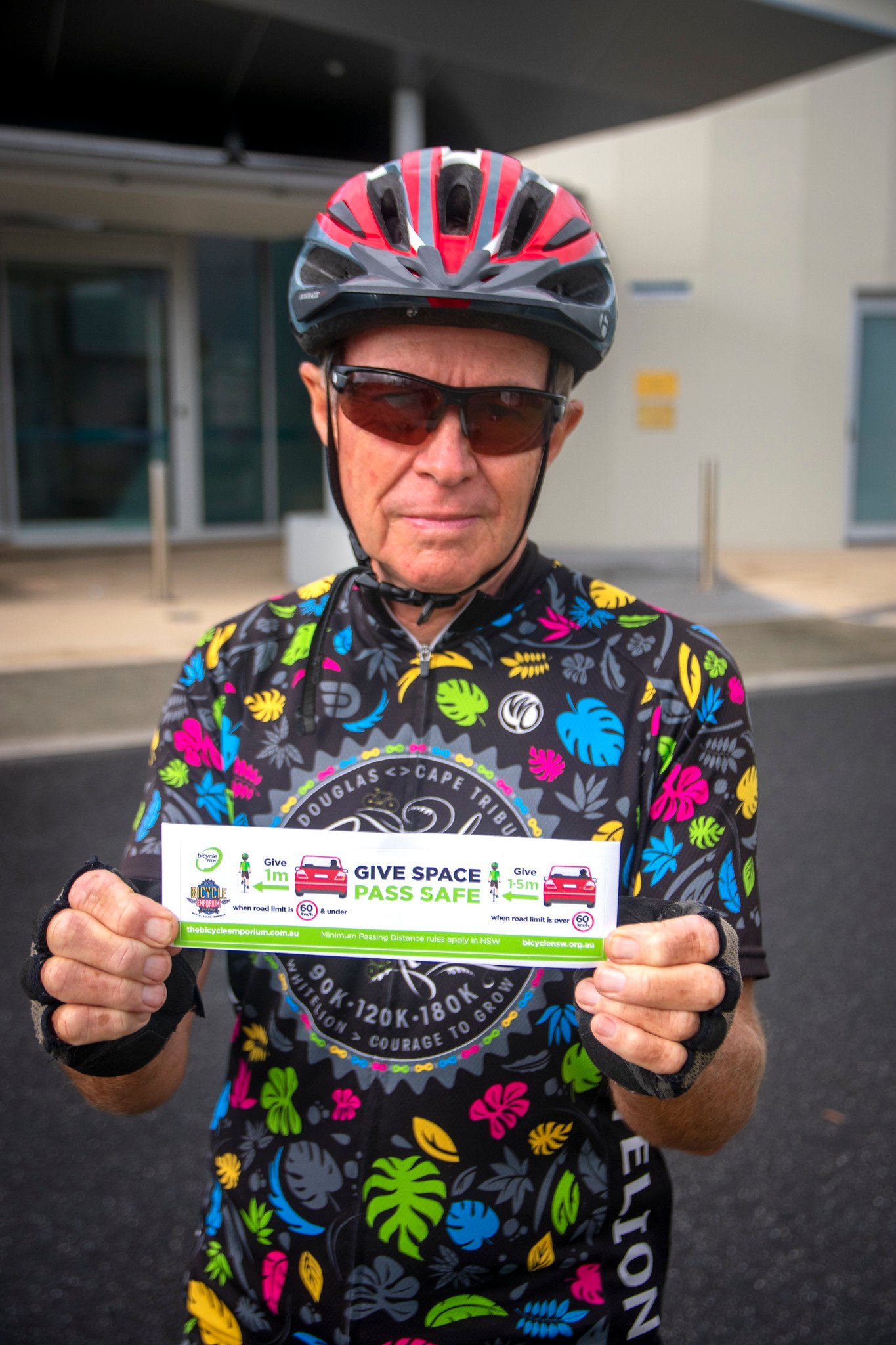
As Rob Goodwill explains, ‘The minimum passing laws were enacted to stop cyclists being killed by motorists. It’s not the other way round, there’s no danger to motorists from cyclists, but you’d think that was the case with the messaging from Transport.’
Official numbers show the fines are falling very disproportionately on cyclists too.
Mr Goodwill says there’s hypocrisy in Ballina Council’s approach, with new cycle paths being built but no safety messaging about the roads which remain necessary for most cyclists to travel on.
‘In their Community Connect publication two editions ago they had a piece on road safety, and it completely omitted any reference to cycling safety.
‘And yet they’ve just built a very nice coastal path. But people don’t cycle when it’s not safe. We’ve got a law that should be used,’ he said.
With very few dedicated cycle paths in the area, and limited council funding available to build more, Mr Goodwill said messaging and education campaigns offer a low cost solution.
‘The point about the minimum passing distance laws is that they’re designed to be enacted and enforced with the current status, which is poor infrastructure,’ he said.
‘But at least we can educate motorists about safe driving. It costs nothing, it can be done quickly, and other jurisdictions have done it.’
With the assistance of the Bicycle Emporium in Ballina, he’s printed his own stickers to show what could be done, based on Bicycle NSW recommendations.
As it stands, he says many motorists are completely unaware of the minimum passing laws, ‘and even a lot of cyclists, which is even more incredible.’

Advice for motorists
Robert Goodwill says that as a motorist himself, he would urge all motorists to look ahead when there’s a cyclist in front. ‘Remember you can overtake a bike on a single white line and a double white line when it’s safe to do so,’ he said.
‘It’s a legal manoeuvre. So don’t push the cyclist off the road. If there’s oncoming traffic, just wait and be considerate.’

Another thing that motorists might not be aware of is that white painted bikes beside roads (ghost bikes) indicate where cyclists have died.
Mr Goodwill says he’s had numerous close shaves himself, with cars getting far too close.
‘When I ride down Ross Lane in the morning, the numbers of motorists doing the wrong thing is not great. If there’s thirty cars passing me, it’s probably only two that get far too close, but that has a big impact on the safety of a cyclist, and that’s why they’re dying as well,’ he said.
Mr Goodwill once saw a cyclist literally pushed off the road on Ross Lane. ‘Yes, going up the steep bit towards the freeway. He was pushed right off the road on to the grass. This was all unfolding in front of me,’ he said.

‘The trouble is a lot of people, unless they visit a different place, like Canberra or Cairns, they just don’t know what good looks like, and they think this is the norm.
‘But it’s not the norm and it’s not acceptable.’
Robert Goodwill’s next port of call as a local cycling safety advocate is a meeting with MP for Ballina, Tamara Smith, who’s also a Greens representative.
‘Active transport is definitely a platform of Greens policy,’ said Mr Goodwill. ‘It reduces carbon emissions, it keeps people fit, it’s good for mental and social health and every other aspect.
‘This is an area that needs serious, rapid improvement. It’s blindingly obvious,’ he said.
 For four decades The Echo has printed the stories some people loved, some people hated, and some pretended not to read. If you want us to keep telling the truth, the real truth, not the sugar-coated version. We’ll need your support to keep the presses rolling.


