


Brought to you by The Echo and Cosmos Magazine
The powerful volcanic eruption was captured in amazing detail, yet remains shrouded in mystery.
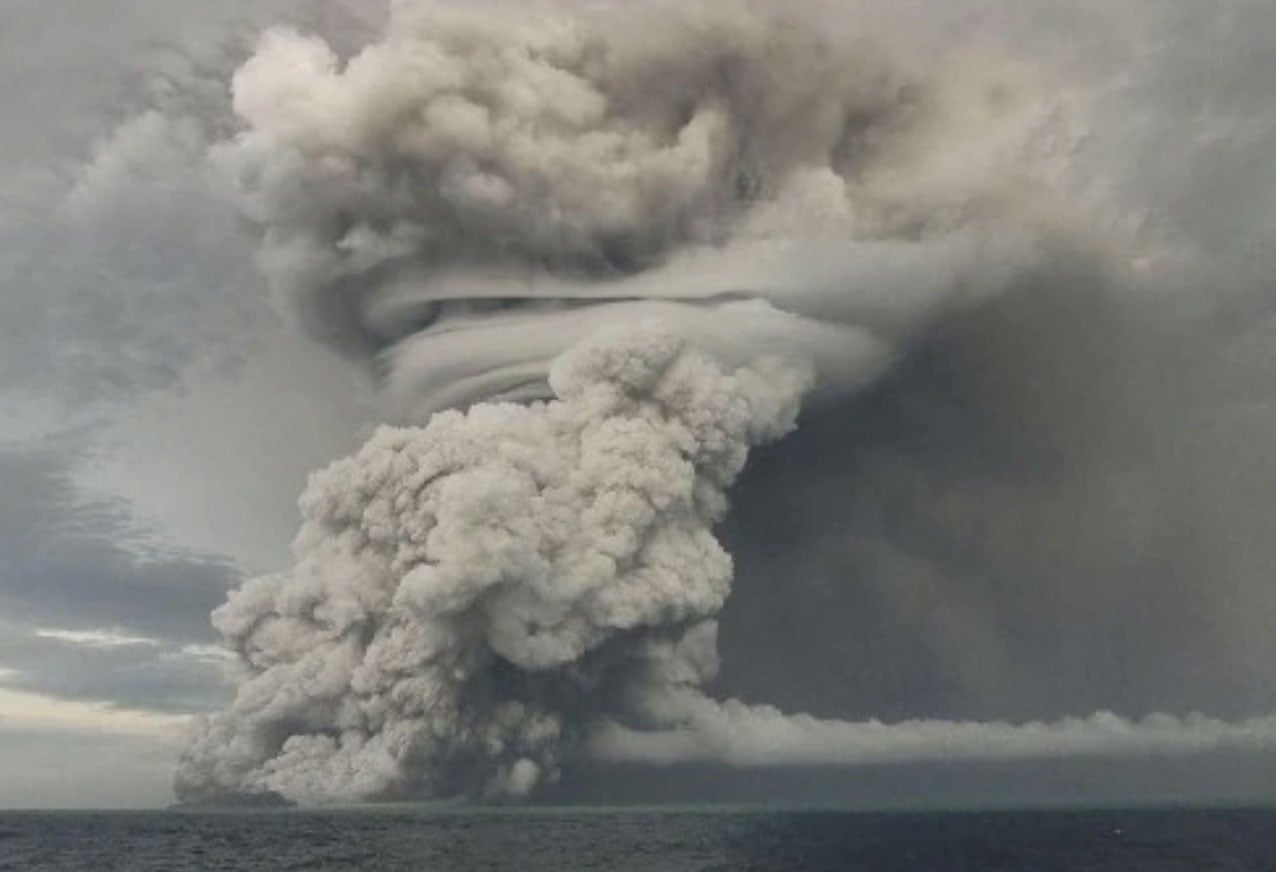
The eruption of the Hunga Tonga-Hunga Ha’apai volcano on January 15 triggered a towering ash plume that reached the stratosphere and sent a shockwave ricocheting around the entire globe. The plume darkened the skies of Tonga’s main island Tongatapu, 75km to the northwest, with ash falling as far away as Fiji. The explosion was accompanied by a trans-Pacific tsunami that had coastal communities as distant as Peru on high alert.
With its sole submarine cable damaged by the force of the eruption, Tonga’s communications have been limited. As the world anxiously awaits updates from the tiny Pacific nation, researchers are piecing together what information they can about the nature of the eruption. One conclusion is clear: we’re not out of the woods yet.
Volcanic activity could continue for weeks, or even months, extending the impact of this natural disaster beyond the cataclysm of the eruption.
What follows in the wake of a major oceanic eruption?
Are there more eruptions to come?
Hunga Tonga-Hunga Ha’apai has been restless during the last month, with previous eruptions on December 20 and January 12 acting as warning signals of the dangers to come. But these precursor eruptions have been dwarfed by the violence of the latest explosion, with all signs indicating that the large Hunga caldera has now truly awoken. How soon will it settle back into dormancy, or is there more to come?
A warning lies in geological deposits from the volcano’s previous eruptions, which appear to recur in roughly 1,000-year cycles as the depleted magma reservoir refills. Shane Cronin, a professor of earth sciences at the University of Auckland, says that the story written into these deposits suggests that the volcano tends to exhibit serial eruptions before returning to quiescence, with small releases increasing in frequency as capacity nears.
‘Once recharged, the large amount of magma crystallising starts to drive gas pressures up, too quickly for it to be released by small eruptions,’ says Cronin.
Was this latest eruption enough to vent the pressure?
‘We’re still in the middle of this major eruptive sequence and many aspects remain unclear,’ says Cronin, ‘partly because the island is currently obscured by ash clouds.’ Without access to the volcano, it’s difficult to determine whether this is the climax of the eruption.
‘It represents a major magma pressure release, which may settle the system,’ he says.
He warns that we could be in for several weeks, or even years, of major unrest from the Hunga Tonga-Hunga Ha’apai volcano. Until the ash cloud has cleared it is impossible to say with any certainty how destructive this unrest could be.
How long before the ash cloud clears?
The explosive eruption generated a huge umbrella cloud that extended well into the stratosphere, with most estimates now putting the plume at approximately 30km high – the largest since the Pinatubo eruption of 1991.
Shrouding the volcano from view and making aerial surveillance access extremely challenging, the cloud is hampering efforts to understand how the volcano is currently behaving, and how the people of Tonga are coping with the aftermath.
Early reports out of Tonga indicate that several inches of ash have fallen on the main island of Tongatapu, likely causing a suite of hazards.
‘Impacts on drinking water are the primary concern,’ says volcanologist Dr Chris Firth.
‘Ash can also blanket gardens and destroy crops, influencing food supply. Over the days and weeks following the eruption, ash will slow recovery efforts because of damage to infrastructure and impacts on transportation. This could become serious if food and water cannot be distributed.’
How long could this cloud persist?
‘The dense particles within the ash cloud will have settled out and fallen back to Earth within hours of the eruption,’ explains Firth.
‘Finer particles, in the range of microns to sub-millimetres, may stay aloft for longer as a haze. Already satellite imagery is showing that most of the ash cloud has settled out, but air quality over Tonga hasn’t returned to pre-eruption levels.’
Will the eruption affect global climate?
Significant volcanic eruptions can act to temporarily cool the climate, an effect observed when Mount Pinatubo erupted in 1991, dropping average global temperatures by half a degree for several years.
‘There are a couple of ingredients required for an eruption to have a climate impact,’ says Firth.
Did the latest eruption have the necessary oomph to achieve climate forcing? Probably not, says Firth.
‘Certainly, this eruption punctured into the stratosphere, but while it was large, it appears not have been big enough to modify the climate.
‘Current estimates suggest about 0.4 megatonnes of SO2 was released on Saturday. By comparison, the eruption at Pinatubo in 1991 emitted around 30 megatonnes. Unless the volcano continues to erupt and releases much more sulphur, it will have a negligible climate impact.’
Is a pumice raft likely to affect oceanic access to Tonga?
Many oceanic eruptions result in the formation of pumice. As roiling magma flows release into the sea, they rapidly cool and depressurise to form billions of frothy volcanic fragments that can aggregate into enormous rafts.
The lightweight structure of pumice belies the significance of the marine hazard it can create.
Though it may seem fragile, pumice can clog oceanic vessels’ cooling systems, effectively blocking engines. Extensive rafts can also hinder the accuracy of navigation systems, reflecting the radar waves that ships rely on to judge their proximity to the coast and other vessels. With maritime access to Tonga an urgent priority for aid, such a major disruption to shipping would be very unwelcome.
Pumice rafts can also be powerful ecological agents, blocking sunlight to photosynthetic phytoplankton and acting as a vehicle for marine hitchhikers.
The vast bulk of the Hunga Tonga-Hunga Ha’apai volcano lies hidden beneath the surface of the Pacific Ocean, and it might seem intuitive to expect that the latest eruption would generate enormous amounts of pumice – but the violence of this latest eruption may have precluded its formation.
‘Because much of the material was ejected into the atmosphere and then fell back down onto the sea surface, it’s likely that pumice rafts will be less massive than from previous eruptions at other volcanoes in Tonga that were deeper under the water,’ says Firth.
The ferocity of the eruption likely dispersed material over very large distances, potentially preventing the accumulation of pumice into sizeable rafts on the surface. Once again, this is a detail that awaits further investigation once the ash cloud has cleared.
Region-wide hazards call for a region-wide response
Australia is among a number of nations to have pledged to mobilise support for Tonga through the difficult recovery process. The destruction wrought by the tsunami and the widespread ashfall is likely to be felt across the country, and relief efforts from overseas may prove crucial. These bring their own concerns though, as Tonga is one of the few countries that remains COVID-free, and keeping the virus away from Tongan shores while the nation is vulnerable will be a pressing concern.
But while this short-term aid is vital, there is more that the world can do to learn from this disaster over the longer term.
‘This eruption reminds us of the importance of global and regional cooperation for monitoring hazards,’ says Dr Andrew Tupper, of Natural Hazards Consulting.
‘The tsunami from the eruption was observed on many tide gauges that had been installed by Australia, and it’s important to keep those going. Tonga’s volcanoes are mostly unmonitored, like many across the region, and sustainable investment in ongoing monitoring would help predict and quickly assess future events.’
There is more than altruism at play at here.
‘This is not just for the benefit of the people of the Pacific Islands, important though they are,’ says Tupper.
‘Investment in observations of this kind helps us predict what will happen in the ocean and atmosphere for Australia and New Zealand, so we actually get the investment returned to us with interest.
‘Nations such as Tonga, with a small population but a vast area, can’t be expected to do all the heavy lifting themselves in dealing with region-wide hazards.
Firth reminds us not to take our eyes off the big picture – as climate change picks up pace and sea levels continue to rise, many island nations are becoming increasingly vulnerable to phenomena such as the tsunami that accompanied this eruption.
‘I have found the Australian government’s rhetoric on this topic interesting,’ he says.
‘There has been talking about supporting our “Pacific family” now that they are suffering, but the Australian government has steadfastly ignored Pacific leaders demands for stronger climate action in the past.’
Tupper agrees: ‘Let’s use this eruption as an opportunity to make sure that we don’t take our eyes off the environmental ball when we’re dealing with other issues such as the pandemic.’
This article was originally published on Cosmos Magazine and was written by Jamie Priest. Jamie Priest is a science journalist at Cosmos. She has a Bachelor of Science in Marine Biology from the University of Adelaide.

 For four decades The Echo has printed the stories some people loved, some people hated, and some pretended not to read. If you want us to keep telling the truth, the real truth, not the sugar-coated version. We’ll need your support to keep the presses rolling.


