


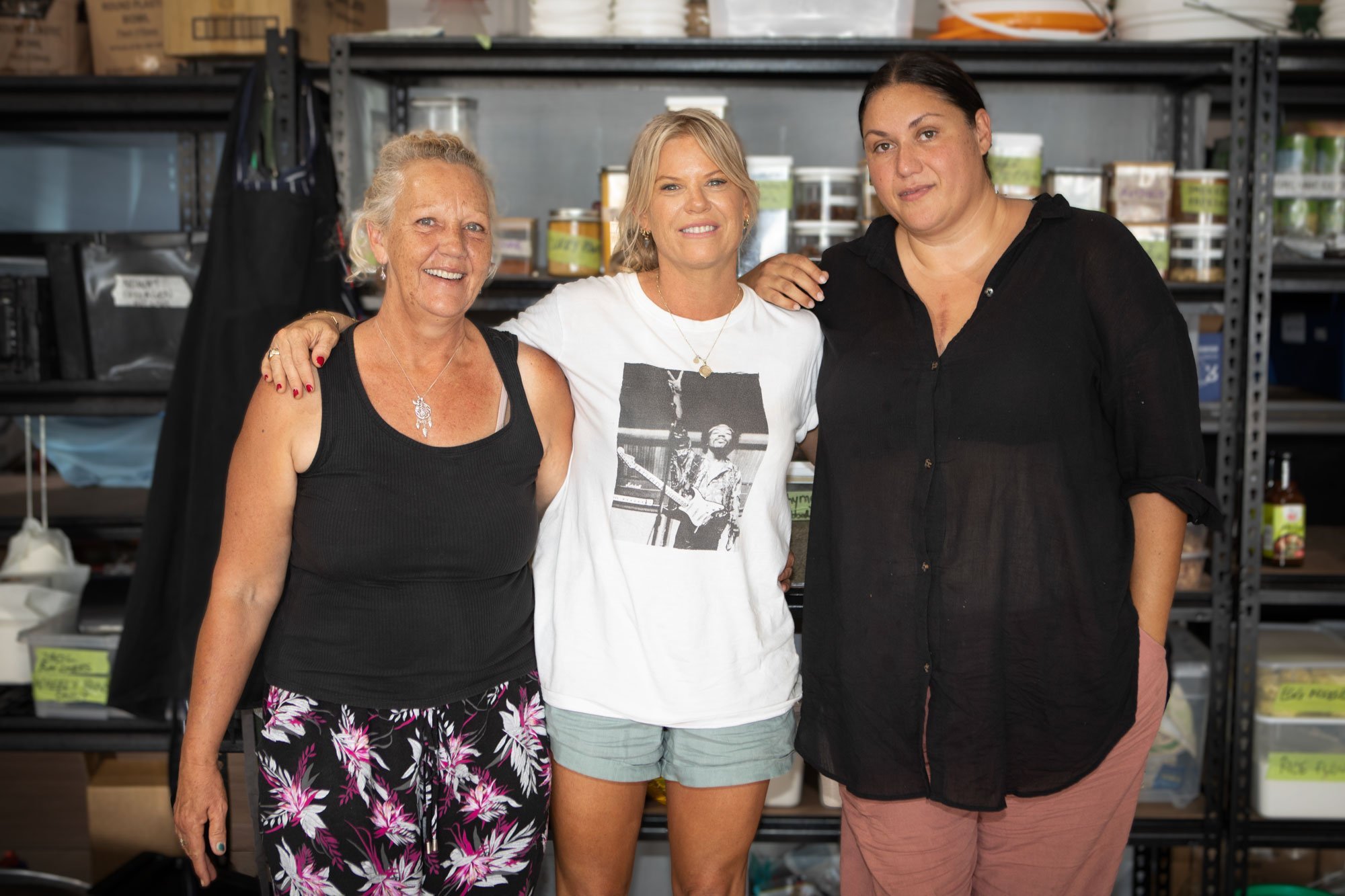
With the new year came the news that the Koori Kitchen in Lismore would not be reopening and that the facility would be packed down – Council wants their parking spaces back.
The Koori Kitchen was a place where the community of Indigenous and non-Indigenous people could gather for a feed, an ear, a shoulder and directions to post-flood services. It was a safe space for people to rest and eat and yarn.
The kitchen opened in March next to the flooded Koori Mail building as part of the Mail’s massive community recovery operation. After the second flood the kitchen moved across the road to the Browns Creek carpark – there it sat happily serving hundreds of meals a day until rumblings from Council in October and November about the carpark spaces and then in December when they were told they needed to go.
An important role in helping our community recover
Lismore City Council Interim General Manager, John Walker, says the Koori Kitchen has played an important role in helping the community recover from the February natural disaster. ‘However, almost 12 months on since the disaster many of our CBD businesses have reopened with even more planning to reopen in the coming months. This means there is now a great demand for parking to assist these businesses to recover.
‘To this end, Council has been working with the Koori Mail to determine what services are still needed, and if and how they can be provided from another location that does not take up crucial parking spaces.’
The footprint of the kitchen does take up about 12 to 15 car spaces and it means that drivers need to use another entrance, but that would appear to be a small inconvenience for the service provided.
The kitchen that grew from a food tent
Kitchen coordinator Chelsea Claydon began as a volunteer and helped in the food tent. ’It evolved from there. We initially started off with some people who were doing dahl and vegetarian food. The demand became so massive that we expanded almost to half of that tent, then we just took over and did a full-scale kitchen – almost 2,000 meals a day at that point, and deliveries going out to every single town that we could send it to.
Claydon says they evacuated the kitchen after the second flood and were put into the carpark with the old tent. The new structure was erected in June.
Claydon says there have been a lot volunteers. ‘There have been so many people helping. Usually, on a shift, it’s about 10 people just to manage to get all the meals out. It runs like a well-oiled machine now – like clockwork.
400 to 600 meals a day
‘When we stopped, just before Christmas, we were doing between 400 and 600 meals a day.
We were so worried because we’ve got so many deliveries. A lot of our people can’t get here, they’re still flood affected, obviously, and no cars. So that’s over 100 people that we do daily. And that’s my biggest fear. Who is going to look after those people?
Claydon says she knew the end was coming since October and she has hoped to find a new location. ‘I was trying to push back and ask for a bit more time because I know that there’s nothing available in town at the moment that’s ready to walk into. I didn’t want to be caught where we would be coming back here having to pack up and then we wouldn’t be able to open for months and months because there’s nothing available for us to move into.’
Shocked at Council’s action
Claydon says she was initially shocked at Council’s action. ‘I know that we’ve worked so hard, tirelessly here, to work on seeing the benefits of not only just being able to give people a nourishing meal, but also the mental health aspect has been massive. So to come and break that down –everyone that comes into this kitchen feels the warmth that we get from our customers who have actually been traumatised, and all of those things. And they just love having a sit thing on the balcony where they can chat to their friends and meet new people.’ Yeah.
The Koori Mail’s General Manager, Naomi Moran, is not happy. ‘I think looking back on the history of how the Koori Kitchen came about, how it started, how it’s evolved, I think the most disappointing part is that what we’ve been able to do here the past 11 months for the community has been 100 per cent supported by the community, and that Lismore City Council certainly didn’t provide any financial support, or any other support for that matter, in terms of the operations down here.
Disappointment on top of disappointment
‘So for them to make a decision as easily as they could without considering just how much effort and time and resources and generosity and kindness has gone into what we’ve been able to do for the people for the community, I think that’s the most disappointing part.
Ms Moran says it’s always the way if you’re not on the ground, doing the work. ‘If you’re not here, seeing the diversity of people that we deal with every single day, whether it’s providing them with food and water, providing them with emotional and mental well-being services, providing them with a holistic approach – to what it means to care for people in their time of crisis, unless you’re here, doing what we’ve been doing the past 11 months, you cannot fathom just how vital and important something like this has been for the community.
No respectful conversation
‘To make a decision from leadership within a local council organisation without having some really robust and respectful conversations with, not just those that run the Koori Kitchen and with the Koori Mail – but with our volunteers with our community – without actually giving us the respect of having those conversations a long time ago, and understanding where we’re coming from so that they could perhaps, support us instead of working against us. that’s the most disappointing thing.
Ms Moran says it isn’t just about conversations that were had in October and November. ‘These are conversations that could have been had throughout the entire year to consider how important the work is that has been done here.’
A service predominantly supported by Indigenous community
Ms Moran said another thing that is important to remember is that it needs to be remembered that this is a service that has been predominantly supported by the Indigenous community. ‘It has been overseen and supported by an Aboriginal organisation that has existed in this community for 30 years. And that is operated out of that building [points across the road] for 20 years.
‘This is about Aboriginal and Torres Strait Islander people certainly being able to govern our own affairs when it comes to looking after people. So to not have respectful conversations with First Nations people here about what we’ve been doing here and how that’s not only supporting the wider Lismore community but supporting our Indigenous community, providing a culturally safe space, providing culturally safe people that can work with our community and look after their needs, that’s what we need to understand.
‘This is also about a complete disregard for how Aboriginal people and an Aboriginal organisation can control their own affairs for the better of the community.
Leadership without title or hierarchy
This isn’t about us. This is about the community and our leadership, how we approach things, how we work with people, respectfully in our community, certainly comes without title, comes without hierarchy. This is about how we’ve always worked together as people for our community, and I just think it’s a real shame that Lismore City council, and the wider Lismore community can’t work with us better, especially in a time of crisis.
‘I think that it’s actually embarrassing. It’s embarrassing that Lismore City council has an Aboriginal advisory group that sits within Council, it’s embarrassing that Lismore City Council has just paid lip service to the Native Title determination for the Widjabul Wyabul people that’s just been handed down yet. They’re very quick to shut down an Aboriginal organisation that is supporting a kitchen could be still providing hundreds of meals a day for people in need.
‘This is also about questioning the existence of an Aboriginal organisation by people that work and operate within Council, which they have no place to do so.
‘So this isn’t just about this decision that was made the other day, this is actually about the last 11 months of constant the expectation that we are answerable culturally, to non-Indigenous people. That disrespect is something now that they can’t take back.’
The kitchen could not go on indefinitely
Chelsea Claydon says she realised the service could not go on indefinitely. ‘To be honest with you, I think if we could continue in some capacity for a while that would be great.
‘I don’t think it’s going to go forever – of course. I do think that it would be nice to carry it on for as long as the need is there.
‘I know that stopping it right now is probably a bit too early because people are still really in need.’
 For four decades The Echo has printed the stories some people loved, some people hated, and some pretended not to read. If you want us to keep telling the truth, the real truth, not the sugar-coated version. We’ll need your support to keep the presses rolling.


