


Council’s Water and Sewer Advisory Committee (WSAC) members Ben Fawcett and Elia Hauge say their concerns around Mullum’s future water strategy were never discussed, nor answered by Council staff.
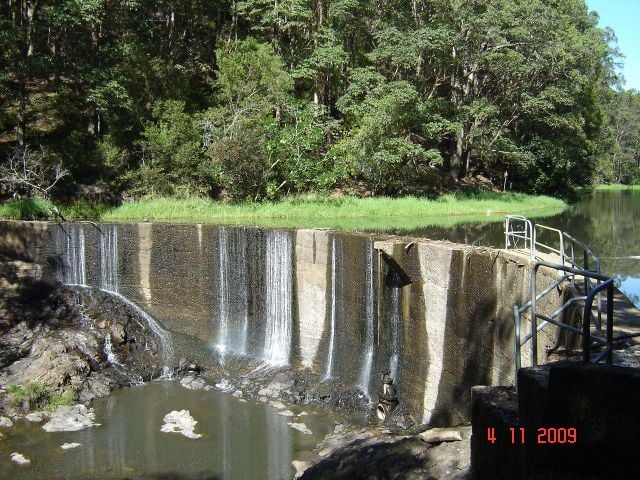
Public submissions are now open for the future of Mullum’s water supply, which is currently sourced from Lavertys Weir in Wilsons Creek. Council staff are pushing to disconnect it, in favour of the town being supplied instead by Rous County Council via its Ricky Creek Dam near Lismore. This is based on a report by consultants Hydrosphere, who also provide Rous with reports and advice.
WSAC member questions are included in the agenda of the Extraordinary Meeting of the WSAC on September 28, 2022, where the Hydrosphere Report (2021) was discussed.
The Echo asked staff, ‘If correct, is there a reason why their concerns were ignored?’
Cameron Clarke, Manager Utilities, replied, ‘A number of the questions raised are addressed in the Hydrosphere report. ‘Further efforts to address the questions were made during discussions at the WSAC meeting and in a presentation by Rous County Council to the committee in May 2023’.
Yet Cr Duncan Dey said fellow WSAC members Ben Fawcett and Elia Hauge ‘raised their questions after reading the Hydrosphere report. To say the answers are in the report is insulting’.
He said the question were for more information around the off-stream storage proposal (Resolution 23-120, parts 7 and 8).
‘We were told that investigating the off-stream storage option would be a waste of $200,000’.
‘Off-stream storage would make the Lavertys Gap source a gem of ecologically sustainable water supply’, he said.
Concerns over criteria dismissed
WSAC member Elia Hauge told The Echo, ‘There is a general approach of dismissing our concerns on the WSAC’.
She said, ‘Best practice water management involves integrated assessment – looking not just at a single supply, but at water systems as a whole. I asked a number of questions about demand management, leakage management and recycled water strategy that were never answered. I also asked how hydrosphere/council established “community acceptance’ of different options – this was not explicitly answered. I also don’t recall a satisfactory answer to the questions about why different criteria were used at the long list & short list options phase – the criteria selected placed less emphasis on environment at the long list stage than at the short list, potentially skewing the outcome of the assessment.
‘One question that was answered, but I believe needs to be re-emphasised: “Has Council or Hydrosphere approached DPE for their updated hydrological and climate models? (i.e. the ones used for the recent Regional Water Strategies)”.
‘I recall the answer was no. So, to assess our next generation’s water supply, we are using climate models that are woefully outdated and leave us unprepared for the climatic extremes we may face in coming decades’.
Multi-Criteria Assessment concerns
Mr Fawcett told The Echo his concerned were around consultant Hydrosphere’s Multi-Criteria Assessment (MCA), which is summarised as Appendix 4 of their report.
‘As I noted there, MCAs should be robust, transparent and defensible. The WSAC is a key stakeholder in this debate, being a group of local people with relevant professional skills, who act as a bridge between Council staff and councillors, and the Byron Shire community. The WSAC has never had any discussion in which Hydrosphere are asked to defend their MCA, including the data used, in all three criteria, the weightings and the scores.
‘Since the MCA is the key component of the report on which recommendations are made about the various scenarios under discussion, this lack of debate and defence is crucial. Staff set the agendas for our meetings and have avoided the essential debates. Without such, thorough debates, decisions made by Council are dubious, to say the least’.
Mayor Micheal Lyon, who is chair of the WSAC, was asked whether he supports staff’s position of disconnecting the town’s water supply in favour of being supplied by Rous County Council. A reply will be published when/if received.
 For four decades The Echo has printed the stories some people loved, some people hated, and some pretended not to read. If you want us to keep telling the truth, the real truth, not the sugar-coated version. We’ll need your support to keep the presses rolling.


