


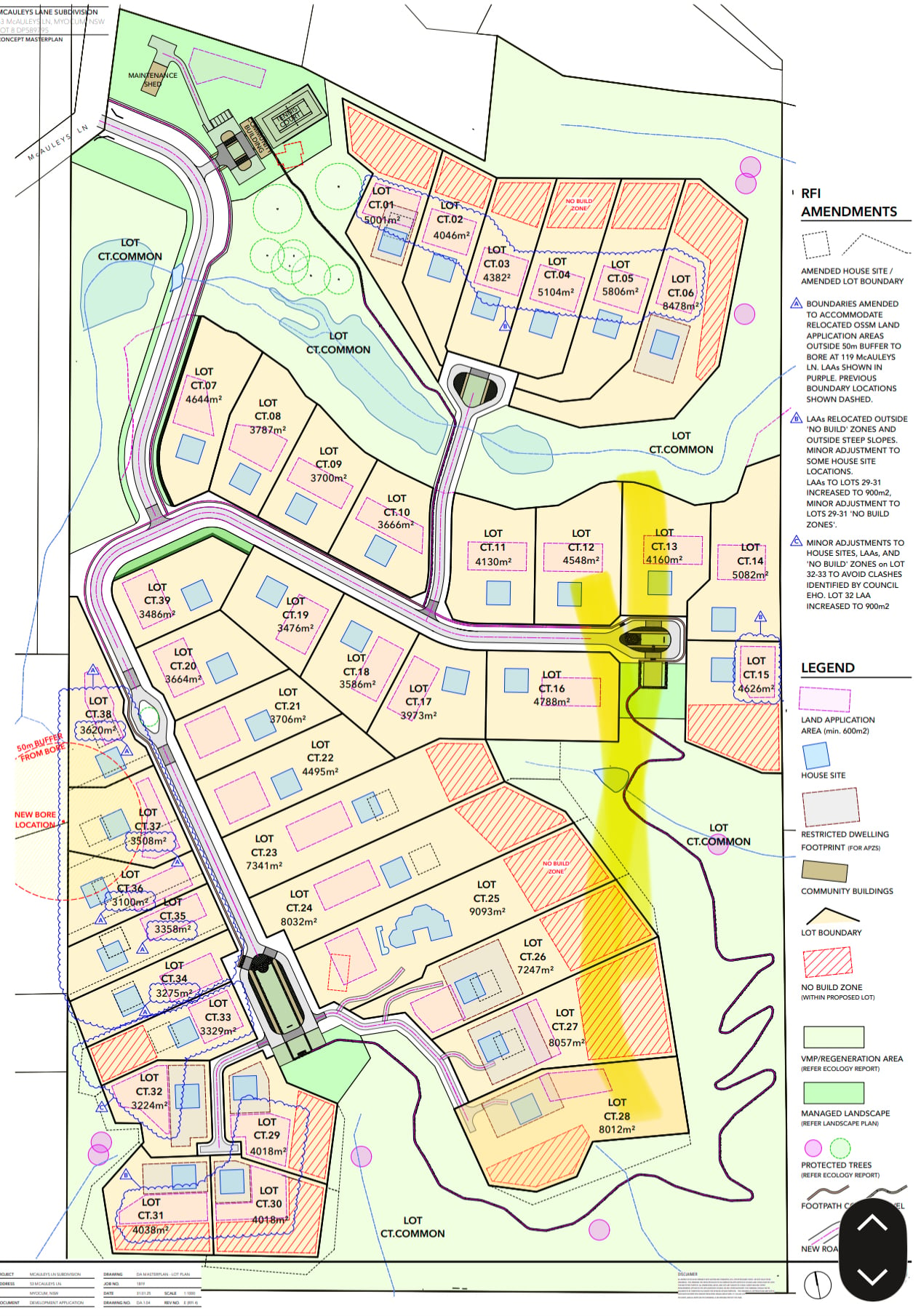
A controversial large exclusive 38-lot DA, proposed by wealthy developers John Callanan, and Tim Mundy – with help from lead designer and now Deputy Mayor Jack Dods – was approved by the Northern Regional Planning Panel (NRPP) on June 26.
The NRPP are tasked with determining large DAs, bypassing Council as the consent authority. Throughout the long process, planning staff and most councillors advocated for the development, despite unanswered questions and bungled processes.
The process has left neighbours aghast at the poor process, and perceived favouritism for the developer, while disadvantaging long-term locals.
The NRPP panel that unanimously approved the subdivision at 53 McAuleys Lane, with conditions, comprised chair Di Leeson, Stephen Gow, Michael Wright, Joe Vescio and Simon Richardson.
Richardson is a former Byron Shire mayor, and presided over Council’s Rural Land Use Strategy that enabled the land to be rezoned. He has mentored previous mayor Michael Lyon and current Greens Mayor Sarah Ndiaye.
Cr Ndiaye supported the DA, and used her casting vote to squash fellow Greens Cr Elia Hauge’s efforts to delay and seek independent legal advice around the planning agreement. That agreement includes the option of Council compulsory acquiring land that was needed for the DA’s approval, and Cr Hauge voiced concerns that acquiring land on behalf of developers was not usual practice. The planning proposal as adopted by Council was supported by Cr Ndayie, but not by her team of Crs Hauge, Kay and Lowe.
The panel said in their support of the DA, ‘While some panel members shared concerns about the number of proposed lots, the panel notes the determination of maximum lot yield, with which the application complies, was made as part of the rezoning process in 2020 prior to being considered by the panel’.
Following the NRPP’s approval of a Community Title (CT), adjoining resident, Sharon McGrath, voiced her ongoing concerns about the process – not the principle – of the development.
‘We were never against the subdivision itself,’ McGrath said. ‘Our involvement has been driven not just by the fact we live next door, but by recognition of serious issues with both the rezoning and the DA.’
Consultation a critical failure
She says the initial lack of consultation was a critical failure.
‘Consultation was promised but never delivered. The wave of community opposition wasn’t just reactionary — it reflected the developers’ complete disregard for the legislated requirements to consult with residents.’
Like many neighbours, McGrath says she was caught off guard when the development application was first lodged — but it didn’t take long to notice things were amiss.
‘We were thrust into it, completely unawares. But straight away it was obvious the developers weren’t following proper process. The whole issue lacked transparency, and Council wasn’t doing enough to ensure they complied with its own planning rules.
‘Once the DA was submitted, red flags started appearing left, right and centre. The subdivision plan ignored advice from what was then the Department of Planning and Environment. The Biodiversity Development Assessment Report didn’t match the original Ecological Assessment. Traffic data was outdated. The intersection plans didn’t meet Austroads standards. And suddenly the developers were walking back their commitment to a cycleway and footpath, saying it was all too hard and expensive. None of it added up.’
In response, McGrath and her husband Richard Kowalski sought expert advice.
Peer reviews confirmed what we feared
‘To get to the bottom of it, we commissioned peer reviews by independent consultants. And those reviews confirmed what we feared — the documentation was incomplete, plant type communities had been downgraded to reduce protections for Threatened Ecological Communities, the traffic data was out of date, DPE advice had been ignored, and the plan included discharging septic and stormwater runoff into our rehabilitated wetland — without even asking us.’
While the final Conditions of Consent don’t resolve all concerns, McGrath acknowledges that some of the issues raised by residents were taken on board.
‘We’re grateful that some of our concerns were heard. There are now no-build zones protecting remnant rainforest, more stringent requirements for on-site sewerage, restrictions on short-term letting, covenants on domestic pets to protect wildlife, a cycle and footpath to the intersection, and protection of high-value vegetation at the Mullumbimby Road end.’
But she says increased traffic on a poorly maintained rural road and the intersection design — a key safety issue — remains unresolved.
‘We’ve consistently advocated for a roundabout with a reduced speed zone. It meets Austroads guidelines, it’s safer, it improves traffic flow, it’s more durable in the long run, and it would fit in the existing road reserve. Even the developer supports it. But our appeals were fobbed off.’
That frustration was compounded when, just days before a key Council vote, a new version of the Planning Agreement was tabled — one that required private land acquisition for the intersection works. According to McGrath, the affected landowners were never notified that the motion was on the agenda.
Blindsided locals
‘It was outrageous. The landowners didn’t even know Councillors were voting on it until the week of the meeting — and only because a neighbour happened to mention it. They weren’t consulted, they weren’t advised, and they were blindsided.’
The emotional toll of that moment has stayed with her.
‘Even after all the years we’ve spent dealing with this DA, I wasn’t prepared for how heartbreaking it was to hear those landowners speak. It brought me to tears. The amendment was manipulative. It ignored Council policy, lacked process, and Councillors weren’t properly briefed. It was just appalling.’
While the development now moves ahead under deferred commencement conditions, McGrath says she still holds out hope for respectful dialogue.
‘I hope John Callanan [the developer] honours his commitment to engage fairly with these long-time Mullum residents. And I hope Council learns from this and adheres to its own policies next time – before it’s left to the community to hold the process to account.”
Reflecting on the experience, she says it has reinforced the importance of civic engagement.
‘This whole ordeal has deepened my appreciation for the community and environmental defenders who step up every day. It’s been a reminder — a sharp one — that we all need to stay vigilant. Because some developments don’t aim to improve outcomes. They just aim to get through without being noticed.’
 For four decades The Echo has printed the stories some people loved, some people hated, and some pretended not to read. If you want us to keep telling the truth, the real truth, not the sugar-coated version. We’ll need your support to keep the presses rolling.


