



The 20th National Rail Safety Week is being marked with a solemn ceremony at the Australian Railway Monument in Werris Creek in northern NSW today. The ceremony will honour rail workers who have died in service to Australia’s rail network.
More than 100 families, friends, and colleagues of those who have died, as well as representatives from across the rail industry, will hold a minute’s silence and lay wreaths next to the names that will be remembered forever.
Each of the more than 4,500 names on the National Railway Monument at Werris Creek represents the loss of a railway worker since the 1850s. This year, four new names have been added to the walls of the monument. One of them was Troy Ernst, a freight train driver who died in an accident in December last year.
The others are names of railway workers, one whose death dates back to early this century and two others from the 1920s and 30s. Their names have only just been added to the monument due to recent research by volunteers from the Australian Railway Monument and Rail Journeys Museum.

Behind every statistic
Minister for Regional Transport Jenny Aitchison said, ‘National Rail Safety Week reminds us that behind every statistic is a person, a family, and a community that has experienced profound loss.
‘Railways have powered our economy and connected communities for generations, but they also carry inherent risks. This week, during National Rail Safety Week, I reaffirm our commitment to keeping everyone safe, every day, in and around our railways,’ she said.
‘I want to thank drivers, engineers, station staff, maintenance teams, and many others who work tirelessly to keep our railways running and safe both now and into the future. Our government will continue to back them with the resources, support and safety measures they deserve.
‘Today’s National Rail Safety Week ceremony is a powerful and poignant reminder that safety must never be taken for granted. It must be lived, acted on, and protected – every day, in every decision we make. The NSW government’s commitment to rail safety is unwavering and absolute.’
Executive Director, TrackSAFE Foundation, Heather Neil said, ‘As an industry, a community and as individuals, we all must play an active role in keeping ourselves and others safe around the rail network.
‘Infrastructure upgrades and the use of new technologies help improve the safety of the network. But we also need truck and car drivers, cyclists, motorbike riders and pedestrians to be aware of tracks, look for trains, tram and light rail vehicles and follow all signposted rules.
‘Any death or injury on the rail network is devastating – not just for the family and friends impacted but also for rail workers involved in the incident and the first responders called upon in the rescue effort.’
Regional level crossings
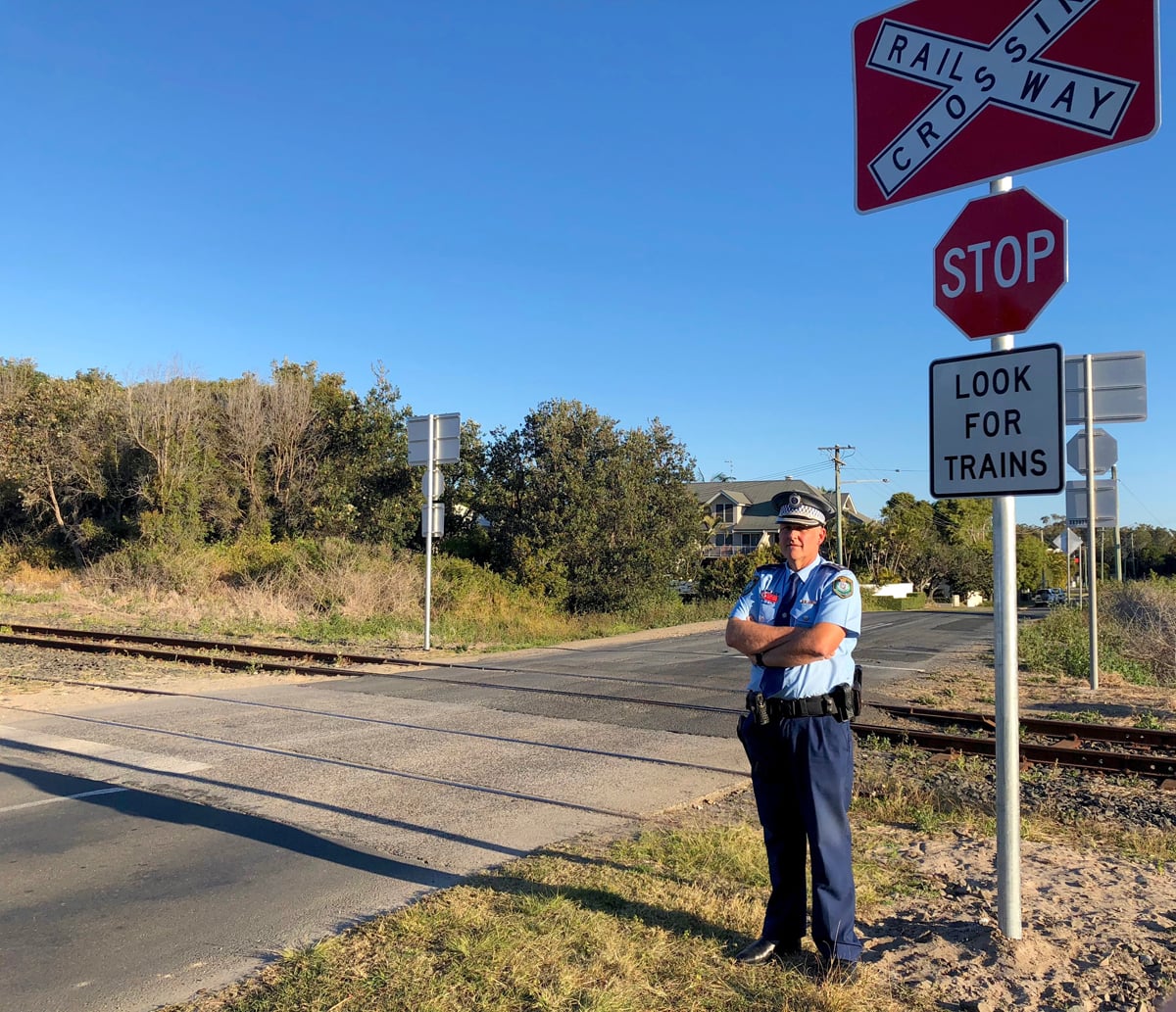
Meanwhile regional motorists are being urged to obey the rules and stay safe around level crossings, after joint enforcement in regional areas resulted in 80 driver fines for ignoring signals about approaching trains and for speeding.
During a recent ten-day Level Crossing Awareness and Enforcement campaign in the Liverpool Plains area, NSW police detected 55 offences at level crossings. Police penalised a further 35 motorists at four level crossings in the Riverina.
There were five collisions between trains and road vehicles at level crossings in NSW last financial year including the single fatal collision at the Twigg Road Yenda level crossing last September. There were also 74 near hits between trains and road vehicles at level crossings in NSW.
In the past 10 years there have been 69 collisions between trains and vehicles at NSW’s 1,307 public road level crossings, resulting in 9 deaths and 9 serious injuries. Some 64 of those crashes occurred in regional NSW.
Every year, the NSW Police Force and Transport for NSW run localised awareness and enforcement campaigns to enforce the rules at level crossings using highly visible police enforcement. Motorists who gamble with their safety at level crossings face three demerit points and a $562 fine.
Trains can travel at speeds of up to 160 kilometres per hour and can take up to 1.4 kilometres, or 14 football fields, to come to a complete stop. Even if a train driver sees you, they can’t stop in time.
Minister for Police and Counter-terrorism, Yasmin Catley said, ‘On long drives, especially on our regional roads, it’s easy to slip into autopilot but if you miss a warning sign, you could be missing the chance to save your own life.
‘If you’re not responding to the signs at level crossings, you’re not paying enough attention to drive on our roads and that makes you a danger to yourself and everyone else. Level crossing safety comes down to one thing – paying attention.
‘Whether you’ve been behind the wheel for five minutes or five hours, you can’t afford to switch off.’
Minister Jenny Aitchison said, ‘Closed gates and flashing lights at level crossings mean that a train is approaching and motorists who choose to ignore these signals are putting themselves, their passengers, pedestrians, as well as train passengers and drivers at risk.
‘With more than 30 trains a day passing through some level crossings, it’s extremely important for motorists to be patient and obey the signs, flashing lights, boom gates and road markings. Ignoring them can and sadly has resulted in avoidable tragedy.’
 For four decades The Echo has printed the stories some people loved, some people hated, and some pretended not to read. If you want us to keep telling the truth, the real truth, not the sugar-coated version. We’ll need your support to keep the presses rolling.


