



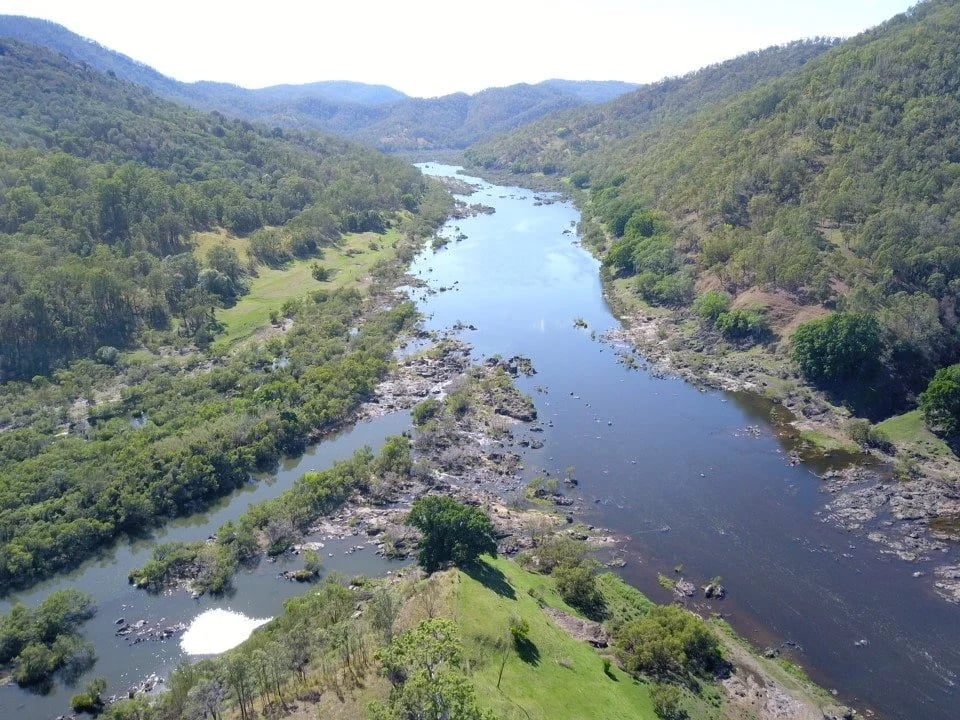
The Clarence Catchment, an important tributary which runs from the Great Dividing Range to the coast at Yamba/Iluka, is under threat from mining and the NSW Labor government is ignoring calls for its protection, says community group Clarence Catchment Alliance (CCA).
Covering an area of over 22,000 square km, it is NSW’s biggest coastal catchment, and is known for its stunning beauty, massive floods, and rich biodiversity (like Eastern Freshwater Cod).
Yet the catchment is also earmarked for mining exploration, with licences being granted by the NSW government.
And given that the catchment is also a crucial freshwater source, supporting communities and agriculture, CCA have called on the NSW government to ‘Ban all mineral exploration and mineral mining activity in the Clarence Catchment’.
In a statement, the CCA said they ‘have been patient; deliberately so’.
‘Since delivering a comprehensive 120-page evidence document to NSW Ministers’ offices at Parliament House on 5 August 2025, the CCA deliberately held back from going to the media’.
‘That document, eight years in the making, did not just outline the serious risks of mineral mining in the Clarence Catchment, it also set out clear, lawful and practical actions available to Government to protect the region.
‘We waited in good faith for the formal, detailed and considered responses our community deserves. We placed trust in the system; and in the responsibility of the two key portfolios that hold the levers for protection in NSW. To say we are disappointed in the response, or lack of, is an understatement.
‘The CCA allowed time for the system to work, and for the two key portfolios that hold the levers for protection in NSW to respond:
• The Minister responsible for the Mining Act
• The Minister responsible for the State Environmental Planning Policy (Resources and Energy) 2021 (Mining SEPP)
‘This approach was taken because the CCA’s goal has always been clear; evidence-led protection of the Clarence Catchment, not political theatre. But the time for silence, and for generic reassurance, has passed.

What the CCA asked Government to do, and why
‘The CCA’s requests were not vague, ideological or reactive. They were structured, lawful and grounded in eight years of work, including flood and bushfire risk mapping, river proximity and contamination pathways, drinking water exposure, threatened species records, cultural impacts, economic analysis, landholder testimony, and hundreds of community stakeholder statements.
‘The CCA formally called on the NSW Government to:
1. Ban all mineral exploration and mineral mining activity in the Clarence Catchment, because this is a high-rainfall, flood-prone drinking water catchment where contamination risks are heightened and irreversible once industrial activity begins.
2. Use existing powers under the Mining Act to cease the renewal and transfer of Exploration Licences and Mining Leases, revoke existing licences, and require stronger assessment in recognition of the Clarence Catchment’s unique risk profile.
3. Amend Schedule 1 of the Mining SEPP to prohibit mineral exploration and mineral mining across the Clarence Catchment, including the relevant feeder sources to the Clarence River from surrounding local government areas.
4. Amend the Mining Act 1992 to prohibit exploration and mining in major drinking water catchments, culturally and environmentally sensitive areas, and flood- and landslip-prone regions, including the Clarence Catchment.
‘The CCA also made a specific, moderate and entirely lawful request to the Minister for Natural Resources to use her discretion to call in environmental and social impact studies for Exploration Licence ‘Applications targeting antimony on the Dorrigo Plateau, inside the Clarence–Coffs regional drinking water catchment. This request was made in light of the March 2025 antimony detection at Shannon Creek Dam and the scale of the drinking water system at risk, servicing approximately 120,000 people.
‘Importantly, the CCA was explicit in its correspondence that it was not seeking generic explanations of existing regulatory frameworks, or that it was ‘just exploration’ and that it was seeking point-by-point responses to the evidence provided, not the same stock language the community has received for years.
What the CCA received, and what it did not
‘The CCA has received no response at all from the Minister for Planning and Public Spaces, Paul Scully, despite that portfolio holding responsibility for the Mining SEPP and the planning mechanisms that can prohibit mining and exploration in sensitive and high-risk regions.
‘Silence is not neutral. It leaves communities without clarity, accountability, or assurance that drinking water protection is being treated with urgency.
‘The CCA has received a response from the Minister for Natural Resources, Courtney Houssos, that does not address the evidence submitted nor the specific Clarence Catchment–focused requests put forward.
Instead, the response relies on broad descriptions of existing regulatory processes and general assurances about how mineral exploration is managed in NSW. However, exploration licences are issued for the purpose of progressing toward extraction and potential Mining Lease approvals. Approving exploration in a flood-prone drinking water catchment without first addressing whether mining is acceptable in that location defers risk rather than managing it. The detection of antimony in the Coffs Clarence drinking water is a case in point.
‘Also, the response does not address the CCA’s call for environmental and social impact studies on the Exploration Licence Applications (ELAs) for antimony on the Dorrigo Plateau. It does not engage with flood-driven contamination risk, nor with the extensive global and Australian evidence of tailings dam failures and water contamination associated with mineral mining, particularly in high-rainfall environments.
‘The Minister’s response also failed to address a specific issue raised directly during the CCA’s parliamentary meetings. During those meetings, advisers gave direct assurances that concerns raised by Clarence landholder and eco-tourism operator Steve Ross would be examined and responded to. Mr Ross’ property is affected by three Mining Leases, and he provided detailed evidence of environmental, land-use and regulatory failures impacting his land and business. To date, no response has been provided to him, despite those assurances and despite the CCA formally requesting a response in its written correspondence.
Public comments that heighten concern
‘The CCA’s concern deepened when, after receiving the 120-page evidence document and meeting with the CCA delegation, and before providing a formal written response, the Minister for Natural Resources publicly stated in NSW Parliament that she did not intend to rule out parts of the State for mining.
‘In that exchange, the Minister framed mining close to towns as beneficial to regional NSW, citing growth and support for local schools and football clubs, completely ignoring more than 10,000 residents who signed a petition, and the 72% of residents who responded to a Southern Cross University survey, all expressing opposition to mineral mining in the Clarence Valley.
‘While community wellbeing matters deeply to the CCA, such framing is disconnected from the seriousness of the risks placed on the public record; risks to drinking water, flood-affected landscapes, cultural Country, and existing clean-water reliant industries that already sustain thousands of jobs in the Clarence region.
‘This is not a values debate about mining communities. It is a risk assessment question about whether some places are simply unsuitable for mining, where risk-free operations cannot be guaranteed no matter how well-intentioned the regulation.
Why this matters
‘This is not an abstract policy discussion.
‘The Clarence Catchment is a flood-prone drinking water catchment. Contamination of water is heightened in such areas. Once contamination occurs, it cannot be undone by rehabilitation conditions or regulatory assurances. That is why precaution matters at the exploration stage, not after harm has occurred.
‘The Clarence community has acted respectfully and transparently. It has followed proper process, provided detailed evidence, and waited for considered responses. Receiving silence from one Minister and a generic response from another, after explicitly asking that this not occur, is not good enough.
What happens next
‘The CCA is again calling on the NSW Government Ministers responsible to respond properly, in writing, by addressing the evidence and specific requests point-by-point. The community is seeking clear answers as to why the evidence presented has not been sufficient to trigger environmental and social impact studies for Exploration Licence Applications in our drinking water catchment, and why the Clarence Catchment, recognised by the NSW Government as the state’s highest flood-risk area under its own disaster mitigation planning, has not been considered for exclusion from mining due to the heightened risk of water contamination.
‘The CCA remains respectful, but will also remain clear, persistent and public. The region’s rivers, drinking water, culture, economy and future generations deserve nothing less.
How the community can help
‘Community members across the Clarence Catchment are encouraged to write respectfully to the Ministers and local representatives responsible, calling for clear, evidence-based responses and action to protect the region from mineral mining, say CCA.
Further information, the list of MPs, and guidance are available at www.clarencecatchmentalliance.com.au
 For four decades The Echo has printed the stories some people loved, some people hated, and some pretended not to read. If you want us to keep telling the truth, the real truth, not the sugar-coated version. We’ll need your support to keep the presses rolling.


