


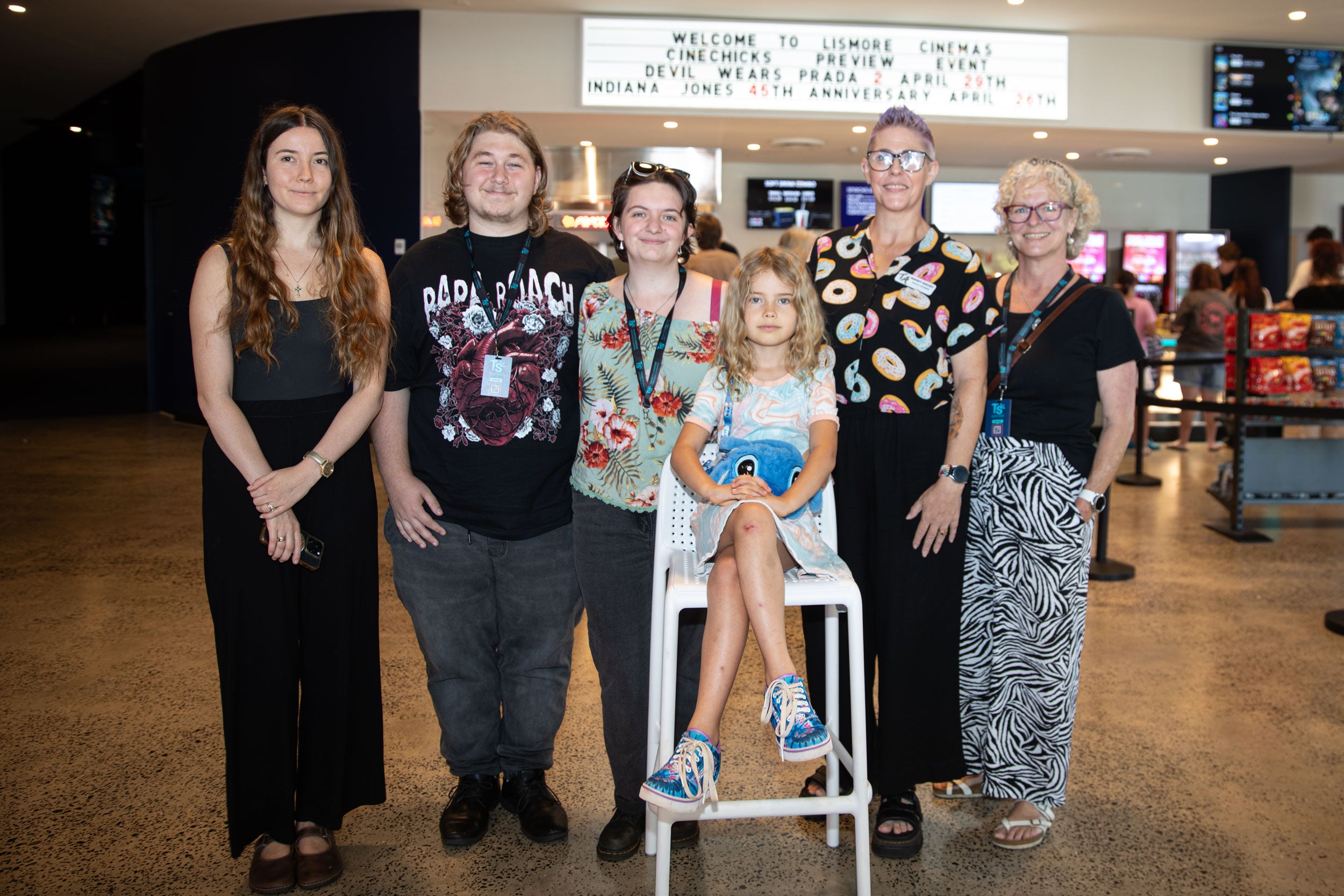
A recent screening of the film I Swear brought a tear to more than one eye, as the small Lismore community of people living with Tourette syndrome (TS) gathered to support each other and raise awareness of this little understood human condition.
Social Coordinators for Tourette’s Australia, Northern Rivers, Sophie Hume-Kennedy and Katrina Hume, hosted the event. They invited members of the public, local councillors and federal and state MPs from Ballina, Richmond and Page including other stakeholders, and were delighted to see Ballina Councillor Simon Chate and Lismore Councillor Virginia Waters among the audience.
TS is not a warm and fuzzy condition, as demonstrated at the recent BAFTA Film Awards when the subject of I Swear – TS campaigner John Davidson, who has had Tourette’s since puberty, shouted a racist slur at black actors Michael B Jordan and Delroy Lindo while they were on stage, causing a huge controversy.
Unfortunately there’s not a lot of pharmaceutical money to be made from Tourette’s, considering the relatively small section of the world population who have the condition. Like many ‘small scale’ conditions and diseases, most research money goes to conditions which can be treated and cured with pills.

I Swear
I Swear tells the extraordinary story of John Davidson, whose life takes a sharp turn when he begins to experience the sudden onset of Tourette syndrome, including episodes of tics and uncontrollable coprolalia – a Tourette syndrome tic with involuntary swearing and the utterance of obscene words or socially inappropriate and derogatory remarks.
The head teacher responds by whipping John’s hand with a belt. This injury and his tics result in his performing poorly as a goalkeeper, to the disappointment of his father.
John is banished from the dining table by his mother after spitting – he and his siblings are told that their father has left. John, distraught, attempts suicide by walking into a river, but is rescued and wakes up in hospital.
At a time when the condition was largely unrecognised and misunderstood, Davidson’s world expands in ways that few could imagine. His unfiltered voice, once seen as disruptive, becomes a rallying point for understanding and change, carving out a space where honesty, individuality, and courage shine through.
Robert Aramayo, who plays John Davidson, won both the British Independent Film Award for Best Lead Performance and the BAFTA for Best Actor in a Leading Role. He embodies his character with remarkable energy and depth, capturing the raw humanity of a figure who insists on being heard.

The Impact for Tourette’s
A current report from the national survey of 206 respondents, evaluating the impact of Tourette’s and tic disorders in Australia, found that there was limited access to healthcare services and intervention. 1 in 4 people have to wait over two years to receive a diagnosis, with minimal information provided following diagnosis.
The Tourette Syndrome Association of Australia (TSAA) is often the only available source of information. Only 40 per cent report positive experiences with services, and survey respondents report limited access to funding for treatment.
The major impacts on daily activity were that two thirds of the respondents reported a moderate to extreme impact on their day-to-day life; over 80 per cent experienced tics daily, often causing emotional distress and physical pain, and two thirds had sustained injuries owing to their tics.
The most frequently reported impacts included difficulty concentrating and paying attention, learning, and sleeping.
Challenges in education and employment were a consideration, with three quarters of parents reporting teachers had very limited knowledge of tic conditions, half had experienced moderate to extreme impacts on their employment, and 1 in 10 adults were unable to work.
Key recommendations
These included that government: fund the development of a National Clinical Guideline for diagnosing and treating tic disorders for use by medical and allied health professionals, and allocate National Disability Insurance Scheme (NDIS) capacity building funding to develop resources and training.
There was also a call to raise awareness and build understanding among key government decision makers, general practitioners, psychologists and other healthcare professionals, educators and school staff and employers.
Respondents called for an adjustment to NDIS policy to ensure accurate assessment and appropriate support for individuals with tic disorders who have significantly reduced functional capacity.

Chair of the Board
Chair of the Board for Tourette’s Australia, Mandy Maysey, who has three children with the condition, co-hosted the screening at the BCC Cinemas.
Maysey has seen the movie four times – and still cries every time. ‘I Swear is an incredible movie. It’s about John Davidson, who grew up in Scotland in the 80s, and it’s about his life story – his struggle, his ups and downs, his triumphs and his challenges. It’s a great way of getting people that don’t know Tourette’s to understand it.
‘It’s an important movie because John’s struggles are still felt very much part of every single day for people with Tourette’s. We’ve done a lot of advocacy, a lot of advocacy is out there, but still not enough work is being done. People are still being ostracized. It’s still a very misunderstood condition.’
Maysey says there is still a lot of fun made of the condition. ‘Things like the Prime Minister [two years ago], using it as a as a slur in Parliament during question time doesn’t help. For us, absolutely wherever you go and whatever you do, it’s still used as the butt of a joke, that stereotype which destroys families – it destroys lives.’
Much-needed exposure
Sophie Hume-Kennedy has had the condition for about five years.
Hume-Kennedy says that as a person with Tourette’s, to have this sort of exposure to the challenges of the condition is much-needed. ‘We need acceptance and people’s understanding. That’s the hardest part, because nobody understands. Some say they do, and then you go out in public, and then they’re the first people to look at you and go, “what is wrong with you?” And it’s like, “I can’t help what’s happening”.’
‘It’s so hard. But this movie just shows how much good is in the world – there’s the sadness of it, and then there’s all of the happiness of him [John] being able to see the queen, but not only that, swear at her as a tic, and it’s just so accepted. If the queen can accept it, why can’t everyone else?’
Hume-Kennedy says she hopes that after seeing the film, people reach out to those who actually live with Tourette’s. ‘Open up conversations. Don’t be judgmental. That’s the hardest part. It’s the lack of understanding. Because there are little kids that have tics and I was just talking to someone who is supporting a 71 year old with Tourette’s.
‘There are also so many supportive people – like my mom, Mandy – there’s so much nice in the world. You just have to find them.’
For more infomration visit Tourette Syndrome Association of Australia.
(I Swear is currently screening at Palace Cinemas in Byron Bay and other cinemas around the country).
 For four decades The Echo has printed the stories some people loved, some people hated, and some pretended not to read. If you want us to keep telling the truth, the real truth, not the sugar-coated version. We’ll need your support to keep the presses rolling.


