



The CSIRO completed a flood-modelling study of the 7,000-square-kilometre Richmond River catchment following the 2022 floods that was delivered in June 2026.
This included modelling for up to ten retention dams across the Richmond catchment that would reduce flooding in Lismore by around 2m, while recognising that no single engineering intervention would have prevented Lismore flooding in the 2022 floods.
The day following the release of the report the majority of Lismore councillors voted to include ‘Bundle 2’, that includes the ten retention dams, in the Lismore Flood Risk Management Plan.
Rejected by Kyogle Council
Kyogle Council has rejected the proposed dam solution in CSIRO’s Northern Rivers Resilience Initiative report and Richmond Valley and Ballina councils have opted to wait until the outcome of the $3 million feasibility study is completed to determine their response.

At Lismore City Council’s 10 November council meeting Councillor Virginia Waters (Greens) moved a motion to remove the proposal to include the flood mitigation measures, Bundle 2, in the Lismore Flood Risk Management Plan until the feasibility study had been completed. The motion was seconded by Councillor Harper Dalton-Earls (Labor).
Cr Waters said that the adoption into the Flood Risk Plan before the feasibility study had been completed, the actual inundation maps released, and community consultation completed was causing undue stress to already highly stressed communities.

These comments were supported by Labor’s Cr Jasmine Knight-Smith who told the meeting, ‘I want a feasibility study, and I want everything included in it. I also want the work of the CSIRO utilized whenever and wherever it is of use to our community, but I feel very uncomfortable including just bundle two. I do not like the tacit approval of an option that has yet to go through a feasibility study.’
Greens Councillor Adam Guise said the feasibility study should go ahead but also flagged the astronomical cost of building ten retention dams when comparing them to other dam building, repair, and raising costs that come in at over $4 billion for just just one dam.
‘It’s not a feasible flood solution to be flooding upstream communities to still allow Lismore to flood. We should take it out of our flood risk management plan,’ he told the meeting.

‘What could be done differently… that is what the CSIRO report did not address. We need to have social and non-engineering solutions to flood mitigation. Like relocating off the floodplain, funding house raising and house relocation, genuine flood resilience design, and proper evacuation plans.’
Cr Guise highlighted that those potential solutions had been properly funded or executed so far.
While supporting the feasibility study, Cr Dalton-Earls emaphsised the impact that the retention dams would have on upstream communities.

‘We don’t have the inundation reports. I believe that unless you live in the upstream communities, you can’t say the upstream communities are going to be looked after. Their properties are going to be flooded. If your house is below a 30 meter wall, of course, it is going to have a major impact. If the water is over your land for probably longer than two weeks, your crops, your farmland, your trees, your regeneration is going to be completely destroyed. I don’t believe that we can create a solution where we flood Peter to save Paul.
‘If, for example, the detention basins came out as a $10 billion for ten of them. I think that’s a quite conservative [estimate]; but the feasibility recommended you could relocate the houses and part of the CBD for $5 billion. What’s a better use of taxpayer money?’
Staff did clarify that Bundle 2 woudln’t be included in the flood management plan before they had followed their process ‘and that includes community consultation and is scheduled for early 2027’.
The motion was lost with Crs Harper-Dalton, Waters, Knight-Smith, and Guise in favour and Crs Electra Jensen, Jeri Hall, Andrew Gordon, Big Rob, Andrew Bing, Gianpiero Battista, and Steve Krieg voting in favour.

Disappointed
Following the meeting engineer, Tinnie man, Steve Posselt, who has put together an analysis of the CSIRO assessment with fellow Tinnie man Graeme Gibson, and had spoken in favour of the motion during public access told The Echo that there would be lots of homes and infrastructure that would end up under water if the retention dams went ahead.
He also highlighted that the secondary route used to bring food to Woolwoths, while the highway was still flooded, following the 2022 flood would no longer be accessible under the ten mega-dam scenario.
Mr Posselt said that releasing the water from the mega-dams would take significantly longer than the two weeks suggested in the CSIRO modelling.
‘If you think about rapid drawdown consequences and the slip failures that would result, you’re talking about many months to release the water,’ he said.
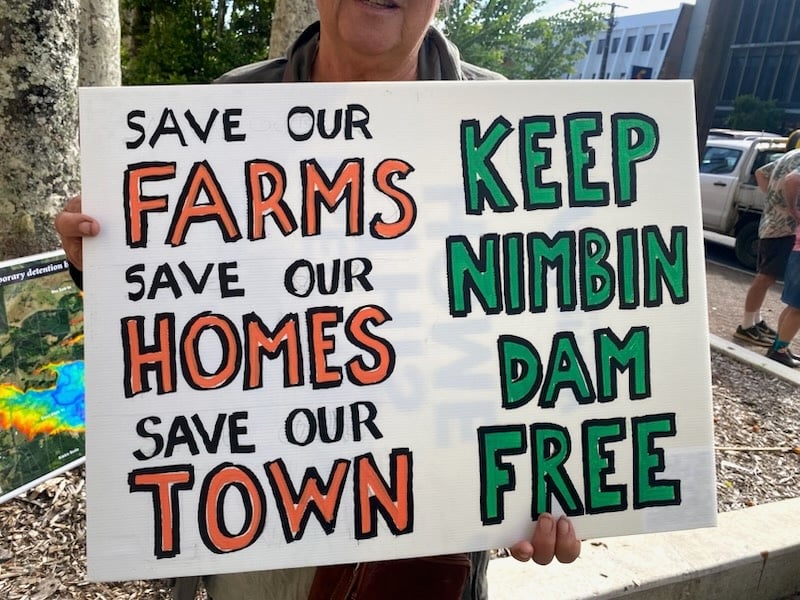
‘With climate change and sea level rise, mankind is going to have to retreat or deal with the flooding. We will not be able to seriously mitigate future flooding, and we have to figure out how to live with it or you live above it.
‘My engineering friends, who critiqued what I wrote, said, “Steve, this is just crazy shit. Don’t worry about it. It’s not going to happen. It can’t happen. What are you worried about?’
In their report Posselt and Gibson concluded that, ‘An examination of the Flood Study has raised numerous concerns about the proposed detention basins and other flood mitigation measures. It is clear there will be major negative impacts on the river system if the works were to go ahead.’
♦ The Echo asked Deputy Mayor Jeri Hal and Cr Electra Jensen why they voted in favour of keeping Bundle 2 in the Lismore Floodplain Management Plan but received no response before publication.
 For four decades The Echo has printed the stories some people loved, some people hated, and some pretended not to read. If you want us to keep telling the truth, the real truth, not the sugar-coated version. We’ll need your support to keep the presses rolling.



