

13.2 C
Byron Shire
August 29, 2026

Coastal erosion in Byron Bay – a solution?

Latest News

How can we keep paying for incompetence

The only way forward is going backwards. That’s how I explain the current situation of Byron Shire Council. The...

Other News

They’ve got their trousers on

They’re almost here – Baggy Trousers bring ‘Madness’ to Ballina next week! London-born and hailed as the Southern Hemisphere’s premier Madness tribute show, Baggy Trousers brings to life the legendary UK band’s iconic hits in The Sound of Madness and bring the energy, humour and soundtrack of the UK’s golden era to Ballina RSL.

Peek behind the scenes of ‘Love for One Night’

Directed and devised by Julian Louis, NORPA's acclaimed production 'Love for One Night' returns to the Eltham Hotel this Thursday, running until 12 September.

Big Council rates rise coming – self-reflection

A chance for self-reflection? Maybe Byron Shire Council should look at having a staff reduction, instead of a rate...

Going beyond the BBQ

The Men & Family Centre will soon be running a free Beyond the BBQ event in Lismore.

Lismore fun run will be bigger than ever

The much-loved Darrel Chapman Fun Run will return to Lismore on Sunday 30 August, with runners and walkers set to start the event on Woodlark Street once again.

Byron’s Philo Café

Byron’s long-running discussion group – Byron Philo Café – is inviting members of the general public to join them on Friday, 4 September, at Marvell Hall, to welcome one of Australia’s most respected journalists.

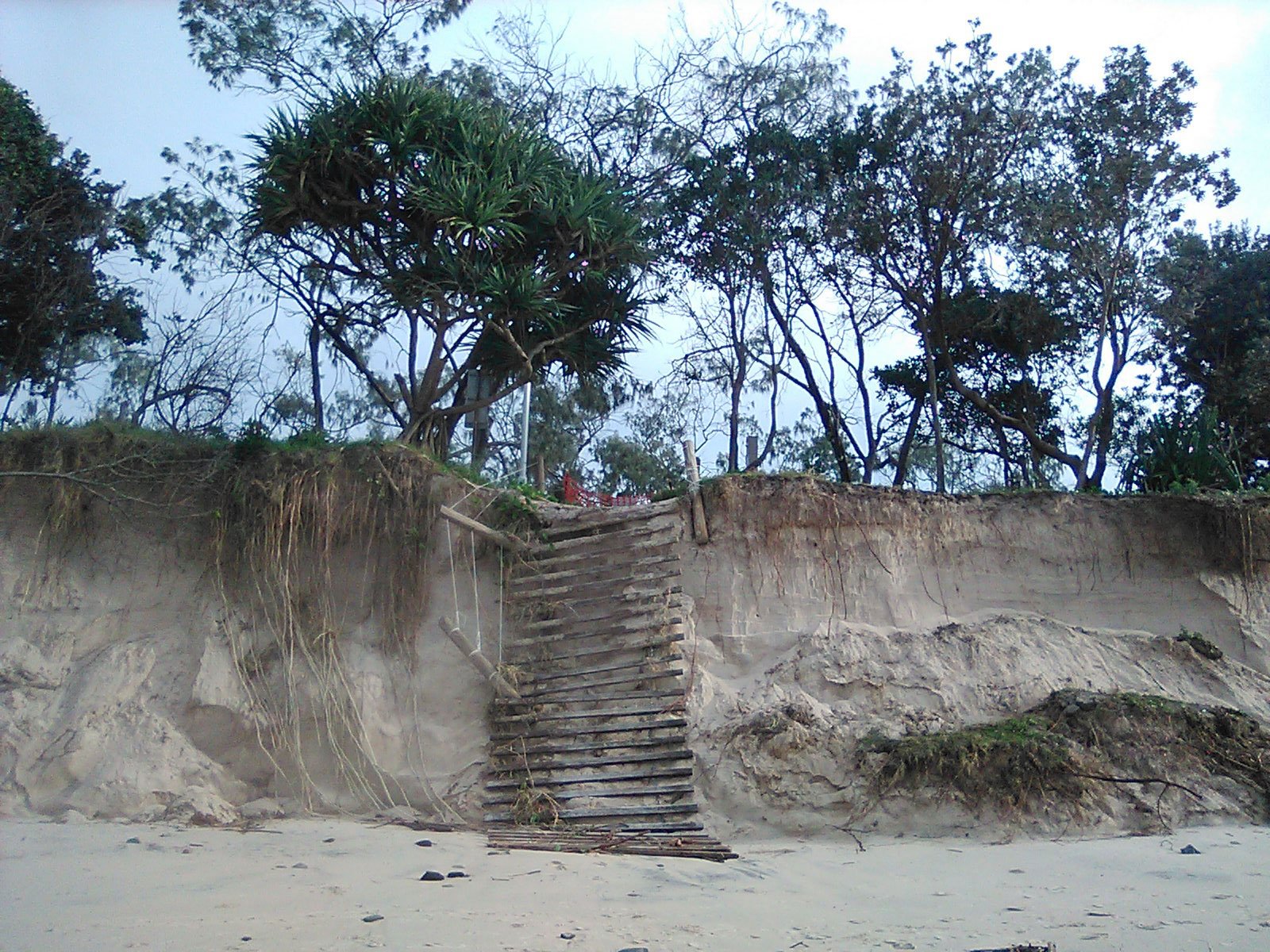
Access track to beach Byron Bay. Photo Steven Hanson

Steve Hansen

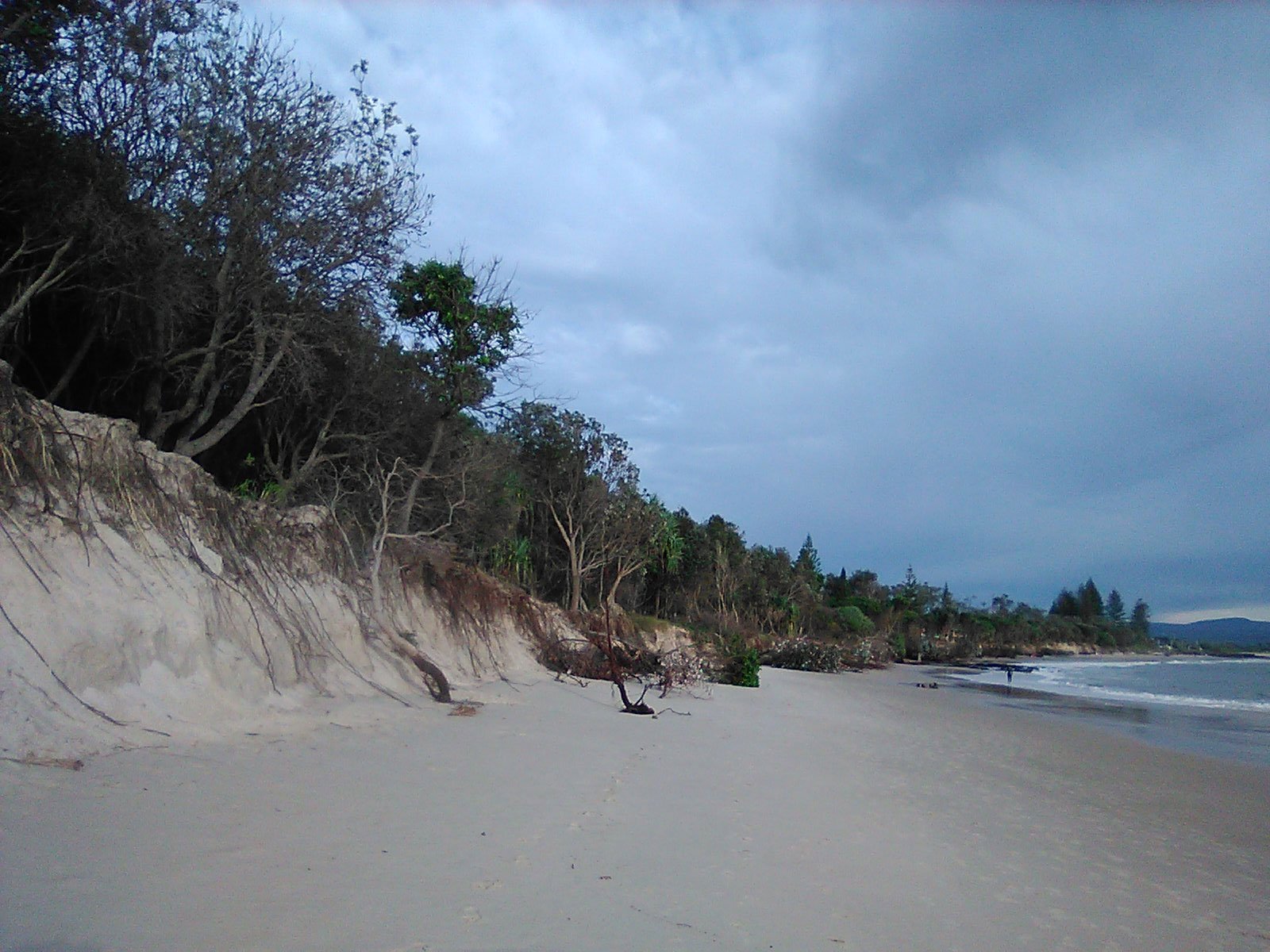
Erosion in Byron Bay appears out of control and may have the potential to threaten the welfare of the town.

Solutions proposed over the years have included building a rock seawall and importing large amounts of sand from elsewhere.

A Council release from April 2021 indicates plans to restore sand dunes by beach scraping, sand trapping, fence restoration and dune revegetation. It is suggested that these approaches will be implemented ‘once the sand rebuilds’.

The rebuilding of the sand appears to be the core of the problem. This may be impeded by the phenomenon of ‘headland bypassing’, which occurs when sand is transported from one beach to another around an obstacle, such as a headland, and, in the absence of the appropriate conditions in terms of wave direction and strength, fails to deposit sand in the area directly behind the obstacle.

Downtown Byron post-sand mining 1971. Photo Historical Society Byron Bay

Sand mining

A study from 1991 identified a pattern of sand movement that sees sand removed by summer storms, and redistributed by winter conditions, typically resulting in a build up at Little Wategos and The Pass, and a removal of sand at Wategos and Clarkes/Main beach.

But the vegetation currently growing on the Clarkes/Main Beach foreshore may be part of the problem. After sand mining finished on the beach and in the dunes of that area in 1968, the area was left a barren wasteland until 1973, after which the dunes were reformed and revegetated.

In a healthy dune system several vegetation zones should succeed each other: a hind dune with tall trees like melaleucas should sit behind a foredune with medium-sized plants like banksias, which should sit behind a primary dune with low colonising species like spinifex.

In front of that should be a beach berm with open sand and a swash zone where waves roll up and down. It is crucial that this berm and swash zone present a low, flat profile to the sea, so that when waves surge, as they do after storms, their energy can be dissipated without doing any damage. Then as they peter out, the sand they contain can be deposited, aiding in the reinforcement of the beach structure. Loose sand can then be redistributed by the wind, further flattening the beach profile.
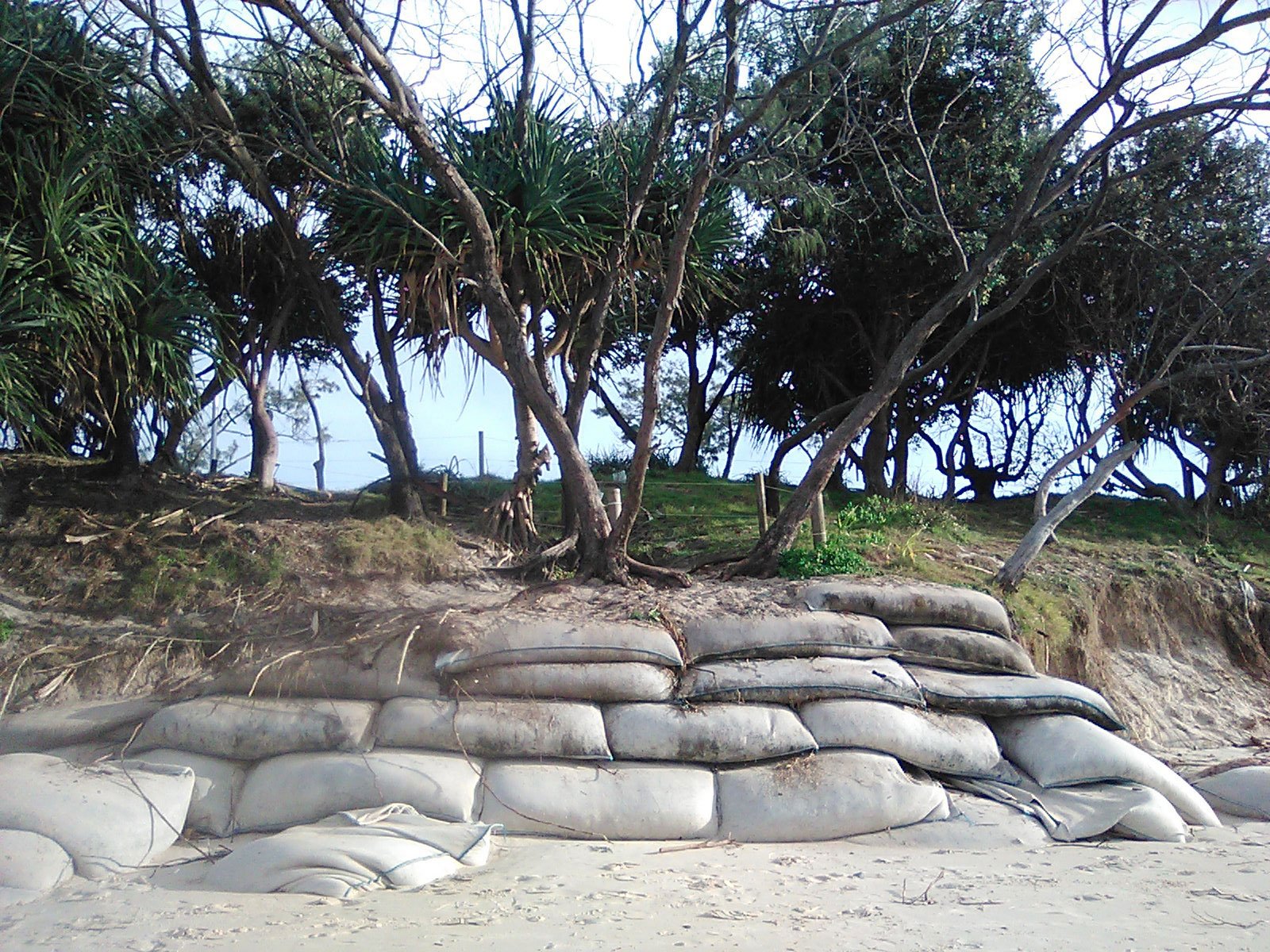
Sndbagged trees Byron Bay. Photo Steven Hanson

However, when vegetation grows too close to the water’s edge, wave energy is reflected by the obstacle of root-bound sand, rather than dissipated by open flat sand. This results in the removal of sand, and the development of an escarpment, as is currently the case. That escarpment then becomes self-perpetuating.

This would indicate that removing the vegetation and flattening the escarpment would be the solution.

In 2014 the council of Woonona, in southern NSW, did exactly that. Faced with deteriorating erosion, as an experiment they cleared a part of their foreshore of all vegetation, while leaving other, erosion-affected parts as they were.

The cleared area was then flattened out. When the storms came the cleared area was able to absorb the impact of surging waves, and natural processes repaired any damage done. The control areas continued to erode, and to develop larger escarpments.
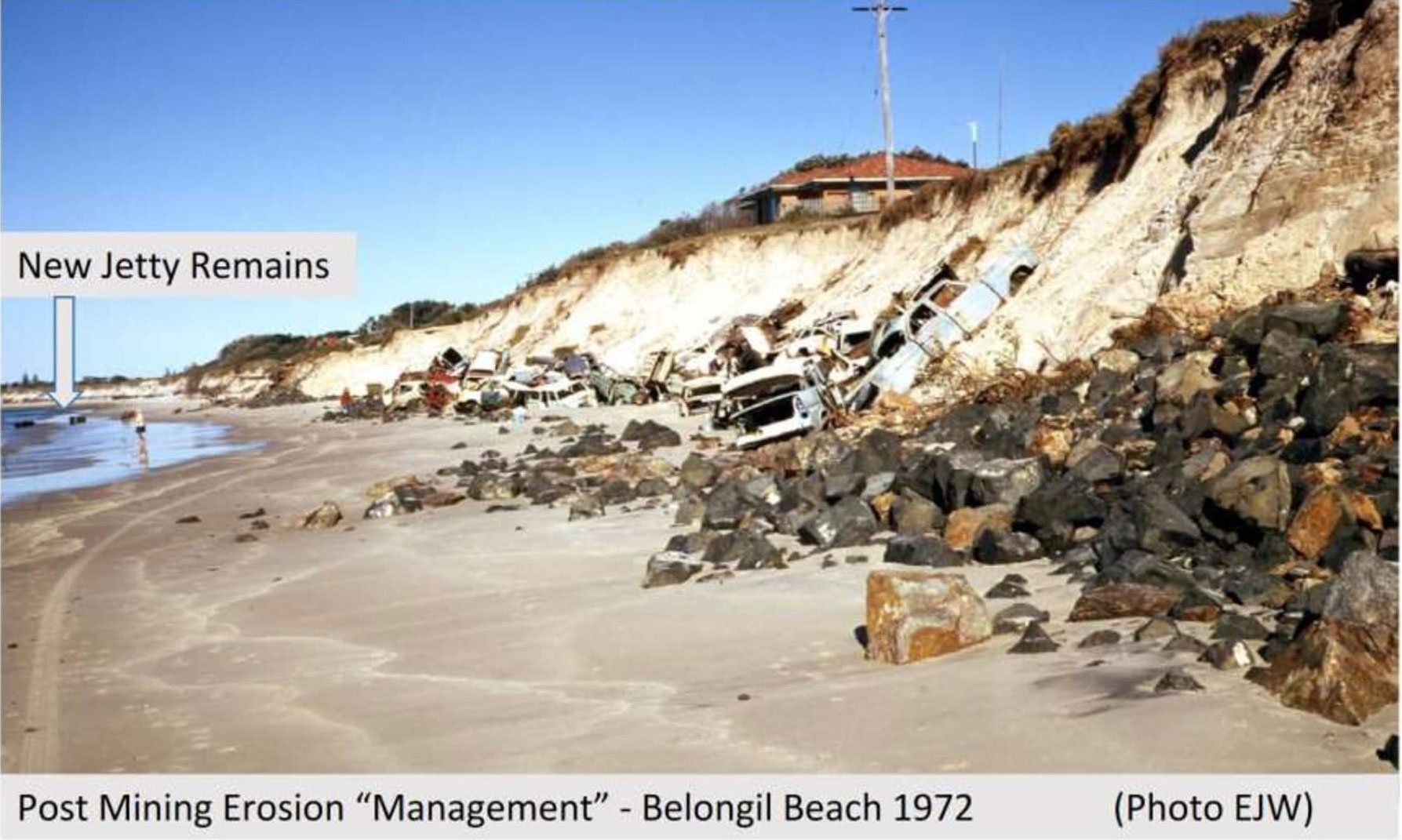
Post sand mining control of erosion in Belongil in 1972. Photo Historical Society Byron Bay

Therefore the solution to our current erosion problem may well be the removal of those banksias and pandanuses still standing, and a flattening of the escarpment, rather than a reinforcing of it.

While this would be a radical remodelling of what’s left of the area between Lawson Street and the beach, this process is currently undertaken by the sea already, whether we like it or not.

The removal of vegetation goes against all our environmental conservation instincts. Would we be able to do it?

♦ Steve Hansen is a former bush regenerator and Parks and Wildlife Service ranger.


For four decades The Echo has printed the stories some people loved, some people hated, and some pretended not to read. If you want us to keep telling the truth, the real truth, not the sugar-coated version. We’ll need your support to keep the presses rolling.

If you are a local business owner help us and in turn we help you. All The Echo asks for is advertising, not a free ride. It is every advert in The Echo and on www.echo.net.au, which creates the space for all the stories and coverage of community events, happenings and concerns.

If you are a reader you can become a sponsor of The Echo. Your support keeps the us independent.

Even a small one-off or regular donation from you will help keep the echo’s independent voice alive and strong.

Support Us

Become one of the supporters who helps keep independent, local journalism alive in the Byron Shire by contributing anything from as little as the cost of a coffee each month.

You're Wonderful, Thank you for supporting independent journalism in the Byron Shire

You’re supporting The Echo, thank you

Your contribution is keeping independent, local journalism alive in the Northern Rivers.

Because of supporters like you, we can keep every story free for everyone — no paywall, no exceptions. Your money goes directly to funding our newsroom of 40-odd local workers covering the stories that matter to this community.

Tell us what you think, give us your opinion

The Echo loves your letters and comments and is proud to provide a community forum on the issues that matter most to our readers and the people of the NSW north coast. So don’t be a passive reader, email us your epistles at editor@echo.net.au.

The letters deadline for The Echo is noon Friday. Letters longer than 200 words may be cut. The publication of letters is at the discretion of the letters editor. Please remember to include your full name, address and telephone number.

Online comments are no longer available.

Greens urged to back pathway to end native forest logging

Some of NSW’s most respected and long-standing forest campaigners and scientists have today urged the Greens not to support the Nationals' attempt to disallow the Improved Native Forest Management (INFM) method.

Ballina Council makes decision on Ross Lane

With the absence of all four of its progressive councillors for various reasons, Ballina Council pushed ahead with its agenda at yesterday's monthly meeting, including a decision which is likely to close Ross Lane for months while the road is upgraded.

Mullumbimby puts new governance models first, and now wants to build it

Imagine Northern Rivers says Mullumbimby is the only community across the region to rank new models of governance and decision-making as the number one element of its preferred future, and last week locals gathered to work out how to make it real.

Appeal to locate man missing from Broadwater

Police are appealing for public assistance to help locate a local missing man.


