


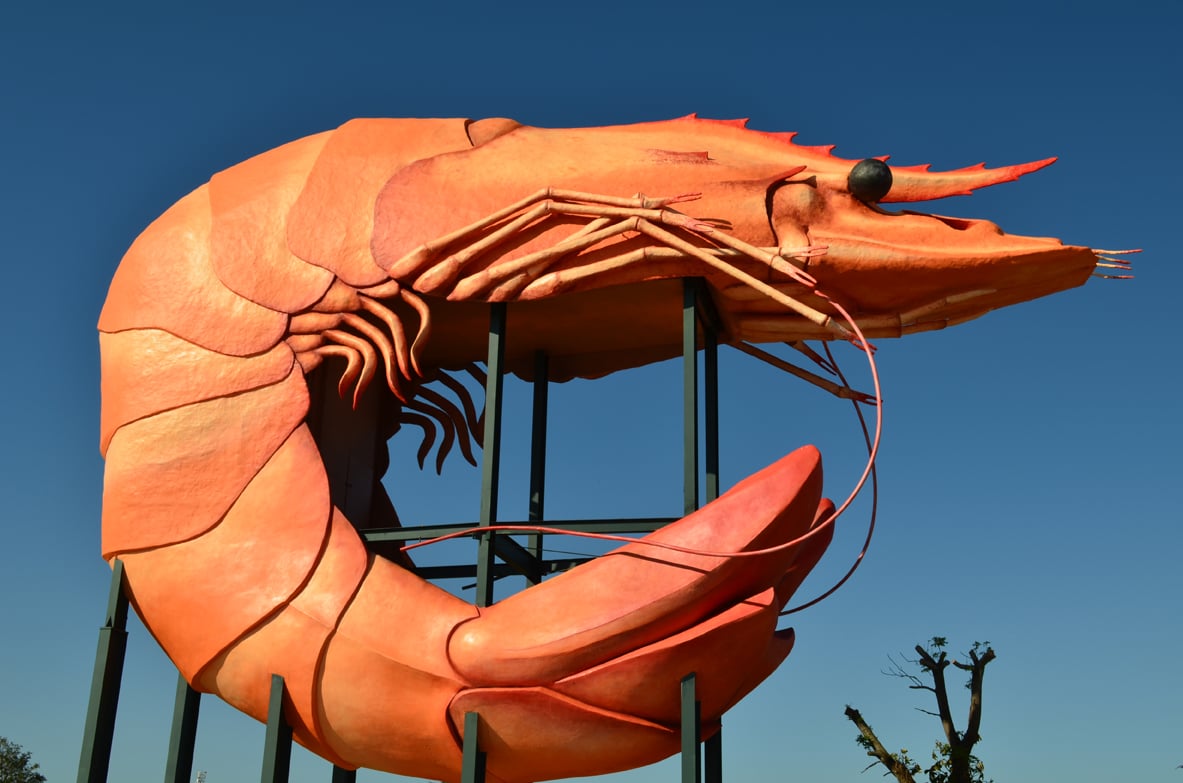
Story & photo Mary Gardner
The Big Prawn, now fronting the Bunnings car park in Ballina, is overwhelming: weighing more than 33 tonnes, costing $400,000 in repairs. This icon is one of Australia’s few ‘Big Things’ that’s been successfully upgraded. It’s as huge for what it represents in Australian culture: cooked crustaceans. But what of the green and brown living creatures themselves?
The two most common Australian prawns caught in NSW and Queensland are eastern king and school prawn. They are known as penaeids. They differ from those of the northern hemisphere, which are carideans. The difference is down to female reproductive habits.
Both penaeid and caridean adult females finish moulting by copulating with the smaller males. The female shells are still quite soft. The male mustn’t be moulting as he needs a hard shell and petasma, that appendage underneath and near the top of the abdomen. This reproductive organ transfers a sperm packet to the female, who holds it in place with a smaller appendage called the thelycum. This process ensures the eggs are fertilised internally.
So far so good. But now the caridean swims in the Gulf of Mexico, the North Atlantic or the Mediterranean, nursing the fertilised eggs attached to her tail until they hatch. Our own Australian penaeid simply swims out to deep sea, shedding the fertilised eggs immediately. All the adults continue living only a few years at most.
Little worlds
Over three weeks, the penaeid eggs hatch and larvae grow, completely dependent on the temperature, salinity and currents of the open sea. It’s imagined they drift south, though they are feisty enough to steer themselves in their little worlds towards food and away from predators.
The larvae morph through three body shapes. Finally, they look like little prawns and travel into estuaries well south of their birth place. Within a year, almost grown, they leave for a last great sea adventure.
In 1990, tagged king prawns were found in Ballina, having travelled from as far away as Gippsland Lakes, Sydney or South West Rocks. As adults travelling north in the open sea, they court others who grew up in different estuaries. By contrast, tagged school prawns only travelled about 120 kilometres and were more likely to mate within populations of a single river. Starting as solitary eggs the size of a pinhead, finishing from 13 to 30cm each, collecting in great schools after journeys up to hundreds of kilometres – nothing kitsch about the lives of either of these penaeids.
Prawn future
Nothing sentimental about the market realities rather. NSW stocks appear to depend on a steady supply of young from Queensland. More are caught in Queensland than NSW. Trawls for Australian prawns include excluders to help turtles escape capture. By-catch, involving more than a dozen other species, as well as undersize prawns, is an ongoing concern. Numbers of boats are more limited than years ago but the viability of the fishery is debated. Meanwhile, much of the seabed is raked over so often, creating underwater change without respite. Thanks to climate change, warmer waters hurry spawning by up to a month for many species. Who knows what else will happen next?
The price of Australian prawns is often undercut by overseas imports. These are as much a worry as imported clothing from sweatshops. Journalist Taras Grescoe and biologist Daniel Pauly all warn that ‘cheap’ prawns come from newfangled ponds, managed with pesticides and antibiotics, carved out of old-growth mangrove forests and laboured by exploited casual staff.
There’s an old Aussie saying: ‘don’t come the raw prawn with me!’ or ‘don’t expect me to swallow such a slippery deceit’. In these globalised days, we are all forced to find deeper meanings with our icons, kitsch and slang. Otherwise, we and our international neighbours risk being left ‘a prawn short of a barbie’.
 For four decades The Echo has printed the stories some people loved, some people hated, and some pretended not to read. If you want us to keep telling the truth, the real truth, not the sugar-coated version. We’ll need your support to keep the presses rolling.


